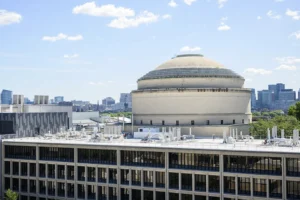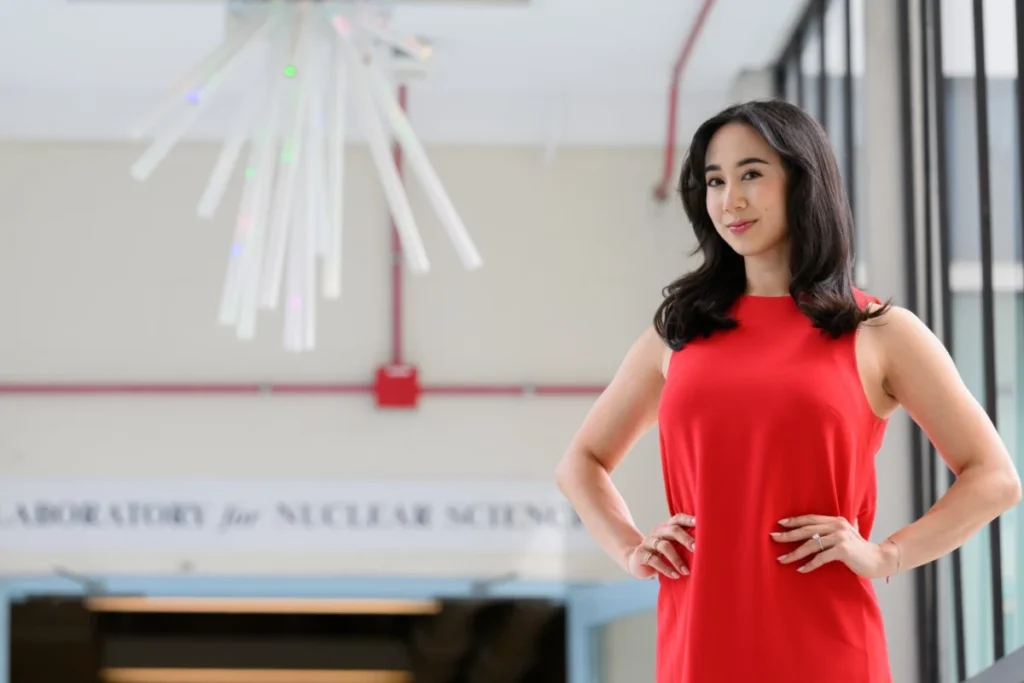
In the quiet, high-tech corridors of the Massachusetts Institute of Technology’s Laboratory for Nuclear Science (LNS), Jessica Fry is engaged in a pursuit that spans the vastness of the cosmos. As a fifth-year PhD candidate, Fry is part of an elite global cohort of physicists searching for dark matter—the elusive substance that constitutes approximately 85 percent of the matter in the universe. Despite its overwhelming presence, dark matter has never been directly detected, remaining one of the most profound mysteries in modern science. Fry’s journey to the forefront of this search is as unconventional as the particles she hunts, defined by a dual life in the competitive world of professional dance and the rigorous landscape of particle physics.
A Foundation of Discipline and Discovery
Jessica Fry’s trajectory began in the San Francisco Bay Area, a region synonymous with technological innovation and home to the SLAC National Accelerator Laboratory. This proximity to one of the world’s premier research facilities provided an early, if unintentional, backdrop to her childhood. However, her first passion was not the laboratory, but the stage. Beginning dance lessons at the age of three, Fry quickly ascended the ranks of competitive dance, traveling across the country for recitals by the time she reached elementary school.
A photograph on her current office desk serves as a testament to this early intensity: a young Fry in a ham costume, arms outstretched in a theatrical flourish. For Fry, the image is more than a memento; it is a philosophy. She notes that even as a child, she refused to "half-ass" any endeavor, a trait that would later define her academic and professional career.
This uncompromising work ethic transitioned into the sciences during her high school years. When a physics teacher provided her with two defunct detectors from SLAC, Fry did not merely tinker with them. She located a research paper from the 1960s that utilized similar instrumentation, replicated the original experiment, and produced a comprehensive report. This moment of discovery—bridging the gap between abstract philosophical questions about space-time and tangible hardware—solidified her desire to pursue physics.
The Parallel Paths of Stanford and Broadway
Fry’s academic journey continued at Stanford University, where she pursued a double major in physics and theater and performance studies. This period of her life was marked by a grueling schedule that balanced the intellectual demands of quantum mechanics with the physical rigors of professional performance.
The intersection of these two worlds reached a climax during her sophomore year. While preparing for midterms, Fry received a call from a talent agent regarding a Broadway production of David Henry Hwang’s "M. Butterfly." The audition required a cross-country flight to New York City, which Fry completed in a whirlwind trip, returning immediately to sit for her exams.
When a month passed without word from the casting directors, Fry pivoted back to science, securing a prestigious summer research position at CERN (the European Organization for Nuclear Research) in Switzerland. It was only after she arrived in Geneva that she received the news: she had been cast in the Broadway show. Demonstrating her characteristic stamina, Fry completed her research at the world’s largest particle physics laboratory before flying directly to New York to begin rehearsals.
For two years, Fry stepped away from her studies at Stanford to immerse herself in the performing arts. Her repertoire expanded to include ballet, contemporary, jazz, traditional Māori dance, Peking opera-style movement, and stage combat. She viewed these disciplines through a narrative lens, constantly asking how to tell a story in the most effective way.
However, the professional theater industry brought unexpected challenges. Fry observed that the constant cycle of auditions and external judgment began to erode her self-confidence. She described an "occupational hazard" of the theater: the tendency to value the opinions of strangers over one’s own self-perception. Recognizing that the environment was altering her character in ways she found undesirable, Fry made the difficult decision to leave the stage and return to Stanford to complete her degrees.
The Transition to MIT and the Hunt for the Axion
Upon returning to academia, Fry set her sights on graduate school, eventually choosing MIT. She was drawn to the Laboratory for Nuclear Science, an entity she describes as having the "buzz" and "scientific energy" comparable to CERN. At MIT, Fry found a community that mirrored the intensity of her Broadway years but directed that energy toward the fundamental questions of the universe.
Fry’s current research focuses on dark matter, a substance that does not emit, absorb, or reflect light, making it invisible to traditional astronomical instruments. Its existence is inferred from its gravitational effects on visible matter, such as the rotation curves of galaxies and the cosmic microwave background radiation.
The primary target of Fry’s search is the axion. Originally proposed in the late 1970s to solve the "strong CP problem" in quantum chromodynamics, the axion has emerged as a leading candidate for dark matter. Unlike other theoretical particles like WIMPs (Weakly Interacting Massive Particles), axions are hypothesized to be incredibly light—many orders of magnitude smaller than an electron. At this scale, axions behave less like individual particles and more like a coherent wave that permeates the galaxy.
Engineering the Detection of the Invisible
Fry is currently contributing to two major experiments designed to detect these elusive waves: ABRACADABRA and DMRadio.
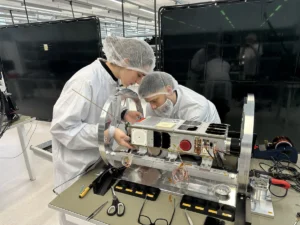
ABRACADABRA (A Broadband/Resonant Approach to Cosmic Axion Detection with a Bayesian B-Ring Apparatus) is an MIT-based experiment that utilizes a toroidal magnet. The theoretical framework suggests that in the presence of a strong magnetic field, axions will convert into a very weak, oscillating magnetic field. This field, in turn, induces a tiny electric current in a pickup loop.
The second project, DMRadio (Dark Matter Radio), is a collaborative effort involving Stanford and other institutions. Both experiments function on a principle similar to a standard AM/FM radio. Because the mass of the axion is unknown, its "frequency" is also unknown. Researchers must systematically tune their detectors across a wide range of frequencies, searching for a specific signal that stands out from the background noise.
Fry uses a vivid analogy to describe the challenge: "Think about two waves in the ocean—when they collide, they create a rip current. We are looking for that rip current." The difficulty lies in the fact that the signal is buried under layers of thermal noise and environmental interference. To isolate the axion, the team employs quantum amplifiers and resonance techniques to boost the signal.
Mentorship and Professional Recognition
At MIT, Fry works under the guidance of Lindley Winslow, a professor of physics who leads the Neutrino and Dark Matter Group. Winslow, who also navigated a path between two passions earlier in her life, sees a unique strength in Fry’s background. Winslow notes that Fry possesses a "fearlessness to deliver" when the metaphorical curtain rises, a trait honed on the stages of Broadway.
The collaborative environment of the LNS has allowed Fry to expand her expertise beyond her specific subfield. This multidisciplinary approach is essential in dark matter research, which sits at the intersection of particle physics, astrophysics, and advanced engineering.
Fry’s contributions to the field have not gone unnoticed. She was recently named to the Forbes 30 Under 30 Science list for 2026, a distinction that highlights her potential as a future leader in the scientific community. Despite the accolades, Fry remains grounded, continuing to dance at a studio near Harvard to maintain a connection with her physical self after long days of abstract mental labor.
Implications and the Future of Cosmology
The successful detection of the axion would be a watershed moment in the history of science. It would not only identify the majority of the universe’s matter but also provide deep insights into the laws of physics that governed the earliest moments of the Big Bang.
From a broader perspective, Fry’s work contributes to the validation of the Standard Model of particle physics—or potentially its expansion. If axions are found, it would solve the strong CP problem and bridge gaps in our understanding of how gravity and quantum mechanics interact on a galactic scale.
As Fry nears the completion of her PhD, her focus remains on the data analysis for DMRadio. She approaches her future—whether it involves postdoctoral research, leading her own lab, or designing new detectors—with a clarity born of her previous career transition. She emphasizes that her pursuit of physics is driven by a genuine desire for impact rather than a search for prestige.
Fry is optimistic about the timeline of discovery. She speaks of the detection of dark matter not as a possibility, but as an inevitability that will occur within her lifetime. "We just need to keep tuning," she says, applying the same relentless discipline that once propelled her to the Broadway stage to the ultimate quest for the secrets of the universe. In the intersection of dance and physics, Jessica Fry has found a unique rhythm, one that may eventually resonate with the very fabric of the cosmos.