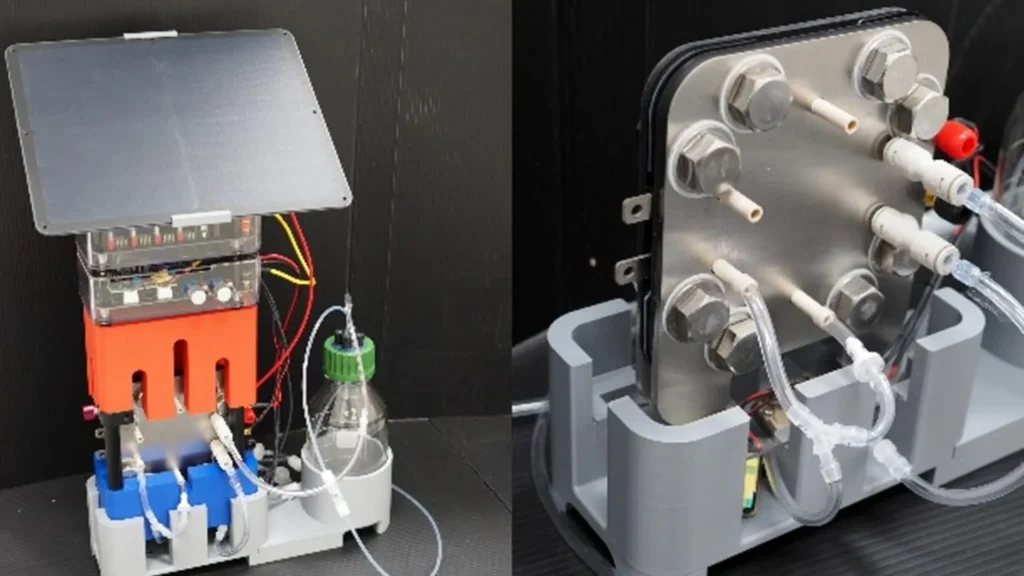
Researchers at Osaka Metropolitan University have engineered a groundbreaking artificial photosynthesis system capable of generating solar fuel with unprecedented consistency, fundamentally eliminating the traditional reliance on battery-based control equipment. This significant leap forward is attributed to the ingenious integration of a self-regulating chemical component directly within the electrolyzer, a design innovation that promises to drastically reduce both system complexity and overall cost. The development marks a pivotal moment in the quest for sustainable energy solutions, offering a more streamlined and economically viable pathway to harness solar power for chemical fuel production.
Harnessing Sunlight: The Promise of Artificial Photosynthesis
At its core, artificial photosynthesis mirrors the natural process observed in plants, leveraging sunlight to convert ubiquitous raw materials—water and carbon dioxide—into energy-rich compounds. Among the most promising products of this technology is formic acid, a versatile chemical that serves not only as a potent fuel but also as an efficient medium for energy storage. The global imperative to decarbonize energy systems and mitigate climate change has intensified research into such technologies, positioning artificial photosynthesis as a cornerstone of future sustainable economies. Estimates suggest the global market for artificial photosynthesis, though nascent, is poised for significant growth, driven by advancements in material science and increasing investment in renewable energy research.
The Electrochemical Engine: Understanding the Electrolyzer
Central to any artificial photosynthesis setup is the electrolyzer, a device engineered to convert electrical energy, typically supplied by solar cells, into chemical energy. This chemical energy is then captured and stored in the form of fuels like formic acid. However, a persistent challenge in deploying these systems at scale has been their susceptibility to the inherent variability of sunlight. Solar irradiance fluctuates dramatically throughout the day, influenced by weather patterns, cloud cover, and the sun’s angle. Maintaining optimal operational efficiency under these dynamic conditions has traditionally necessitated sophisticated control mechanisms.
The Challenge of Intermittency and Traditional Solutions
To counteract the erratic nature of solar input, many conventional artificial photosynthesis systems incorporate Maximum Power Point Tracking (MPPT). MPPT is an advanced technique designed to continuously adjust the voltage and current output of solar cells, ensuring they operate at their peak power point, thereby maximizing the harvest of available solar energy. This optimization is crucial because the power output of a solar panel is not constant; it varies with irradiance and temperature, tracing a unique power curve. An MPPT controller actively tracks this curve to extract the highest possible power.
While highly effective, conventional MPPT setups typically introduce significant complexity and cost. They often rely on an array of external electronic components, including DC-DC converters, microcontrollers, and critically, battery storage systems. Batteries serve to buffer energy fluctuations, smoothing out the power supply and allowing the electrolyzer to operate more consistently despite intermittent sunlight. However, these additions contribute substantially to the system’s capital expenditure, increase its physical footprint, and introduce additional points of failure, alongside the environmental considerations associated with battery manufacturing and disposal. The high cost of these auxiliary components has been a major impediment to the widespread commercialization of artificial photosynthesis technologies.
A Paradigm Shift: The Self-Regulating Electrolyzer
Recognizing these limitations, a dedicated team at the Research Center for Artificial Photosynthesis at Osaka Metropolitan University embarked on a mission to redefine the architecture of the electrolyzer itself. Under the leadership of Associate Professor Yasuo Matsubara and Professor Yutaka Amao, and in strategic collaboration with Iida Group Holdings Co., Ltd., the researchers conceived and developed an electrolyzer that fundamentally bypasses the need for external MPPT electronics and battery-based control.
Their innovative approach centers on a specially engineered solid electrolyte directly integrated into the device. This ingenious design empowers the electrolyzer to intrinsically perform the MPPT function, rendering external battery-based control systems obsolete. Instead of relying on a suite of external electronics, converters, or energy storage units, the electrolyzer autonomously adjusts its electrical characteristics by leveraging its inherent thermal and impedance properties. This internal self-regulation represents a profound simplification of the system.
Professor Amao elaborated on the elegant mechanism: "As sunlight intensity increases, the electrolyzer naturally experiences a rise in temperature. The system has been meticulously designed such that this warming effect causes a corresponding drop in its electrical resistance. This allows electricity to flow more freely and efficiently, precisely when more power is available from the solar cells." He added, "This intrinsic response enables the system to automatically adjust its electrical behavior, effectively tracking the solar panel’s maximum power point without any external intervention."
Professor Matsubara further highlighted the benefits: "This self-regulating behavior is key to maintaining a more stable rate of fuel production throughout the day, significantly automating the entire system. Crucially, it drastically reduces our dependence on expensive external components and battery storage, which have historically been major cost drivers and sources of complexity."
Formic Acid: A Versatile Solar Fuel
Formic acid (HCOOH) is not merely a laboratory curiosity; it holds immense potential as a practical solar fuel. It is the simplest carboxylic acid and is widely used in various industrial applications, including as a preservative and antibacterial agent in livestock feed, a coagulant in rubber production, and a reducing agent in textile dyeing and leather tanning. More importantly for energy applications, formic acid can serve as a hydrogen carrier, releasing hydrogen for fuel cells, or it can be directly utilized in direct formic acid fuel cells (DFAFCs) to generate electricity. Its liquid state at room temperature and relatively low toxicity make it safer and easier to store and transport compared to gaseous hydrogen. This versatility positions formic acid as an attractive candidate for decentralized energy storage and utilization, from powering homes to industrial processes.
Rigorous Validation and Real-World Application
To substantiate the efficacy of their novel design, the researchers subjected the technology to rigorous testing under actual outdoor conditions. The results were compelling: the system consistently produced formic acid from water and CO2, even when confronted with the unpredictable fluctuations characteristic of real-world sunlight levels. This robust performance under variable conditions underscores the practical viability of the self-regulating mechanism.
A significant milestone in the technology’s development and public presentation occurred in the lead-up to the Osaka Kansai Expo 2025. "We were confident that it would be successful, as we previously showcased this research at the ‘Joint Pavilion Iida Group × Osaka Metropolitan University’ exhibition as part of the Osaka Kansai Expo 2025," Professor Matsubara recounted. The exhibition served as a public demonstration, where the system successfully generated enough formic acid to power a miniature diorama within the pavilion. This highly visible demonstration not only validated its functionality but also effectively communicated its potential as an efficient artificial photosynthesis system capable of powering various applications, potentially even within residential settings.
The findings, having undergone rigorous peer review, were subsequently published in EES Solar, a highly respected scientific journal in the field of energy and environmental science, lending further scientific credibility and widespread recognition to the breakthrough.
Strategic Collaboration: Bridging Academia and Industry
The successful development of this self-regulating electrolyzer highlights the critical role of synergistic collaborations between academic institutions and industrial partners. The partnership with Iida Group Holdings Co., Ltd. was instrumental, providing not only financial backing but also potentially industrial insights and a pathway for future commercialization. Such collaborations are vital for translating innovative scientific discoveries from the laboratory into scalable, market-ready technologies. Iida Group Holdings, with its interests spanning various sectors, likely recognized the immense potential of this technology to contribute to sustainable development and potentially diversify its business portfolio. While specific statements from Iida Group Holdings were not detailed, their involvement underscores a shared vision for a future powered by clean, renewable energy.
Broader Implications and Future Outlook
The implications of this breakthrough extend far beyond the laboratory. Economically, by eliminating the need for expensive batteries and complex electronic control units, the Osaka Metropolitan University system promises to significantly lower the capital expenditure and operational costs associated with artificial photosynthesis. This cost reduction could be a game-changer, making solar fuel production more economically competitive with traditional fossil fuels and accelerating its adoption. The simplification of the system also implies reduced maintenance requirements and enhanced reliability, further improving its economic attractiveness.
Environmentally, a more efficient and cost-effective artificial photosynthesis system brings us closer to a circular carbon economy. By utilizing CO2 as a feedstock, this technology offers a dual benefit: it produces clean fuel while simultaneously mitigating greenhouse gas emissions. The ability to convert atmospheric CO2 into valuable chemicals and fuels provides a tangible pathway for carbon capture and utilization, moving beyond mere carbon sequestration to actual value creation from waste CO2. This aligns perfectly with global efforts to achieve net-zero emissions and combat climate change.
Technologically, this self-regulating electrolyzer paves the way for simpler, more robust, and more deployable artificial photosynthesis systems. Its inherent ability to manage solar variability without external components means it can be installed in diverse locations, including remote areas where grid infrastructure is limited or non-existent, making decentralized energy production a more viable reality. This could empower communities and industries to produce their own clean fuel on-site, enhancing energy security and resilience.
Looking ahead, the research team is likely to focus on scaling up the technology, optimizing its efficiency, and exploring its application with other types of solar fuels. Further research may also involve investigating the long-term durability of the self-regulating component and its performance under an even wider range of environmental conditions. The successful demonstration at the Osaka Kansai Expo 2025 provides a strong foundation for future commercialization efforts, potentially positioning Osaka Metropolitan University and Iida Group Holdings Co., Ltd. at the forefront of the solar fuel revolution. The development represents a significant stride towards a future where energy is not only clean and abundant but also produced and managed with elegant simplicity.