Water covers approximately 71% of Earth’s surface, a ubiquitous substance essential for life, yet its fundamental behavior deviates significantly from nearly every other known liquid. One of its most counterintuitive properties is its expansion upon freezing, rather than contracting—a characteristic that allows ice to float, insulating aquatic life beneath. Scientists have long attributed these peculiar traits to intricate changes in water’s microscopic structure, which shift in response to variations in temperature and pressure. However, a consistent, universally accepted methodology for describing and comparing these structural transformations has remained elusive, posing a persistent challenge to a complete understanding of this vital compound.
Now, a team of researchers at the University of Osaka has employed artificial intelligence (AI) to address this long-standing scientific hurdle. Their novel AI system offers a unified and robust framework for comparing disparate methods used to characterize the structure of supercooled water, thereby identifying which descriptors most effectively capture its critical features. This groundbreaking research, published in the esteemed journal Communications Chemistry, marks a significant step forward in unraveling the deep mysteries of water’s molecular architecture.
The Enduring Enigma of Water’s Anomalies
For centuries, water has fascinated and perplexed scientists due to its numerous anomalous properties. Beyond its expansion upon freezing, water exhibits a density maximum at 4°C, meaning it becomes less dense as it cools further towards its freezing point of 0°C. It possesses an exceptionally high specific heat capacity, allowing it to absorb and release large amounts of heat with minimal temperature change, thus moderating global climates. Its high surface tension, high boiling and melting points relative to its molecular weight (compared to hydrides like H₂S or H₂Se), and high dielectric constant are further examples of its unique characteristics. These properties are not merely academic curiosities; they are foundational to the existence and sustenance of life on Earth, influencing everything from weather patterns to biological processes within cells.
The prevailing scientific consensus links these anomalies to the intricate network of hydrogen bonds formed between water molecules. Each water molecule (H₂O) can form up to four hydrogen bonds with neighboring molecules, creating a dynamic, constantly forming and breaking network. The precise arrangement and dynamics of these bonds at the molecular level dictate water’s macroscopic behavior. However, observing and quantifying these transient, microscopic structures directly has proven exceptionally difficult, leading to a proliferation of theoretical models and descriptors over the decades, each attempting to capture a facet of water’s complexity.
The Peculiar State of Supercooled Water
The journey of liquid water to solid ice typically involves its molecules arranging themselves into an orderly crystal lattice. This process initiates at a nucleation site—a surface or impurity where ice crystals can begin to form. Minute impurities within the water or even microscopic imperfections on the surface of a container can serve as these starting points.
In the absence of such nucleation sites, water can defy its natural tendency to freeze, remaining in a liquid state even when cooled significantly below its standard freezing point of 0°C. This extraordinary, metastable condition is known as supercooled water. In nature, supercooling occurs in high-altitude clouds, enabling the formation of supercooled liquid droplets that can freeze instantly upon contact with an aircraft or other surfaces.
Under supercooled conditions, water’s already unusual properties become even more pronounced and amplified. Scientists theorize that these exacerbated behaviors are intrinsically linked to a delicate balance between two competing structural forms of liquid water: a high-density liquid (HDL) and a low-density liquid (LDL). At the molecular scale, water molecules are perpetually engaged in the formation and dissolution of hydrogen bond networks. As temperature increases, the more compact and disordered HDL structures tend to become increasingly prevalent, gradually dominating over the more open, tetrahedral, and ordered LDL arrangements. Understanding the precise interplay and transition between these two proposed liquid states is considered crucial for a comprehensive explanation of water’s anomalies.
Historical Context: A Quest Spanning Decades
The scientific pursuit to comprehend water’s unusual nature is not new; it dates back to at least the 18th century, with observations by scientists like Charles-Augustin de Coulomb. In the 20th century, the advent of quantum mechanics and advanced spectroscopy provided new tools, but the sheer complexity of water’s hydrogen bond network continued to defy simple explanations. The concept of "two-state" or "two-structure" models for liquid water gained prominence in the mid-20th century, proposing that water exists as a mixture of different structural motifs. However, directly proving and quantifying these different states remained a significant challenge.
The last few decades have seen a surge in computational power, enabling sophisticated molecular dynamics simulations. These simulations allow scientists to model the behavior of water molecules over time, providing a wealth of data on their positions, velocities, and interactions. This computational approach has been instrumental in generating the raw data needed to explore water’s microscopic structures, but the interpretation of this vast data has been a bottleneck. Various "structural descriptors"—mathematical methods designed to quantify local molecular arrangements, such as tetrahedral bond order parameters, local density measurements, and network connectivity indices—were developed independently. The inherent problem was that these descriptors, originating from different theoretical frameworks, often utilized different scales, dimensions, and types of information, making direct comparison and evaluation of their effectiveness extremely difficult. This fragmented landscape hindered the development of a unified understanding.
AI Compares Competing Models of Water
This is precisely where the innovation from the University of Osaka enters the picture. Recognizing the limitations of traditional analytical methods, the researchers leveraged the power of artificial intelligence, specifically a neural network model, to overcome the challenge of comparing these disparate structural descriptors.
"Past studies have shown that using machine learning to classify and understand structural data is effective," explains corresponding author Kang Kim. "We specifically wanted to incorporate a neural network model into this study to evaluate how accurate the descriptors were at capturing key structural information, in a way that is like human cognition." This statement highlights the aspiration to move beyond mere data processing to a form of pattern recognition that mimics human intuition in discerning meaningful structural differences.
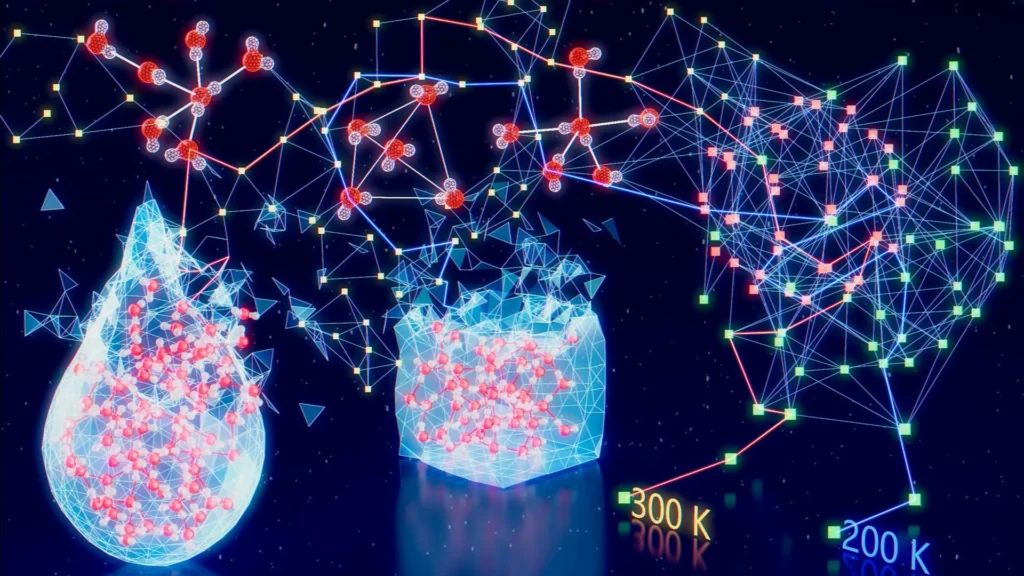
To train the AI system, the researchers fed the neural network an extensive dataset of structural information. This data was meticulously generated from molecular dynamics simulations of supercooled water, capturing the dynamic interplay of water molecules under various conditions. Through an iterative process of repeated trial and error, a hallmark of machine learning, the neural network learned to identify and differentiate meaningful patterns within the complex molecular structures. Essentially, the AI was taught to recognize the subtle distinctions between different local arrangements of water molecules, which are hypothesized to correspond to the HDL and LDL states.
A New Era for Structural Characterization
The culmination of this training process allowed the AI network to perform a crucial comparative analysis. "The network used what it had learned to compare how 16 descriptors differentiated between LDL and HDL structures at different temperatures," reports Nobuyuki Matubayasi, the senior author of the study. "In this way, we determined the most efficient descriptors." This systematic evaluation, previously unachievable with traditional methods, provides a clear hierarchy of effectiveness among the various structural descriptors. It means scientists can now confidently select the most appropriate tools for characterizing water’s microscopic structure, streamlining future research and reducing ambiguities.
The application of AI in this context is part of a broader trend in scientific discovery. Fields ranging from drug design (e.g., AlphaFold’s success in protein folding) to materials science are increasingly employing machine learning to accelerate research, uncover hidden correlations in vast datasets, and even generate new hypotheses. The Osaka study exemplifies how AI can serve as a powerful analytical engine, sifting through complexity to identify underlying truths that might elude human observation or conventional computational methods.
Broader Implications and Future Directions
The implications of this research extend far beyond a more refined understanding of water. The researchers assert that their novel AI framework has the potential to profoundly improve scientists’ understanding of how microscopic structural changes are intimately connected to the macroscopic thermodynamic behavior of water. This enhanced clarity could finally provide definitive answers regarding the fundamental origin of water’s unusual properties—a quest that has spanned centuries.
Furthermore, the findings are poised to guide the development of even better tools and methodologies for studying complex molecular structures, not just in water but in other liquids and materials where intricate molecular arrangements dictate bulk properties. This could have a ripple effect across numerous scientific and engineering disciplines:
- Climate Science: A deeper understanding of water’s phase transitions and behavior in supercooled states is critical for accurate climate models, particularly concerning cloud formation, precipitation, and atmospheric dynamics.
- Biology: Water is the universal solvent for life, playing a crucial role in protein folding, enzyme activity, and cellular processes. Insights into its structural behavior could illuminate fundamental biological mechanisms and aid in understanding diseases linked to water-protein interactions.
- Materials Science: The ability to precisely characterize and predict molecular structures could lead to the design of novel materials with tailored properties, such as advanced cryopreservation agents or more efficient water filtration membranes.
- Cryogenics: Improving our understanding of how water behaves at extremely low temperatures, especially in its supercooled state, has direct applications in cryopreservation, organ storage, and even space exploration.
"This work represents a significant step forward in a field that has perplexed scientists for generations," remarked Dr. Elena Petrova, a theoretical chemist specializing in complex liquids at the University of Cambridge, who was not involved in the Osaka study. "Leveraging AI to bring clarity to the myriad ways we describe molecular structures is a powerful methodology that will undoubtedly find applications beyond water. It pushes the boundaries of how we approach fundamental problems in physical chemistry, blending advanced computational techniques with foundational questions."
The Osaka team’s work provides a compelling demonstration of AI’s transformative potential in fundamental scientific research. By providing a unified lens through which to view water’s microscopic world, they have not only shed new light on one of nature’s most enigmatic substances but also paved the way for more efficient and insightful structural characterization across the broad spectrum of materials science and chemistry. Future research may involve applying this AI framework to other complex liquids, exploring water’s behavior under extreme conditions, or even integrating it with experimental data to further validate and refine its predictions, bringing us closer to a complete understanding of the molecule that underpins all life.