Achieving true precision in advanced motion control applications transcends the mere summation of individual component specifications, demanding a profound focus on comprehensive system integration. This intricate process, often overlooked in initial design phases, is the cornerstone upon which micron-level accuracy and sustained performance are built. As industries push the boundaries of manufacturing, automation, and scientific research, the understanding that precision is engineered, not accidental, becomes paramount. This article, the fourth and final in a series dedicated to high-precision motion control, delves into the critical elements of system integration, revealing how seemingly minor details can dictate the success or failure of complex motion systems.
The Evolving Landscape of Motion Control Precision
The journey towards ultra-high precision motion control began with an emphasis on individual component excellence. Initially, engineers focused primarily on the specifications of mechanical actuators—repeatability, accuracy, and load capability. While these foundational metrics remain crucial, a growing realization has emerged that a holistic perspective is indispensable. The preceding articles in this series systematically dissected the contributing layers: Part 1 examined the mechanics, highlighting often-neglected factors such as bearing deflection, body stiffness, and structural smoothness; Part 2 explored the intricate world of motors, detailing their designs, construction, and quality; and Part 3 focused on the sophisticated designs and features of drives and controls. This final installment synthesizes these insights, underscoring that the true potential of these meticulously engineered components is unlocked only through thoughtful, rigorous system integration.
The common thread weaving through all these discussions is the existence of critical details that do not appear on standard data sheets but profoundly impact system performance. As motion systems strive for accuracy beyond the micron level, traditional specifications can lose their typical meaning, necessitating nuanced engineering decisions and a systems-level approach. This series has aimed to equip engineers, designers, and system integrators with the understanding required to navigate these complexities, ensuring that every decision contributes to the overarching goal of high-precision motion. The performance tiers—basic, specification-level, and pushing-beyond-the-specifications—apply not just to individual components but critically, to their integration.
System Integration: The Unseen Architecture of Precision
The notion that disparate components can be "thrown together" and simply "work" is a dangerous fallacy in precision motion control. While initial assemblies might function adequately, the long-term demands of high-performance applications inevitably expose the shortcomings of haphazard integration. Consider the analogy of a paper airplane: a simple fold might allow it to fly initially, but achieving greater distance, stability, and repeated performance requires meticulous, precise folds. Similarly, in motion control, even the most advanced sub-systems will underperform if the overall system is not thoughtfully engineered and properly integrated. Optimal performance is an emergent property of the whole system, not merely a sum of its parts.
System integration, therefore, is the art and science of orchestrating all mechanical, motor, drive, and control components to function harmoniously and to their full potential within the broader system infrastructure. Every component specification is predicated on a set of "hidden assumptions" about its operational environment and interfaces. For instance, mechanical actuators assume specific levels of flatness and stability from their mounting surfaces; motors require adequate airflow and heat sinking; and drives and controllers demand clean, stable power. A failure to meet these underlying assumptions inevitably compromises stated performance.
Real-World Consequences of Integration Failures
The implications of poor integration are not theoretical; they manifest as tangible performance degradation, increased wear, system failures, and ultimately, significant financial losses due to downtime and reduced product quality. Several common scenarios highlight these real-world challenges:

- Mechanical Alignment and Mounting Surfaces: A precision linear motor’s performance is profoundly affected by the flatness and stability of its mounting surface and its precise alignment with accompanying linear bearings. In a system utilizing a linear motor alongside linear guides, the three components must be meticulously aligned. Misalignment can induce mechanical binding, leading to uneven friction, accelerated wear, and in severe cases, complete immobilization of the motor. This binding creates unpredictable forces that counteract the motor’s intended motion, eroding accuracy and repeatability.
- Thermal Management and Environmental Factors: The environment in which a motion system operates is a critical, yet frequently underestimated, factor. A system calibrated in a climate-controlled workshop may falter when deployed in a hot industrial environment. Thermal expansion and contraction can subtly alter mechanical alignments, bearing preloads, and sensor readings, causing deviations that push the system far from its performance requirements. For example, a 1-meter aluminum component might expand by approximately 24 micrometers for every degree Celsius increase. In ultra-precision applications, such shifts are catastrophic. Conversely, extreme cold can lead to material contraction, increased viscosity of lubricants, and stress on components.
- Electrical Noise and Power Quality: Controllers and drives are often tested in controlled lab environments with pristine electrical power. However, when these systems are deployed in industrial settings, they are exposed to "dirty" power sources, electromagnetic interference (EMI), and radio-frequency interference (RFI) from other machinery, welding equipment, or variable frequency drives. Shortcuts in grounding techniques, shielding, and EMC filtering during integration can allow these electrical disturbances to corrupt signals, induce false readings, and cause erratic system behavior, leading to reduced precision, instability, and even component damage.
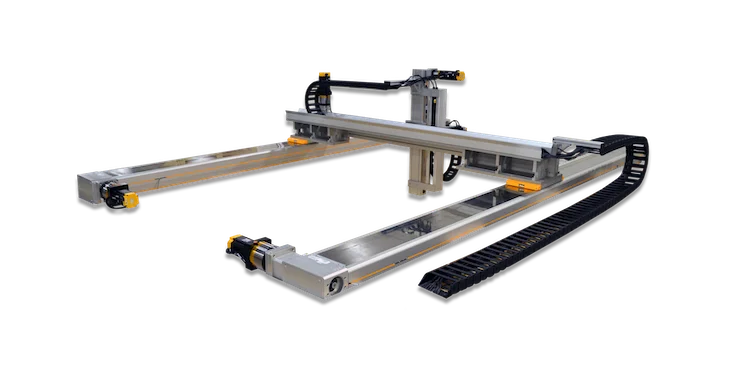
- Multi-Axis Synchronization: Systems involving multiple parallel axes, such as gantry systems with two long linear belt and pulley actuators, present unique integration challenges. Beyond precise parallelism, their travel lengths must be meticulously tuned to match. Variations in belt tension between the two actuators, even minor ones, can cause discrepancies in distance per revolution of the pulleys. Over extended travel distances, say two meters, a seemingly small 5-mm variance at the end of travel can be unacceptable in applications demanding synchronous, precise movements, leading to skewed loads, increased friction, and reduced positional accuracy.
- Cable Management and Signal Integrity: Improper cable routing is a frequent oversight. Running low-power signal cables in parallel with high-power motor cables over long distances creates opportunities for inductive coupling and electromagnetic interference, corrupting sensitive data signals. Coiling excess high-power cable, while seemingly innocuous, can create inductive loops that act as antennas, radiating or receiving noise.
Elevating Precision: Essential Integration Practices
For systems reliant on precision motion control, a disciplined approach to integration is not merely advisable but essential. Several practices, when rigorously implemented, significantly enhance system reliability and performance:
- Rigorous Site Preparation and Foundation Design: The foundation upon which a motion system rests is as critical as the components themselves. Mounting surfaces for actuators must meet or exceed the assumed flatness and stability standards. For ultra-high precision systems, this often necessitates specialized foundations, such as isolated concrete slabs or air-damped tables, decoupled from the vibrations of the surrounding facility. The use of dowel pins between actuators and mounting surfaces ensures repeatable assembly and reassembly, maintaining alignment integrity over time.
- Precision Alignment Techniques and Tooling: Achieving micron-level alignment for linear, rotary, or ring-type encoders requires specialized fixtures, laser interferometers, autocollimators, and other high-precision measurement tools. These tools allow for iterative adjustments and verification, ensuring that the encoder accurately reflects the true position of the moving element, free from cosine errors or Abbe errors. Regular calibration and environmental monitoring during alignment are crucial.
- Optimized Cable Management and Shielding Protocols: Strict adherence to cable routing best practices is non-negotiable. Low-power signal cables must be segregated from high-power cables, ideally running in separate, grounded cable trays. When they must cross, they should do so perpendicularly to minimize inductive coupling. Proper shielding—using braided or foil shields, and ensuring continuous grounding—is vital for sensitive signal lines. Avoiding excess cable length and coiling minimizes potential noise sources.
- Environmental Control and Isolation: The operational environment must be actively managed to mitigate its impact on system precision. Temperature-controlled rooms are fundamental for systems sensitive to thermal expansion. For the highest precision applications, these rooms often incorporate active vibration damping systems and are built on foundations physically separate from the main building structure to isolate them from ambient seismic and mechanical vibrations. Humidity control can also be critical for certain components or processes.
- The Role of Simulation and Digital Twins: Modern engineering leverages advanced simulation tools and the concept of "digital twins" to optimize integration before physical assembly. By creating virtual models of the entire motion system, engineers can simulate various operational scenarios, identify potential alignment issues, analyze thermal effects, and predict vibration modes. This allows for proactive design adjustments, reducing costly physical prototypes and accelerating the development cycle while significantly improving the integrated system’s robustness.
Industry Perspectives and Expert Insights
Leading engineers and system integrators in fields such as semiconductor manufacturing, biomedical automation, and aerospace acknowledge the paradigm shift from component-centric design to system-centric engineering. "The days of simply picking parts from a catalog and hoping for the best are long gone in high-precision motion control," states an anonymous senior automation engineer from a prominent robotics firm. "What looks good on a spec sheet can easily be undermined by a poorly prepared mounting surface or inadequate EMI protection. Our biggest breakthroughs often come from refining the integration process, not just upgrading components." Analysts further suggest that companies investing heavily in advanced integration methodologies report up to a 20% reduction in commissioning time and a 15% improvement in long-term system reliability compared to those who treat integration as an afterthought. This highlights the tangible return on investment for a meticulous approach.
Broader Impact and Implications
The implications of robust system integration extend far beyond the immediate performance of a single motion control system. For industries reliant on precision, such as microelectronics, advanced optics, and additive manufacturing, superior integration translates directly into higher yield rates, reduced waste, faster throughput, and the ability to manufacture products with increasingly stringent tolerances. This, in turn, fosters innovation and competitive advantage.
Economically, the initial investment in thorough integration practices—including specialized tooling, skilled personnel, and rigorous testing—is often offset by significant long-term savings. These savings come from reduced maintenance, fewer unplanned downtimes, extended equipment lifespan, and the avoidance of costly rework or product recalls caused by precision failures. The cost of addressing integration issues post-deployment can be exponentially higher than addressing them during the design and build phases.
Furthermore, as industrial automation increasingly incorporates artificial intelligence and machine learning for predictive maintenance and adaptive control, the quality of the underlying integrated system becomes even more critical. Clean data from precisely integrated sensors and actuators is essential for effective AI algorithms, enabling smarter, more resilient, and truly autonomous motion systems. The future of precision manufacturing will undoubtedly hinge on our ability to master the art and science of system integration.
Conclusion: Precision is a Deliberate Achievement
The journey through the layers of performance and specifications in motion control culminates in a singular, undeniable truth: true precision is a deliberate achievement, not an accidental outcome. It requires engineers to transcend the role of "product selectors" and embrace the mindset of "systems engineers." By understanding how mechanics, motors, drives, and controls interact within a complex ecosystem, and by diligently applying best practices in system integration—from site preparation and alignment to cable management and environmental control—the hidden assumptions behind component specifications can be met, and the full potential of high-precision motion control can be realized. The questions unasked during the integration process are the ones most likely to haunt a system’s performance, underscoring the critical need for a comprehensive, inquisitive, and meticulous approach to every detail.