A groundbreaking advancement in material science has emerged from Penn State University, where a team of researchers has developed a novel "smart synthetic skin" that can perform a wide array of tasks, mimicking the remarkable adaptability of living organisms. Led by Assistant Professor Hongtao Sun of Industrial and Manufacturing Engineering (IME), the group has engineered a programmable hydrogel material capable of dynamic transformations in appearance, texture, and shape, opening doors to unprecedented applications in fields ranging from camouflage and information security to soft robotics and biomedical devices.
The development, detailed in a recent publication in the prestigious journal Nature Communications, represents a significant departure from traditional synthetic materials, which are typically designed for a single purpose. This new smart skin, however, can be "programmed" to respond to external stimuli such as heat, solvents, or physical stress, altering its properties on demand. This adaptability allows it to perform functions like hiding or revealing information, creating dynamic camouflage, and providing crucial support for the burgeoning field of soft robotics. The study was further recognized by its inclusion in Nature Communications‘ Editors’ Highlights, underscoring its scientific significance.
Nature’s Blueprint: The Octopus as a Muse
The inspiration for this innovative material stems from the natural world, specifically from cephalopods like octopuses. These marine invertebrates possess an extraordinary ability to rapidly change the color, pattern, and texture of their skin, allowing them to blend seamlessly with their surroundings for camouflage or to communicate with other individuals.
"Cephalopods utilize a complex interplay of muscles and nerves to achieve dynamic control over their skin’s appearance and texture," explained Sun, the principal investigator of the project. "Drawing inspiration from these incredibly adaptable soft organisms, we developed a 4D-printing system to translate that concept into a synthetic, soft material."
The "4D printing" designation, as described by Sun, who also holds affiliations with Penn State’s departments of Biomedical Engineering, Materials Science and Engineering, and the Materials Research Institute, signifies that the printed objects are not static. Instead, they are designed to undergo active changes in response to environmental conditions, effectively adding a temporal dimension to the printing process.
Halftone Encoding: Printing Digital Instructions into Material
The key to the smart skin’s remarkable adaptability lies in a sophisticated fabrication technique known as halftone-encoded printing. This method translates digital information, such as images or texture data, into binary patterns of ones and zeros. These binary codes are then embedded directly into the hydrogel material during the printing process. The principle is analogous to how dot patterns are used in newspapers or photographs to create detailed visual representations.
By precisely encoding these digital patterns within the hydrogel, researchers can dictate how specific regions of the smart skin will react to different stimuli. The printed patterns act as a set of instructions, determining whether certain areas will swell, shrink, or soften more than others when exposed to changes in temperature, the presence of specific liquids, or mechanical forces. This meticulous design of the encoded patterns allows for precise control over the material’s overall behavior and functional response.
"In essence, we are printing instructions directly into the material," Sun elaborated. "These embedded instructions guide the skin on how to react when it encounters changes in its environment."
Hiding and Revealing Information: A Glimpse into the Future of Security and Communication
One of the most compelling demonstrations of the smart skin’s capabilities is its ability to conceal and subsequently reveal visual information on demand. Haoqing Yang, a doctoral candidate in IME and the lead author of the research paper, highlighted the significant potential of this feature.
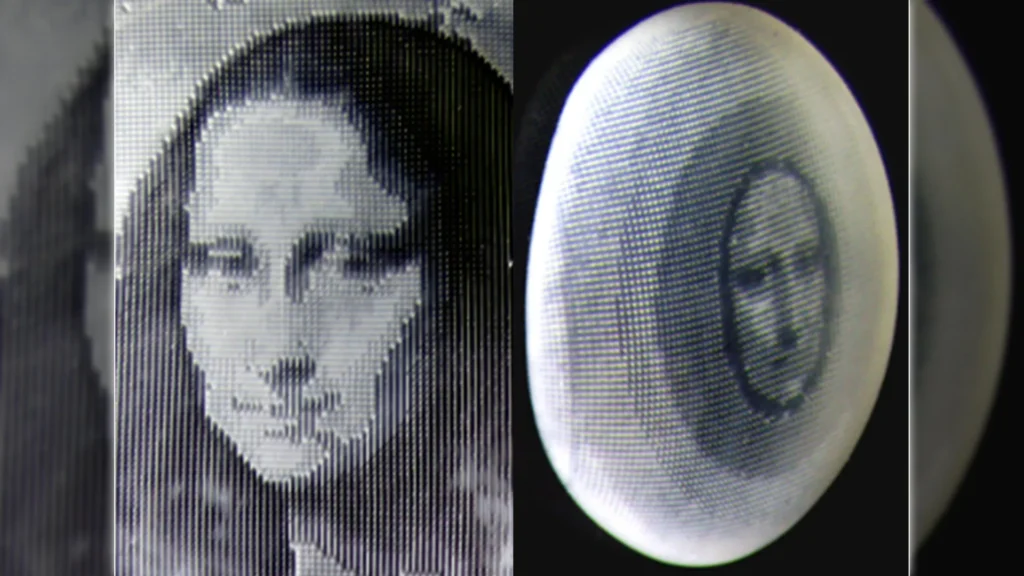
In a striking demonstration, the research team encoded an image of Leonardo da Vinci’s Mona Lisa into a thin film of the hydrogel. When this film was exposed to ethanol, it became transparent, rendering the image completely invisible. The hidden masterpiece reappeared only when the film was subsequently immersed in ice water or allowed to gradually warm up.
Yang emphasized that the Mona Lisa was chosen for illustrative purposes. The halftone-encoded printing technique is versatile enough to embed virtually any image or pattern into the hydrogel.
"This capability has profound implications for applications such as camouflage, where a surface can dynamically blend into its surroundings, or for information encryption, where sensitive messages can be hidden and revealed only under specific, predetermined conditions," Yang stated.
Beyond visual revelation, the researchers also demonstrated that concealed patterns could be detected through mechanical interaction. By gently stretching the material and employing digital image correlation analysis to observe its deformation patterns, they could infer the presence of hidden information. This adds an additional layer of security, allowing for information retrieval not only through direct visual cues but also through physical manipulation.
Unveiling Shape-Shifting Prowess: Single Material, Multifaceted Transformations
The smart synthetic skin also exhibits remarkable versatility in its ability to change shape. According to Sun, the material can transition seamlessly from a flat sheet into complex, bio-inspired three-dimensional forms with intricate surface textures. A key differentiator of this innovation is that these transformations do not necessitate the use of multiple layers or dissimilar materials, a common limitation in many existing shape-changing materials.
Instead, the changes in both shape and texture are exclusively governed by the digitally printed halftone patterns within a single, monolithic sheet of hydrogel. This streamlined approach allows the material to replicate sophisticated effects observed in the dynamic skin of cephalopods.
The research team further showcased the material’s ability to integrate multiple functionalities. By carefully designing the halftone patterns, they successfully encoded the Mona Lisa image into flat films that subsequently transformed into three-dimensional structures. As these films curved into dome-like shapes, the hidden image gradually became visible, illustrating the material’s capacity to coordinate changes in shape and visual appearance simultaneously within a single, unified material.
"Much like how cephalopods synchronize their body shape with their skin patterning, our synthetic smart skin can concurrently control its visual appearance and its physical deformation, all within one adaptable, soft material," Sun remarked.
Expanding the Horizons of 4D-Printed Hydrogels
This latest work builds upon prior research conducted by Sun’s team, which also focused on 4D-printed smart hydrogels and was published in Nature Communications. The earlier study concentrated on integrating mechanical properties with programmable transitions from flat to three-dimensional configurations. The current research significantly broadens this scope by employing halftone-encoded 4D printing to imbue a single hydrogel film with an even greater array of functionalities.
Looking towards the future, the researchers aspire to develop a scalable and versatile platform that facilitates the precise digital encoding of multiple functions into a single adaptive material. This would pave the way for highly sophisticated and responsive materials with broad applicability.
"This interdisciplinary research, situated at the confluence of advanced manufacturing, intelligent materials, and mechanics, unlocks novel opportunities with far-reaching implications for stimulus-responsive systems, biomimetic engineering, advanced encryption technologies, biomedical devices, and much more," Sun concluded.
The collaborative effort involved several key contributors from Penn State, including doctoral candidates Haotian Li and Juchen Zhang from IME, and Tengxiao Liu, a lecturer in Biomedical Engineering. Professor H. Jerry Qi from the Georgia Institute of Technology’s Mechanical Engineering department also played a crucial role in the project. The implications of this breakthrough are vast, promising to revolutionize how we design and interact with materials in the coming years. The ability to create programmable, adaptable materials that respond to their environment opens up a new frontier in technological innovation.