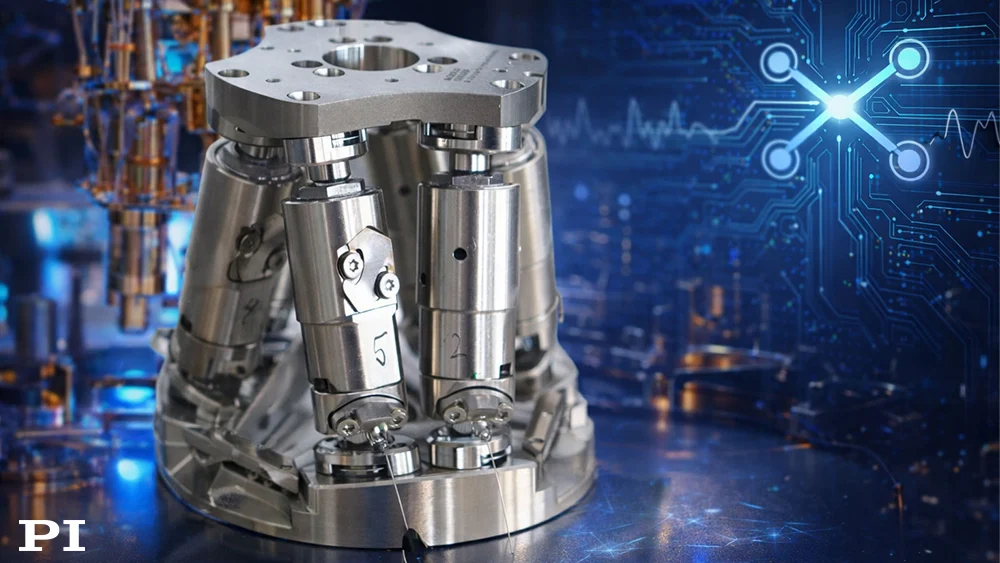
PI (Physik Instrumente) has formally initiated a comprehensive low-temperature development program, strategically focused on advancing multi-axis nanopositioning systems specifically engineered for the burgeoning field of quantum applications. This significant undertaking underscores the growing demand for ultra-precise motion control in environments operating at the extreme frontiers of temperature, a critical requirement for unlocking the full potential of quantum technologies, advanced photonics, and next-generation semiconductor research.
The burgeoning landscape of quantum science and its associated technologies presents unprecedented challenges for precision instrumentation. Early iterations of cryogenic motion solutions often relied on simpler, stacked XYZ stages, which, while functional for initial experiments, are increasingly inadequate for the complex demands of modern quantum setups. Contemporary applications now necessitate sophisticated 5- and 6-degree-of-freedom (6DOF) alignment systems. These systems must not only provide unparalleled precision but also support significantly larger payloads and accommodate increasingly intricate optical configurations, all while operating within the highly constrained and thermally sensitive confines of cryostats and dilution refrigerators.
The Quantum Imperative: Why Cryogenic Precision is Paramount
The global race to develop functional quantum computers, robust quantum communication networks, and highly sensitive quantum sensors is fundamentally predicated on the ability to maintain and manipulate quantum states. These delicate states, governed by the principles of superposition and entanglement, are extraordinarily susceptible to environmental noise, including thermal fluctuations and mechanical vibrations. To mitigate these disruptive influences, many quantum systems, particularly those based on superconducting circuits, trapped ions, or photonic qubits, must operate at temperatures approaching absolute zero, typically below 4 Kelvin (K) and often into the millikelvin (mK) range.
Within these extreme cryogenic environments, every component must be meticulously designed to minimize heat generation, resist material degradation at ultra-low temperatures, and deliver sub-nanometer, or even picometer, level precision. The manipulation of individual photons, atoms, or quantum dots requires motion systems capable of positioning optical elements, fibers, or sample stages with exquisite accuracy and repeatability over extended periods. Imprecise positioning can lead to significant signal loss, decoherence, or misaligned optical paths, rendering experimental results unreliable or hindering the scalability of quantum devices.
Evolution of Cryogenic Motion Control: From Stacks to Parallel Kinematics
Historically, researchers employed stacked linear stages to achieve multi-axis motion within cryostats. While straightforward in concept, this approach suffers from inherent limitations. Each additional stage in a stack introduces potential for cumulative errors, increased mechanical compliance, and a larger footprint, which is particularly problematic in the restricted volumes of dilution refrigerators. Furthermore, stacked systems often exhibit kinematic coupling, where motion in one axis can inadvertently induce unwanted motion in another, complicating precise alignment tasks. The cumulative mass and complexity of wiring for multiple motors also contribute to higher heat loads, a critical concern in cryogenic systems where every milliwatt of dissipated power can significantly impact the base temperature.
As quantum experiments grew in complexity, demanding more than simple XYZ translation, the need for integrated 5DOF (e.g., XYZ and two rotations) and 6DOF (XYZ and three rotations) systems became apparent. These advanced setups might involve aligning multiple optical fibers to a photonic chip, precisely steering laser beams onto individual qubits, or correcting for optical aberrations within a cryogenic lens system. The increasing payload requirements, driven by larger optical assemblies and more integrated experimental components, further underscored the limitations of traditional stacked designs.

PI’s Strategic Response: Advanced Parallel Kinematics for Extreme Environments
PI’s innovative approach to this challenge is firmly rooted in the company’s extensive expertise in precision motion control, particularly its development of compact 6DOF parallel kinematics, commonly known as Hexapods. This architectural choice represents a significant leap forward for cryogenic applications. Unlike stacked systems, where errors accumulate sequentially, parallel kinematic structures distribute forces and motions across multiple struts, inherently leading to higher stiffness, reduced error accumulation, and a much smaller form factor.
The inherent compactness of Hexapod designs is a critical advantage for integration within the severely limited spatial envelopes of cryostats and dilution refrigerators. These systems are specifically engineered for demanding optical tasks, including:
- Beam Steering: Directing laser beams with sub-microradian precision onto target areas within the quantum device.
- Lens Aberration Correction: Compensating for optical imperfections that can arise from cryogenic temperatures or complex optical paths, ensuring optimal light delivery and collection.
- Polarization Control: Precisely adjusting the polarization state of light, crucial for manipulating photonic qubits or interacting with spin states.
- Fiber Alignment: Achieving nanometer-level alignment of optical fibers to photonic integrated circuits or single quantum emitters, minimizing coupling losses.
- Positioning of Dispersive Elements: Accurately placing gratings, prisms, or other spectroscopic components for precise wavelength selection or analysis in cryogenic setups.
These systems are meticulously designed to maintain their high-performance characteristics at temperatures well below 4K. They are capable of supporting motion of several hundred grams over millimeter-scale travel ranges, all while delivering exceptional stability and repeatability. This combination of payload capacity, travel range, and cryogenic operation at nanoscale precision is essential for the next generation of quantum research and industrial applications.
Technical Deep Dive: Overcoming Cryogenic Challenges with Piezo Technology
Hexapod-type parallel kinematics offer several intrinsic advantages beyond their compact size. The simultaneous control of all six degrees of freedom eliminates the error accumulation characteristic of stacked systems. Other key characteristics include:
- Low Inertia: The lightweight design of parallel kinematics contributes to faster response times and reduced thermal mass.
- Lower Energy Requirements: Efficient design and specialized drives minimize power consumption, directly translating to reduced heat dissipation within the cryogenic environment. This is paramount, as even small amounts of heat can drastically increase the time and energy required to cool a system, or even prevent it from reaching desired base temperatures.
- Programmable Pivot Point: A standout feature, this allows users to define the center of rotation anywhere in space. For optical alignment tasks, this is invaluable, enabling precise rotational adjustments around a specific optical element or a virtual point in the beam path without introducing unwanted translational shifts.
- Open Aperture: Many PI Hexapod designs feature a central opening, providing unimpeded optical access through the center of the stage, which is critical for complex optical setups.
The core of PI’s cryogenic nanopositioning technology lies in its advanced piezo-based architecture. Piezoelectric actuators are ideally suited for cryogenic environments for several reasons:
- Low Heat Generation: Unlike conventional electromagnetic motors that generate significant heat through resistive losses, piezoelectric actuators convert electrical energy directly into mechanical strain with high efficiency, resulting in minimal heat dissipation. This makes them indispensable for maintaining ultra-low temperatures.
- Self-Locking Operation: Many piezo-based systems, especially those utilizing stick-slip or inertia drives, exhibit a self-locking mechanism when power is switched off. This means the position is held without continuous power consumption, further reducing heat load and allowing for stable, drift-free positioning once the desired location is achieved. This "set-and-forget" capability is invaluable in thermally sensitive low-temperature environments, where even momentary power fluctuations could impact stability.
- Non-Magnetic Materials: The entire system is constructed using carefully selected non-magnetic materials. This is a critical design consideration, as magnetic fields can severely interfere with sensitive quantum devices, particularly those relying on superconducting qubits or spin states. Ensuring UHV (Ultra-High Vacuum) compatibility is another crucial aspect, preventing contamination of the delicate quantum environment and maintaining the vacuum integrity required for stable operation.
This comprehensive development program represents a significant expansion of PI’s long-standing work in motion technology for quantum research and cryogenic photonic systems. The company has a rich history of developing high-precision motion solutions, and this latest initiative leverages that expertise to address the unique and demanding requirements of the quantum era.
Diverse Applications Across High-Tech Sectors

The technology emanating from PI’s cryogenic nanopositioning program is poised to make a profound impact across several critical high-tech industries:
1. Quantum Technology:
- Qubit Manipulation: Essential for precisely positioning optical fibers, waveguides, or individual superconducting resonators to interact with and control qubits.
- Quantum Communication: Enabling highly accurate alignment of optical components in cryogenic quantum repeaters or entangled photon sources.
- Quantum Sensing: Enhancing the precision of cryogenic quantum sensors by providing stable and repeatable positioning of detection elements or samples.
- Cryogenic Quantum Computing Architectures: Facilitating the assembly and testing of complex multi-qubit systems within dilution refrigerators, ensuring optimal performance and scalability.
2. Photonics:
- Advanced Cryogenic Optical Systems: Allowing for the dynamic and precise alignment of lenses, mirrors, and other optical elements in experiments where light manipulation at cryogenic temperatures is paramount.
- Integrated Photonics at Low Temperatures: Enabling the precise coupling of light into and out of cryogenic photonic integrated circuits, which are increasingly being explored for quantum applications and high-performance classical computing.
- Laser Micro-Machining and Probing: Facilitating ultra-precise material processing or characterization at cryogenic temperatures for novel material development.
3. Semiconductor Industry (Advanced Research and Development):
- Cryogenic Wafer Probing: Enabling the electrical characterization of advanced semiconductor devices, such as quantum dots, topological insulators, or novel 2D materials, at extremely low temperatures to understand their fundamental properties and potential for future technologies.
- Development of Cryo-CMOS: Supporting the research and development of specialized CMOS control electronics designed to operate at cryogenic temperatures, which are essential for scaling up quantum processors by reducing the "wiring bottleneck" from room temperature to the cryostat.
- Fault Analysis: Assisting in the precise localization and analysis of defects in semiconductor devices that manifest only at cryogenic conditions.
Industry Perspectives and Future Outlook
The launch of this development program by PI is a clear indication of the intensifying focus on the foundational technologies required to bring quantum science from the laboratory into practical application. Dr. Stefan Vorndran, Vice President of Marketing at PI, commented on the strategic importance of this initiative, stating, "The quantum revolution demands an entirely new class of precision instrumentation. Our cryogenic nanopositioning program is a direct response to the critical need for ultra-stable, high-resolution motion systems that can reliably operate in the most challenging environments. We are committed to empowering researchers and developers with the tools necessary to accelerate breakthroughs in quantum computing, communication, and sensing."
Experts in the field recognize the significance of such specialized development. "Achieving nanometer-scale precision at millikelvin temperatures is an extraordinary engineering feat," explains Professor Anya Sharma, a leading researcher in quantum optics. "The shift towards integrated parallel kinematics for multi-axis control within cryostats is a logical and necessary progression. Systems that minimize heat load, offer high stiffness, and provide simultaneous 6DOF control with programmable pivot points will undoubtedly become indispensable for scaling up our quantum experiments and moving closer to commercial quantum technologies."
The market for quantum technologies is projected for substantial growth over the next decade, with significant investments from governments and private enterprises worldwide. Companies like PI, by providing enabling technologies such as advanced cryogenic nanopositioning, play a crucial role in accelerating this trajectory. The ability to precisely align and manipulate components within the quantum stack is not merely an incremental improvement; it is a fundamental prerequisite for unlocking new avenues of research and transitioning theoretical concepts into tangible, scalable quantum devices.
This development program positions PI not just as a supplier of components, but as a strategic partner in the quantum ecosystem, addressing one of the most critical bottlenecks in the field: the interface between the macroscopic control world and the microscopic quantum realm in extreme conditions. As quantum technology continues its rapid advancement, the demand for such sophisticated, purpose-built cryogenic motion systems will only intensify, solidifying PI’s role at the forefront of this transformative technological era. The company’s ongoing commitment to innovation in this highly specialized domain promises to facilitate groundbreaking discoveries and accelerate the commercialization of quantum-enabled solutions for years to come.






