The Quantum Frontier and Its Cryogenic Demands
The global race to harness quantum mechanics for revolutionary technologies has intensified dramatically over the past decade. Quantum computing, quantum sensing, and quantum communication promise unprecedented capabilities, from solving intractable computational problems to developing ultra-sensitive medical diagnostics and creating unhackable communication networks. At the heart of many of these nascent quantum technologies lies the qubit – the fundamental unit of quantum information. Qubits, whether based on superconducting circuits, trapped ions, quantum dots, or topological materials, are incredibly fragile and susceptible to environmental noise. To maintain their quantum coherence and enable their delicate manipulation, these systems often require operation at temperatures just a few milliKelvin above absolute zero – colder than deep space.
Operating scientific and technological instruments in such extreme cryogenic environments, typically achieved through specialized cryostats and dilution refrigerators, presents a formidable engineering challenge. Traditional mechanical components are prone to performance degradation at these temperatures due to material contraction, increased friction, and thermal expansion mismatches. Furthermore, any heat generated by motion control systems can catastrophically destabilize the cryogenic environment, leading to qubit decoherence and system failure. The physical space within cryostats is also severely constrained, demanding compact and highly integrated solutions.
Early cryogenic motion solutions, while functional for simpler tasks, often relied on stacked XYZ stages. These serial kinematic designs, where each axis is built upon the previous one, inherently suffer from accumulated errors, reduced stiffness, and a larger footprint. For the emerging complexities of quantum experiments, such as the precise alignment of multiple optical pathways, sophisticated fiber coupling, or the manipulation of intricate sample arrays, these legacy systems are no longer sufficient. Modern quantum applications frequently require highly integrated 5- and 6-degree-of-freedom (DOF) alignment systems capable of supporting larger payloads and accommodating more complex optical configurations with nanometer-level precision and stability. This unmet need has created a critical bottleneck in the advancement and scalability of quantum technologies, a gap that PI’s new development program aims to close.
PI’s Hexapod Innovation for Extreme Environments
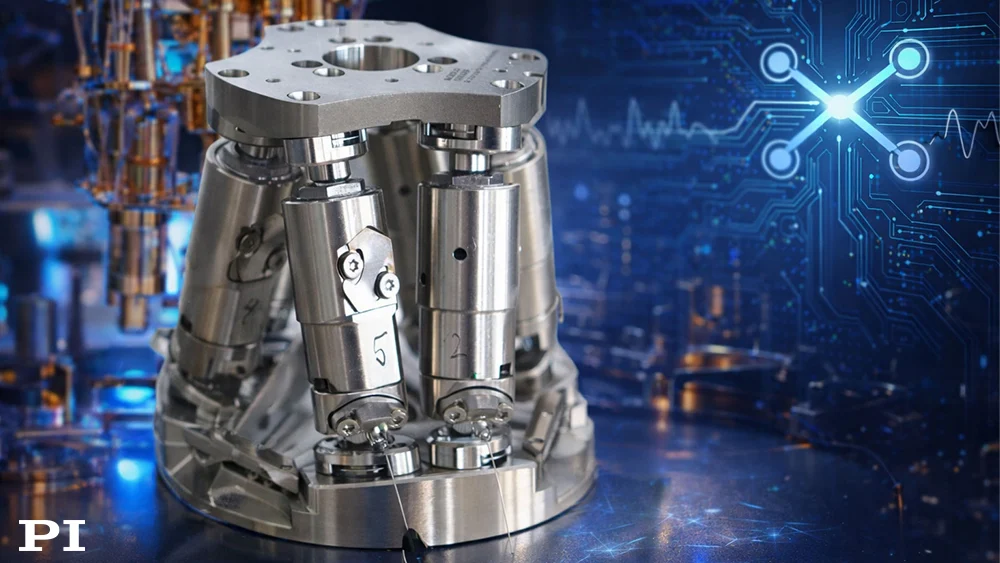
PI’s response to these challenges is rooted in its extensive expertise in precision motion control, particularly its pioneering work with parallel kinematics. The company’s new cryogenic nanopositioning program leverages compact 6DOF parallel kinematic designs, commonly known as Hexapods, to deliver unparalleled precision within the confined spaces of cryostats and dilution refrigerators. Unlike serial stages, Hexapods consist of a platform supported by six independent struts, each with a variable length. This architecture allows for simultaneous and coordinated control of all six degrees of freedom (X, Y, Z, pitch, roll, yaw) from a single, compact base.
The adoption of Hexapod-type parallel kinematics offers several profound advantages for cryogenic quantum applications. Firstly, the parallel arrangement inherently minimizes error accumulation, a common pitfall of stacked systems. Each strut contributes to the overall stiffness, resulting in higher rigidity and greater stability, which is crucial for maintaining nanometer-scale positions over extended periods. Secondly, Hexapods typically exhibit lower inertia and require less energy for operation compared to serial equivalents, a critical factor in heat-sensitive cryogenic environments. Their symmetrical design also provides a programmable pivot point, allowing for precise rotational alignment about any desired external point, greatly simplifying complex optical adjustments such as beam steering, lens aberration correction, polarization control, and the precise positioning of dispersive elements like gratings and prisms. The integrated design also facilitates an open aperture, which is vital for optical access in many quantum setups.
This innovative approach is specifically engineered to operate at temperatures below 4 Kelvin, often extending into the milliKelvin range within dilution refrigerators, while supporting payloads of several hundred grams. This capability is significant, as complex optical assemblies and sample holders in quantum experiments can be substantial. The systems are designed to offer millimeter-scale travel ranges, providing the necessary coarse positioning for initial setup, followed by ultra-fine nanopositioning with exceptional stability and repeatability. The ability to achieve such performance in extreme cold represents a monumental achievement in precision engineering.

The Power of Piezoelectric Actuation in Cryogenics
A cornerstone of PI’s cryogenic nanopositioning technology is its reliance on advanced piezoelectric actuation. Piezoelectric materials exhibit a unique property: they change shape when an electric field is applied, and conversely, generate an electric charge when mechanically stressed. This direct conversion of electrical energy into mechanical displacement (and vice-versa) makes them ideal for high-precision motion control, particularly in cryogenic settings.
Unlike conventional electromagnetic motors, which rely on coils and magnets and generate significant resistive heat, piezoelectric actuators produce minimal waste heat. This is paramount in cryogenic environments, where every milliwatt of heat load can disrupt delicate quantum states. The direct drive nature of piezo actuators also enables incredibly fine resolution, typically in the nanometer or even sub-nanometer range, far surpassing the capabilities of most mechanical drives. Furthermore, piezoelectric materials are inherently non-magnetic, preventing any interference with sensitive quantum devices that are often highly susceptible to magnetic fields.
Another critical feature of PI’s piezo-based architecture is its self-locking operation when power is switched off. This capability is invaluable in thermally sensitive low-temperature environments. Once a position is achieved and power is removed, the actuator mechanically holds its position without further energy consumption or heat generation. This ensures long-term stability without compromising the thermal integrity of the cryostat, allowing researchers to maintain precise alignment for extended experimental runs without continuous power draw or active feedback loops that might introduce noise or heat. The use of ultra-high vacuum (UHV) compatible and non-magnetic materials throughout the system further underscores PI’s commitment to integration near the most sensitive quantum devices, preventing contamination and magnetic interference that could otherwise compromise experimental results.
Strategic Implications and Market Impact
PI’s cryogenic nanopositioning development program extends and solidifies its existing work in quantum research and cryogenic photonic systems. The company has a long-standing reputation for pushing the boundaries of precision motion, and this new initiative is a direct response to the evolving needs of the scientific and industrial communities at the forefront of quantum technology.
The primary beneficiaries of this technology will be the quantum technology, photonics, and semiconductor industries. In quantum technology, these precise motion systems will enable:
- Quantum Computing: Facilitating the exact alignment of optical elements for laser delivery to trapped ions or neutral atoms, precise fiber coupling for superconducting qubits, and the positioning of quantum dot arrays. This directly addresses scaling challenges by allowing more complex qubit architectures to be reliably assembled and operated.
- Quantum Sensing: Enhancing the sensitivity and stability of quantum sensors by precisely positioning their active elements, critical for applications ranging from ultra-sensitive magnetometers to atomic clocks.
- Quantum Communication: Enabling highly stable and accurate alignment of optical fibers and free-space optics for distributing entangled photons over long distances, a cornerstone of secure quantum networks.
Within the photonics sector, the demand for cryogenic nanopositioning is also growing rapidly. Integrated photonic circuits, often designed for low-loss operation at cryogenic temperatures, require extremely precise alignment for fiber coupling and component integration. The ability to perform complex beam steering and polarization control at these temperatures opens new avenues for cryogenic optical systems, essential for fundamental research in quantum optics and for next-generation optoelectronic devices.
The semiconductor industry will also find significant utility in these advanced systems. As chip manufacturers explore quantum devices and develop advanced materials for extreme environments, precise low-temperature characterization and testing capabilities become indispensable. PI’s nanopositioners can facilitate accurate probing, alignment, and manipulation of samples within cryogenic test chambers, accelerating research and development cycles for next-generation semiconductor technologies.

Industry analysts suggest that this strategic investment positions PI as a critical enabler for the quantum revolution. The market for quantum technologies is projected to grow substantially, with estimates reaching tens of billions of dollars within the next decade. As quantum systems mature from laboratory curiosities to commercially viable products, the demand for robust, high-precision, and cryogenically compatible components will skyrocket. Experts in quantum physics consistently emphasize the critical need for such high-precision, low-temperature solutions to push the boundaries of quantum research and move closer to scalable quantum hardware. PI’s program directly addresses these foundational requirements, offering tools that could unlock breakthroughs currently constrained by technological limitations.
A Chronology of Precision in Extreme Environments
The evolution of precision motion control for extreme environments has been a gradual yet accelerating process, mirroring the advancements in fields like quantum physics and space exploration. Initially, simple, manual adjustment mechanisms were adapted for low temperatures, offering limited precision and flexibility. As the demands for scientific experiments grew in the mid-to-late 20th century, the need for remotely controlled, motorized stages became apparent. Early motorized cryogenic stages often struggled with issues like excessive heat generation, material compatibility, and achieving true nanometer precision.
The advent of piezoelectric technology in the late 20th century marked a significant turning point. Its inherent low heat generation, high resolution, and non-magnetic properties made it a natural fit for cryogenic applications, though adapting these systems for extreme cold still presented considerable engineering challenges related to material selection and thermal management. PI, with its decades of experience in piezoelectric-based nanopositioning, has been a consistent innovator in this space. Their prior work in developing precision stages for cryogenic optical systems and initial quantum research efforts laid the groundwork for the current ambitious program.
This latest development program represents a culmination of these efforts, a deliberate and concentrated push to integrate the most advanced motion control principles – specifically parallel kinematics and sophisticated piezoelectric actuation – with the extreme demands of the quantum era. It signifies a shift from adapting existing technologies to purpose-building solutions from the ground up, designed for the unique constraints and requirements of milliKelvin environments. This proactive approach by PI is not merely incremental but represents a foundational leap, providing the robust and precise tools essential for the next generation of quantum science and engineering.
Conclusion
The launch of PI’s cryogenic nanopositioning development program is a pivotal moment for the advancement of quantum technologies. By addressing the critical need for ultra-precise, multi-axis motion control in extreme low-temperature environments, PI is not only expanding its technological portfolio but also directly contributing to the foundational infrastructure required for the quantum revolution. The integration of compact 6DOF parallel kinematics with low-heat, self-locking piezoelectric actuation, all while maintaining compatibility with UHV and non-magnetic environments, sets a new benchmark for cryogenic precision. As the world races to unlock the full potential of quantum mechanics, PI’s commitment to delivering these enabling technologies will undoubtedly play a crucial role in accelerating scientific discovery and fostering the industrial realization of quantum-era innovations. For further details on PI’s cutting-edge developments, interested parties are encouraged to visit pi-usa.us.