In the intricate realm of quantum materials, where electrons exhibit collective behaviors that defy classical descriptions, the emergence of electronic order rarely follows a simple, uniform trajectory. Instead, these phenomena often manifest as complex, heterogeneous patterns that vary dramatically across microscopic regions of a material. A prime example of such collective electronic states is the charge density wave (CDW), a quantum state where electrons self-organize into repeating, periodic patterns, typically at cryogenic temperatures. While charge density waves have been a subject of intense research for decades, a significant challenge has persisted: directly observing how their strength, known as amplitude, and their spatial coherence – the extent to which these patterns are well-ordered and interconnected – evolve dynamically during a quantum phase transition. This fundamental lack of direct visualization has hindered a complete understanding of the mechanisms governing their formation, stability, and interaction with other exotic quantum phenomena.
A groundbreaking research team, spearheaded by Professor Yongsoo Yang of the Department of Physics at the Korea Advanced Institute of Science and Technology (KAIST), has achieved a monumental breakthrough in this challenging field. Collaborating with Professors SungBin Lee, Heejun Yang, and Yeongkwan Kim from KAIST, and esteemed colleagues at Stanford University, the team has, for the first time, directly visualized the evolution of charge density wave order across space within a quantum material at the nanoscale. This unprecedented capability allows scientists to peer into the microscopic world and witness the birth, maturation, and decay of these elusive electronic patterns, offering profound new insights into the fundamental physics of quantum materials.
Unveiling the Hidden Heterogeneity of Electronic Order
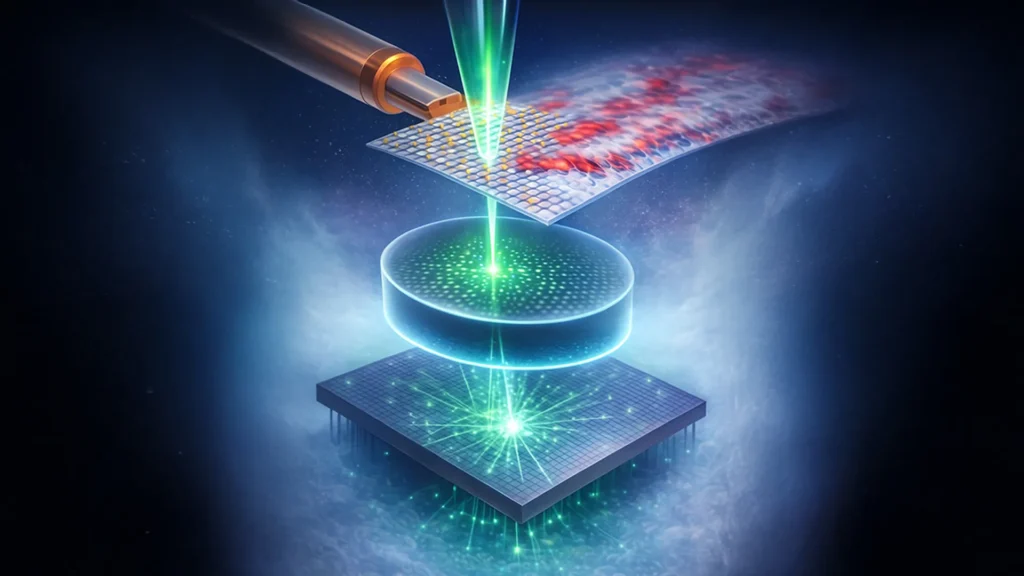
The journey to unraveling the mysteries of CDWs required an innovative experimental approach that pushed the boundaries of existing microscopy techniques. To achieve this remarkable feat, the researchers employed a sophisticated experimental setup featuring a liquid-helium-cooled electron microscope integrated with four-dimensional scanning transmission electron microscopy (4D-STEM). This advanced configuration is not merely a high-resolution imaging tool; it functions as a powerful spectroscopic probe, capable of extracting rich information about the material’s electronic and structural properties at extremely fine spatial and temporal scales. The cryogenic environment, maintained at temperatures as low as -253°C (approximately 20 Kelvin), is crucial for stabilizing the delicate quantum states under investigation, allowing the team to precisely track how CDW order forms, weakens, and ultimately breaks apart as the temperature is carefully varied across a phase transition.
Crucially, this advanced 4D-STEM technique allowed the team to generate detailed nanoscale maps. Unlike conventional methods that might only indicate the presence or absence of electronic order, these maps provided quantitative information on both the strength (amplitude) of the electronic order and its spatial coherence—how well these ordered regions connect and extend across different parts of the material. This level of detail is akin to observing a complex natural phenomenon with unprecedented clarity. The researchers likened the process to watching individual ice crystals nucleate and grow as water freezes, but at an incredibly magnified scale, where the subjects are electrons arranging themselves in a quantum material. Their microscope boasted an extraordinary resolution, capable of distinguishing structures as small as one hundred-thousandth the width of a human hair, or roughly a nanometer—a scale where individual atomic arrangements become discernible.
The resulting images revealed a startling finding: electronic order does not propagate uniformly throughout the material. Instead, it forms in a highly heterogeneous manner. The nanoscale maps showed distinct areas where electronic patterns were clearly defined and robust, existing in close proximity to regions where such order was entirely absent or significantly weakened. This patchy, non-uniform distribution challenges traditional models that often assume a more homogeneous emergence of order. Professor Yang elaborated on this observation, stating, "The visual evidence we obtained strikingly resembles a frozen lake where ice forms in scattered patches, some strong and some weak, rather than covering the entire surface all at once. This heterogeneity holds vital clues to the underlying mechanisms of these quantum states."
The Critical Role of Local Strain and Lattice Distortions
Beyond mapping the spatial distribution of CDW order, the study unearthed a profound connection between these uneven electronic patterns and minute structural imperfections within the crystal lattice. The research team discovered that even incredibly small amounts of mechanical strain—tiny distortions in the material’s atomic arrangement—were sufficient to significantly suppress the amplitude of the charge density wave. These minute strains are far too subtle to be detected by conventional optical microscopy or X-ray diffraction techniques, highlighting the power of 4D-STEM in revealing hidden structural influences.
This strong, direct correlation between localized strain and the weakening of electronic order provides compelling evidence that subtle lattice distortions play a critical, often underestimated, role in shaping how these quantum patterns form and stabilize. In essence, the physical arrangement of atoms acts as a crucial stage upon which the electronic ballet of charge density waves is performed, and even the slightest wrinkle in this stage can disrupt the performance. Understanding this interplay is vital because strain is ubiquitous in real-world materials, arising from growth imperfections, defects, or external mechanical forces. The ability to directly link such subtle structural variations to electronic properties opens new avenues for material design and engineering, potentially allowing for the local control of quantum phases.
Pockets of Persistence: Redefining Phase Transitions
Another unexpected and highly significant discovery from the KAIST-Stanford collaboration challenged conventional understanding of quantum phase transitions. The researchers found that small, isolated pockets of charge density wave order could persist even above the material’s nominal transition temperature—the point where long-range electronic order is typically expected to completely vanish. This phenomenon suggests that the phase transition from an ordered CDW state to a disordered state is not a simple, abrupt, and uniform process across the entire material.
Instead of disappearing instantaneously or homogeneously, the electronic order appears to gradually lose its spatial coherence. These persistent pockets indicate a more complex, multi-stage transition where local regions retain some degree of order even as the global, long-range order breaks down. This observation is crucial for refining theoretical models of phase transitions in quantum materials, moving beyond idealized uniform systems to embrace the inherent heterogeneity of real materials. It implies that the "critical temperature" might represent a global average, while locally, order can fluctuate and persist in nanometer-scale domains, hinting at the importance of local fluctuations and precursory phenomena near critical points.
A New Metric: Measuring Correlations in CDW Amplitude
A central technical triumph of this study lies in its ability to perform the first direct measurement of correlations in CDW amplitude. By meticulously analyzing how the strength of electronic order at one specific location relates to that at another nearby location, the researchers were able to quantitatively demonstrate how spatial coherence breaks down across the phase transition, even while the local amplitude of the CDW might still be present in isolated regions.
This novel capability provides an unprecedented window into the intricate mechanisms governing electronic order. Previously, researchers relied on indirect methods such as diffraction patterns, which provide an averaged view of order across a macroscopic sample, or scanning probe techniques, which offer local information but often struggle with the dynamic and spatially coherent aspects of order. The 4D-STEM approach, by contrast, offers both high spatial resolution and the ability to map amplitude correlations, providing a truly comprehensive picture that was previously inaccessible. This direct measurement of amplitude correlations is a powerful new tool for understanding the "texture" of quantum phases and how they evolve.
The Broader Significance: A New Framework for Quantum Materials
Charge density waves are not isolated curiosities; they are a fundamental and ubiquitous feature in a wide array of quantum materials. These materials, which include high-temperature superconductors, topological insulators, and materials exhibiting colossal magnetoresistance, often display a rich interplay between various electronic states. CDWs frequently coexist with or compete against other exotic phenomena like superconductivity, magnetism, and Mott insulation. Understanding the precise mechanisms of CDW formation and evolution is therefore critical for unlocking the full potential of these materials for future technological applications, such as ultra-fast computing, energy-efficient electronics, and quantum information science.
By directly mapping the spatial structure and correlations of CDWs, this pioneering study provides a new experimental paradigm for understanding how collective electronic order forms, evolves, and interacts with structural degrees of freedom in real-world quantum systems. This work moves the field beyond inferential models to direct observation, opening up vast possibilities for validating theoretical predictions and uncovering entirely new phenomena. The ability to visualize and quantify the spatial heterogeneity of CDWs, their sensitivity to local strain, and their complex behavior near phase transitions represents a significant leap forward in condensed matter physics.
Expert Perspectives and Future Directions
Dr. Yongsoo Yang, the lead author from KAIST, underscored the transformative nature of their findings. "Until now, the spatial coherence and local variations of charge density waves were largely inferred indirectly from averaged measurements or theoretical models. Our innovative approach, utilizing advanced 4D-STEM at cryogenic temperatures, allows us to directly visualize how electronic order varies across space and temperature with unparalleled detail. More importantly, it enables us to precisely identify the specific factors—such as minute lattice strain—that locally stabilize or suppress this order." He further elaborated that this direct observational capability is crucial for moving beyond macroscopic descriptions to a true nanoscale understanding of quantum phenomena.
The implications of this research extend far beyond the fundamental understanding of CDWs. The methodology developed by the KAIST-Stanford team could be applied to a wide range of other quantum materials and electronic phases, providing a universal tool for investigating spatial heterogeneity in quantum systems. Researchers can now probe the local origins of other exotic phenomena, such as superconductivity, by examining how these ordered states nucleate and grow. This could lead to strategies for enhancing desired quantum properties by controlling local strain or engineering specific defects.
The study, which saw Seokjo Hong, Jaewhan Oh, and Jemin Park of KAIST as co-first authors, was published in the prestigious journal Physical Review Letters, a testament to its significance within the scientific community. The rigorous peer-review process and publication in such a high-impact journal validate the originality and importance of the work.
Funding and Collaborative Support
The research received substantial financial backing, primarily from the National Research Foundation of Korea (NRF) through various grants, including the Individual Basic Research Program, Basic Research Laboratory Program, and Nanomaterial Technology Development Program, all funded by the Korean Government (MSIT). Professor Yang also acknowledged support from the KAIST singularity professor program. Further support was provided by NRF grants to Professor SungBin Lee and Professor Yeongkwan Kim, and by the Korea Research Institute of Standards and Science (KRISS) for Professor Kim. Professor Heejun Yang also received NRF funding. The advanced 4D-STEM, ADF-STEM, and EELS experiments, which were central to this breakthrough, were conducted using state-of-the-art equipment—a double Cs corrected Titan cubed G2 60-300 (FEI) and Spectra Ultra (ThermoFisher)—at the KAIST Analysis Center for Research Advancement (KARA). The authors expressed their gratitude for the excellent support provided by Hyung Bin Bae, Jin-Seok Choi, and the dedicated staff of KARA, whose technical expertise was instrumental in the success of the experiments. The researchers also acknowledged helpful discussions with E.-G. Moon. The authors explicitly stated that while ChatGPT was utilized for language editing, the original manuscript texts were entirely written by human authors.
This pioneering work marks a critical juncture in the study of quantum materials. By providing an unprecedented microscopic view into the dynamic and spatially heterogeneous world of charge density waves, the KAIST-Stanford collaboration has not only resolved long-standing observational challenges but has also laid a robust foundation for future discoveries, promising to accelerate the development of next-generation quantum technologies. The ability to directly ‘see’ the invisible dance of electrons at the nanoscale heralds a new era of experimental condensed matter physics.