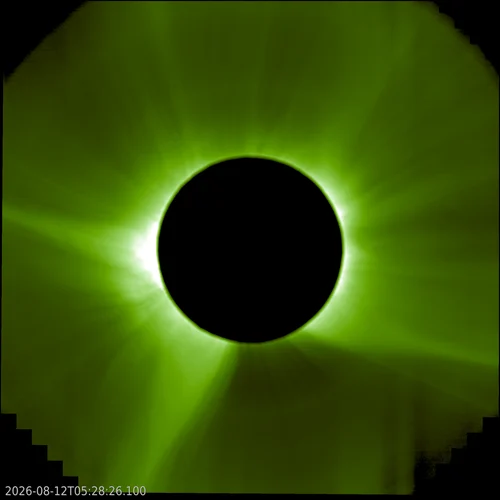
On August 12, 2026, as anticipation built across Europe for the rare celestial event of a total solar eclipse, the European Space Agency’s (ESA) Proba-3 mission achieved a remarkable feat of its own. Hours before the Moon’s shadow was set to sweep across the continent, the two-satellite formation successfully engineered its 65th artificial solar eclipse, showcasing humanity’s ingenuity in replicating cosmic phenomena from the vantage point of space. This meticulously choreographed event provided an unprecedented opportunity to study the Sun’s elusive corona, offering insights that complement and inform our understanding of the natural eclipse unfolding below.
The Proba-3 mission, a testament to ESA’s commitment to pushing the boundaries of space science and technology, comprises two sophisticated spacecraft, the Occulter and the Coronagraph. Operating in precise formation, approximately 150 meters apart, at an altitude of 60,000 kilometers above Earth, these satellites work in tandem to achieve their ambitious scientific goals. The Occulter spacecraft, designed to be the "artificial Moon," meticulously positions itself to block the Sun’s blindingly bright disk. This deliberate obscuration creates a stable and controlled environment, allowing the Coronagraph spacecraft to achieve an uninterrupted, long-duration view of the Sun’s corona.
This delicate ballet in orbit is crucial for studying the Sun’s outer atmosphere, the corona, a region of extreme heat and dynamic activity that is typically hidden from view by the Sun’s intense glare. The corona is a key area of research for understanding solar flares, coronal mass ejections (CMEs), and the solar wind – phenomena that can significantly impact Earth’s technological infrastructure, including satellite operations, power grids, and communication systems.
A Unique Celestial Alignment: The Double Eclipse
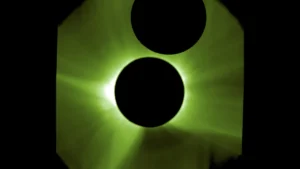
August 12, 2026, proved to be an exceptionally memorable day for the Proba-3 mission, not only for its scheduled artificial eclipse but also for an unexpected celestial bonus. Shortly after the ASPIICS coronagraph aboard Proba-3 captured its image of the artificially eclipsed Sun, the Moon, our closest celestial neighbor, made its grand entrance into the mission’s field of view. This serendipitous alignment resulted in what mission scientists have described as a "double eclipse," a rare occurrence where both the artificial occulter and the natural Moon simultaneously obscured the Sun from Proba-3’s perspective. This unique event provided an unparalleled opportunity for comparative analysis, allowing scientists to study the corona under two distinct, yet related, eclipsing conditions.
The image captured by the ASPIICS coronagraph on this momentous morning revealed the Sun’s inner corona in its characteristic greenish hue. This coloration is consistent with how observers on Earth, using a green filter during the natural solar eclipse, would perceive this region of the Sun. The ASPIICS instrument is specifically designed to isolate and capture these faint outer layers of the Sun, providing detailed spectral and imaging data that are vital for understanding the complex processes at play.
Proba-3’s Predictive Power: A Glimpse into the Future
The Proba-3 mission’s capabilities extend beyond mere observation; they offer a remarkable predictive insight into solar activity. Approximately two weeks prior to the August 12th event, Proba-3 had been positioned on the opposite side of its orbit, observing the Sun. Given that the Sun completes roughly half a rotation on its axis in a two-week period, the images captured from this earlier observation point served as a remarkably accurate prediction of the solar corona’s appearance during the natural eclipse on August 12th. This foresight allowed scientists to anticipate the visual characteristics of the corona and to refine their observational strategies for both the artificial and natural events. The mission’s coronagraphy images from this prior observation were so precise that they effectively mimicked the views that ground-based observers would experience during the full solar eclipse.
This predictive capability highlights the sophisticated understanding Proba-3 provides of solar rotation and the dynamic nature of the corona. By observing the Sun from different vantage points and at different times, scientists can build a more comprehensive three-dimensional picture of solar activity, enabling better forecasting of space weather events.
The Natural Eclipse: A Continent-Wide Spectacle
The natural total solar eclipse of August 12, 2026, was a highly anticipated event across Europe. The path of totality, where the Sun is completely obscured by the Moon, stretched across several countries, drawing millions of spectators to prime viewing locations. These natural eclipses are rare and fleeting, offering a profound astronomical experience and a unique scientific opportunity.
The spectacle of a total solar eclipse has captivated humanity for millennia, inspiring awe, scientific curiosity, and cultural traditions. During totality, the Sun’s corona, normally invisible, becomes a radiant halo around the darkened solar disk. This is the very phenomenon that Proba-3 endeavors to study continuously from space. The 2026 eclipse provided a widespread opportunity for both the public and the scientific community to witness this celestial marvel. Numerous space missions, in addition to Proba-3, were also engaged in observing the natural eclipse, collecting data that will contribute to a broader understanding of solar physics and its impact on the heliosphere. ESA and other space agencies have curated collections of images and data from these diverse observations, offering a comprehensive look back at this significant astronomical event.
Proba-3’s Mission Objectives and Technological Prowess
The Proba-3 mission, launched in 2023, represents a significant advancement in coronagraphy technology. The core challenge in studying the solar corona is the immense difference in brightness between the Sun’s disk and its faint outer atmosphere. Traditional coronagraphs often struggle to completely suppress the glare, leading to obscured or noisy data. Proba-3 overcomes this limitation through its innovative two-spacecraft design.
The precise formation flying required for Proba-3 is a marvel of modern orbital mechanics and control systems. The spacecraft must maintain their relative positions with centimeter-level accuracy over a distance of 150 meters, a feat that demands sophisticated sensors, thrusters, and real-time trajectory correction. The Occulter spacecraft is equipped with a precisely shaped baffle to block the Sun’s direct light, while the Coronagraph spacecraft houses the ASPIICS instrument. ASPIICS, which stands for the Association de Spectrométrie Solaire et d’Imagerie de la Couronne Interne, is a highly advanced coronagraph designed to capture detailed images and spectral data of the inner corona.
The data collected by Proba-3 are invaluable for several key scientific objectives:
- Understanding Coronal Heating: The corona is millions of degrees hotter than the Sun’s visible surface, a puzzle that has long intrigued solar physicists. Proba-3’s observations help to investigate the mechanisms responsible for this extreme heating, such as the role of magnetic fields and plasma waves.
- Studying Solar Wind Acceleration: The solar wind, a continuous stream of charged particles flowing from the Sun, originates in the corona. Proba-3’s detailed imagery and spectral data contribute to understanding how this wind is accelerated to such high speeds.
- Monitoring Coronal Mass Ejections (CMEs): CMEs are massive eruptions of plasma and magnetic field from the Sun’s corona. While Proba-3 focuses on the inner corona, its data can provide context for understanding the initiation and evolution of these powerful events.
- Space Weather Prediction: By providing a continuous and detailed view of the corona, Proba-3 contributes to improving our ability to predict space weather events that can impact Earth.
Broader Implications and Future Prospects
The success of the Proba-3 mission and its artificial eclipsing capabilities has significant implications for the future of solar research. The ability to create controlled eclipses on demand offers a consistent and stable platform for studying the Sun’s corona, free from the limitations and transient nature of natural eclipses. This continuous observational capacity allows for the study of solar phenomena over extended periods, leading to a deeper understanding of their long-term evolution and underlying physics.
The data generated by Proba-3 are expected to contribute to a more robust understanding of solar activity, which in turn is crucial for safeguarding our increasingly technology-dependent society. Improved space weather forecasts can help mitigate the risks posed by solar storms to satellites, power grids, and communication networks. Furthermore, the mission’s success in precise formation flying demonstrates advancements in spacecraft control and rendezvous technology, which could have applications in future space missions, such as assembly of large structures in orbit or complex rendezvous and docking maneuvers.
The August 12, 2026, event, with its confluence of an artificial and a natural eclipse, serves as a powerful reminder of the dual nature of scientific exploration: the meticulous, planned endeavors that extend our knowledge from controlled environments, and the serendipitous discoveries that arise from observing the grand spectacles of the cosmos. Proba-3, through its innovative approach, bridges these two realms, offering a unique perspective on our Sun and its profound influence on our solar system. As the mission continues its operations, it promises to unlock further secrets of our star, contributing significantly to our ongoing quest to understand the universe.