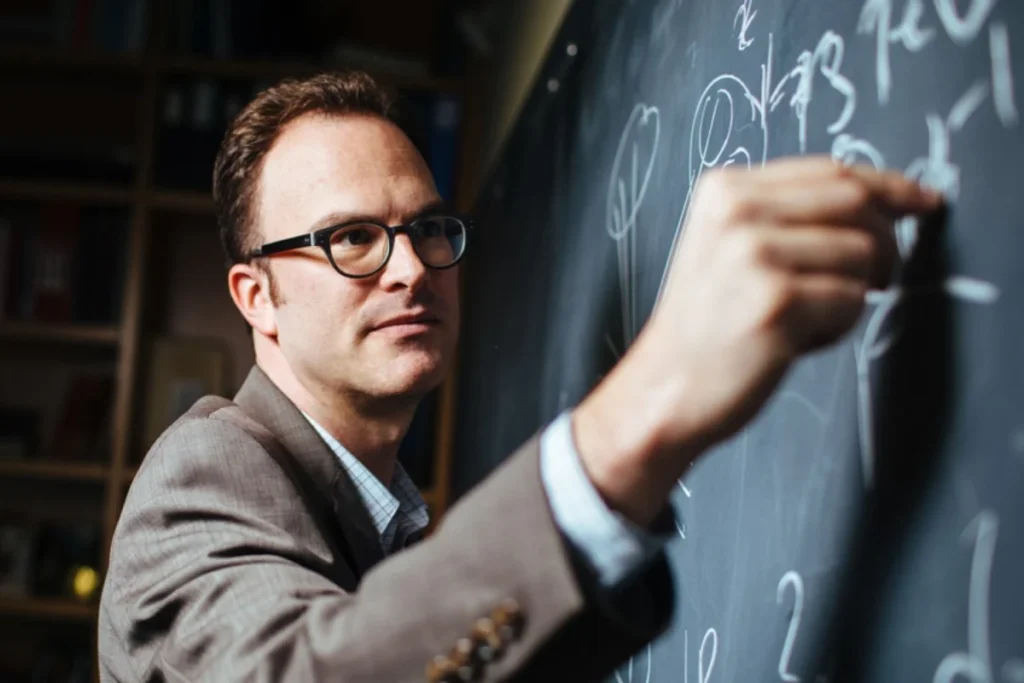
The Massachusetts Institute of Technology has announced the appointment of Professor Jesse Thaler as the new director of the Laboratory for Nuclear Science (LNS), effective August 1. Thaler, a distinguished theoretical particle physicist, succeeds Professor Bolek Wyslouch, who has steered the laboratory through a decade of significant growth and scientific achievement. This leadership transition occurs at a pivotal moment for the field of fundamental physics, as the integration of artificial intelligence and machine learning begins to redefine the boundaries of experimental and theoretical research.
Thaler is currently the William and Emma Rogers Professor of Physics within the MIT Center for Theoretical Physics—a Leinweber Institute (CTP-LI). His appointment is seen as a strategic move to position the LNS at the forefront of the "AI revolution" in the physical sciences. Known for his pioneering work in utilizing machine learning to analyze particle jets at the Large Hadron Collider (LHC), Thaler brings a unique interdisciplinary perspective to a laboratory that has been a cornerstone of nuclear and particle physics for nearly 80 years.
A Legacy of Leadership and the Transition of Authority
The Laboratory for Nuclear Science is one of MIT’s largest and most storied interdepartmental laboratories. Since its founding in 1946, it has served as a hub for investigating the fundamental constituents of matter and the forces that govern the universe. Professor Bolek Wyslouch, the outgoing director, is credited with maintaining the laboratory’s excellence during a period of rapid technological change. Under his leadership, the LNS expanded its reach, participating in global collaborations and fostering research in areas ranging from heavy-ion physics to dark matter searches.
Nergis Mavalvala, the dean of the MIT School of Science and the Curtis and Kathleen Marble Professor of Astrophysics, praised the outgoing and incoming directors for their contributions to the institute. "In his research, Jesse has done pioneering work on particle jets at the Large Hadron Collider and is a leader in combining AI and machine learning with fundamental particle physics," Mavalvala stated. She emphasized that the collaborative nature of Thaler’s research programs is perfectly suited for the LNS as it enters a new era of AI-driven discovery.
The transition marks a shift in focus toward the computational aspects of physics. While the LNS remains deeply rooted in experimental nuclear physics, the growing complexity of data coming from facilities like the LHC and the upcoming Electron-Ion Collider (EIC) necessitates a leader who understands the bridge between raw data and theoretical insight.
The Intersection of Particle Physics and Artificial Intelligence
Professor Thaler’s career has been defined by his ability to merge techniques from quantum field theory with the latest advancements in machine learning. His work on particle jets—the sprays of particles produced in high-energy collisions—has been instrumental in helping physicists distinguish between known processes and potential signs of "new physics" beyond the Standard Model.
As the inaugural director of the National Science Foundation (NSF) AI Institute for Artificial Intelligence and Fundamental Interactions (IAIFI), Thaler has already demonstrated his capacity to lead large-scale, interdisciplinary initiatives. Launched in 2020, the IAIFI was recently renewed for another five-year term, a testament to the success of its mission to advance physics knowledge through AI while simultaneously using physics principles to improve AI technology itself.
"In my own field of particle physics, researchers are developing cutting-edge AI algorithms to handle the data deluge from collider experiments and to perform heroic theoretical calculations," Thaler remarked. He noted that while these algorithms are designed for discovering new physics, their utility often extends into other domains, creating a feedback loop of innovation that benefits broader society.
With Thaler moving to lead the LNS, Mike Williams, a professor of physics at MIT and a key figure in the LHCb experiment at CERN, will take over as the director of IAIFI. This reshuffling of leadership underscores MIT’s commitment to weaving AI into the fabric of its core scientific disciplines.
Historical Context: The Evolution of the Laboratory for Nuclear Science
To understand the significance of Thaler’s appointment, one must look at the trajectory of the LNS. Established in the immediate aftermath of World War II, the laboratory was initially focused on the burgeoning field of nuclear science and the development of particle accelerators. Over the decades, its scope has widened considerably.
Today, the LNS encompasses research in:
- High-Energy Physics: Investigating the fundamental particles of nature at the highest energy scales.
- Nuclear Physics: Studying the structure of protons, neutrons, and nuclei, as well as the behavior of matter under extreme conditions.
- Cosmology and Gravity: Exploring the origins of the universe, dark energy, and gravitational waves.
- Quantum Information Science: Leveraging the principles of quantum mechanics for new methods of computation and sensing.
The LNS currently supports the work of dozens of faculty members and hundreds of students and researchers. It acts as a bridge between MIT and global facilities such as CERN in Switzerland, Brookhaven National Laboratory in New York, and Jefferson Lab in Virginia. The appointment of a theorist who specializes in AI signals that the laboratory’s next chapter will be defined by how it processes the massive amounts of data generated by these international collaborations.
Supporting Data: The Impact of AI on Modern Physics
The necessity of AI in physics is driven by the sheer scale of modern experiments. For instance, the Large Hadron Collider produces approximately 90 petabytes of data per year. Traditional methods of data filtering and analysis are increasingly strained by this volume.
Supporting data from recent physics publications indicates that AI-assisted analysis can improve the sensitivity of certain searches for rare particles by up to 50% compared to classical statistical methods. Furthermore, in theoretical physics, machine learning is being used to solve complex many-body problems and lattice QCD (Quantum Chromodynamics) calculations that were previously computationally prohibitive.
The Department of Energy’s (DOE) Genesis Mission, which the LNS is poised to join, further emphasizes this trend. The Genesis Mission focuses on AI-enabled scientific discovery, providing the infrastructure and funding necessary to develop "foundation models" for science—AI systems trained on vast datasets of physical laws and experimental results.
Educational Innovation and the Next Generation of Scientists
One of Thaler’s most significant contributions during his time at IAIFI was the focus on human capital. Under his leadership, the institute partnered with the MIT Institute for Data, Systems, and Society (IDSS) to create a unique doctoral program. This program allows students to earn a PhD in physics, statistics, and data science, equipping them with the diverse skill set required for 21st-century research.
Thaler also championed dedicated postdoctoral fellowships that provide early-career researchers with the intellectual freedom to pursue work that crosses traditional departmental lines. "Giving young scientists space to build connections across domains, universities, and career stages has been transformative within IAIFI," Thaler said. He expressed his intention to bring this collaborative framework to the LNS, ensuring that the laboratory remains an attractive environment for the world’s top scientific talent.
Philanthropic Support and the CTP-LI
As the head of LNS, Thaler will also oversee his home center, the Center for Theoretical Physics (CTP), which was recently renamed the Center for Theoretical Physics—Leinweber Institute (CTP-LI). This change followed a historic donation from the Leinweber Foundation in 2023.
According to the Science Philanthropy Alliance, this gift represents the largest philanthropic commitment ever made to the field of theoretical physics. The funds are earmarked for establishing a network of theoretical physics research institutes, supporting graduate fellowships, and fostering international collaboration. This financial backing provides the LNS and CTP-LI with a level of stability and resources that are rare in the field of fundamental science, allowing researchers to pursue high-risk, high-reward inquiries that might not receive traditional federal funding.
Analysis of Implications: A New Paradigm for Physics
The appointment of Jesse Thaler is more than just a change in personnel; it is an indicator of a paradigm shift in how fundamental science is conducted. For much of the 20th century, theory and experiment were often siloed. In the 21st century, the "third pillar" of science—computation—has become the glue that holds them together.
By placing a leader with deep expertise in AI at the helm of the LNS, MIT is acknowledging that the next great discovery in physics—whether it be the nature of dark matter, the properties of the quark-gluon plasma, or a breakthrough in quantum gravity—will likely be found within a dataset too large for a human to scan alone. The AI algorithms being developed at MIT are not merely tools for automation; they are becoming "co-scientists" capable of identifying patterns and anomalies that human intuition might overlook.
Furthermore, the appointment reflects the increasing importance of "cross-pollination." The techniques Thaler developed for particle physics are already finding applications in other fields. For example, the same "optimal transport" math used to compare particle jets can be used in medical imaging to track the movement of cells or in finance to model market fluctuations.
Chronology of Jesse Thaler’s Career and MIT Tenure
- 2002: Graduated from Brown University with a BS in Mathematics and Physics.
- 2006: Received his PhD in Physics from Harvard University.
- 2006–2009: Served as a fellow at the Miller Institute for Basic Research in Science at the University of California, Berkeley.
- 2010: Joined the MIT faculty, beginning his tenure at the Center for Theoretical Physics.
- 2020: Appointed as the inaugural director of the NSF AI Institute for Artificial Intelligence and Fundamental Interactions (IAIFI).
- 2023: Witnessed the expansion of the CTP into the CTP-LI following the Leinweber Foundation gift.
- 2024 (June): NSF renews support for IAIFI for another five years.
- 2024 (August 1): Assumes directorship of the MIT Laboratory for Nuclear Science.
Conclusion and Future Outlook
As Professor Jesse Thaler takes the reins of the MIT Laboratory for Nuclear Science, the institution stands at a crossroads of tradition and innovation. With the support of the DOE’s Genesis Mission and the philanthropic backing of the Leinweber Foundation, the LNS is well-equipped to tackle the most profound questions of the universe.
The laboratory’s future will likely be characterized by a "physics-first" approach to artificial intelligence, where the laws of nature are baked into the algorithms themselves, ensuring that AI-driven discoveries are not just statistically significant but physically sound. Under Thaler’s guidance, the LNS is poised to remain a global leader in the quest to understand the fundamental building blocks of our world, leveraging the power of AI to shine a light on the mysteries of the subatomic and cosmological realms.