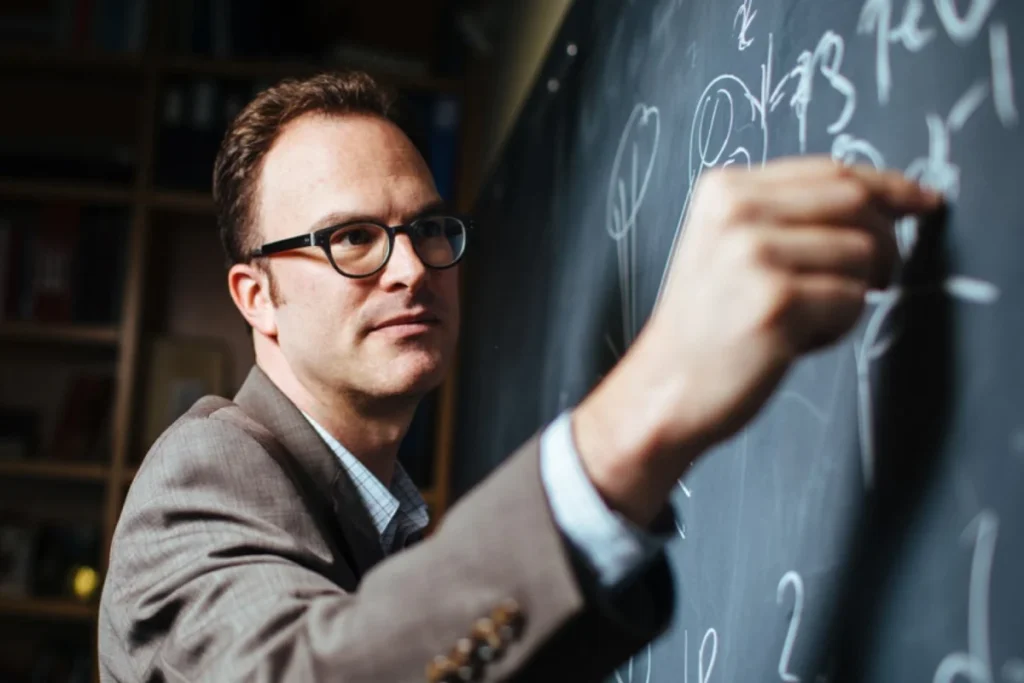
The Massachusetts Institute of Technology (MIT) has officially announced the appointment of Professor Jesse Thaler as the new director of the Laboratory for Nuclear Science (LNS), effective August 1. Thaler, a distinguished theoretical particle physicist, succeeds Professor Bolek Wyslouch, who has steered the laboratory through a decade of significant growth and scientific advancement. This transition marks a pivotal moment for the LNS, one of MIT’s oldest and most expansive interdisciplinary research hubs, as it increasingly integrates artificial intelligence (AI) and machine learning (ML) into the bedrock of fundamental physical inquiry.
Thaler’s appointment comes at a time when the field of high-energy physics is grappling with an unprecedented influx of data from global experiments, most notably from the Large Hadron Collider (LHC) at CERN. As the William and Emma Rogers Professor of Physics in the MIT Center for Theoretical Physics—now designated as the Leinweber Institute (CTP-LI)—Thaler has built a reputation for pioneering work that bridges the gap between abstract quantum field theory and the practical application of AI. His leadership is expected to solidify MIT’s position at the vanguard of the "AI for Science" movement, ensuring that the Laboratory for Nuclear Science remains a cornerstone of discovery in an increasingly computational era.
A Vision for AI-Driven Discovery
Nergis Mavalvala, the dean of the MIT School of Science and the Curtis and Kathleen Marble Professor of Astrophysics, expressed high confidence in Thaler’s ability to lead the LNS into its next chapter. Mavalvala highlighted Thaler’s unique ability to combine traditional physics methodologies with modern computational tools. "In his research, Jesse has done pioneering work on particle jets at the Large Hadron Collider and is a leader in combining AI and machine learning with fundamental particle physics," Mavalvala stated. She further emphasized that the collaborative nature of Thaler’s research programs is perfectly suited for the LNS as the scientific community enters an era where AI-driven discovery is no longer a peripheral tool but a core necessity.
Thaler’s research primarily focuses on the "data deluge" generated by modern collider experiments. When subatomic particles collide at nearly the speed of light, they produce complex sprays of particles known as jets. Deciphering the information contained within these jets requires sophisticated algorithms capable of identifying patterns that are often invisible to traditional statistical methods. Thaler has been a vocal advocate for using AI not just to process this data more quickly, but to perform "heroic theoretical calculations" that were previously considered computationally impossible.
"In my own field of particle physics, researchers are developing cutting-edge AI algorithms to handle the data deluge from collider experiments and to perform heroic theoretical calculations," Thaler remarked regarding his new role. He noted that while these algorithms are developed to solve specific problems in physics, their utility often extends far beyond the laboratory, influencing broader fields of data science and industrial AI applications.
The Legacy and Evolution of the Laboratory for Nuclear Science
Established in 1946, the Laboratory for Nuclear Science was founded in the wake of World War II to provide a formal structure for MIT’s extensive research into nuclear and particle physics. In the nearly eight decades since its inception, the scope of the LNS has expanded dramatically. While its name remains rooted in nuclear science, its current research portfolio encompasses a vast array of disciplines, including cosmology, gravity, field theory, and quantum information science.
Under the outgoing leadership of Professor Bolek Wyslouch, the LNS maintained its status as a premier center for experimental and theoretical physics. Wyslouch, an experimentalist who played a key role in the CMS experiment at the LHC, oversaw a decade of participation in some of the world’s most ambitious scientific endeavors. Thaler’s appointment signals a strategic shift toward the theoretical and computational frameworks that will define the next fifty years of the laboratory’s mission.
As the head of LNS, Thaler will also oversee his home center, the CTP-LI. This center recently gained significant momentum following a transformative donation from the Leinweber Foundation. This gift was intended to establish a network of theoretical physics research institutes, a move that the Science Philanthropy Alliance described as the largest philanthropic commitment ever made to the field of theoretical physics. This financial backing provides the LNS and CTP-LI with the resources necessary to recruit top-tier talent and pursue high-risk, high-reward research that traditional government grants might not cover.
Transition of Leadership at IAIFI
Thaler’s move to the directorship of the LNS necessitates a transition in his previous leadership role. Since 2020, Thaler has served as the inaugural director of the National Science Foundation (NSF) AI Institute for Artificial Intelligence and Fundamental Interactions (IAIFI). The IAIFI was established as one of the flagship institutes designed to advance AI research by grounding it in the laws of physics, while simultaneously using AI to unlock new physical laws.
Under Thaler’s guidance, the IAIFI became a model for interdisciplinary collaboration. The institute was recently renewed for another five-year term, a testament to the success of its initial mission. Stepping into Thaler’s shoes as the director of IAIFI is Mike Williams, a professor of physics at MIT known for his work on the LHCb experiment and his expertise in data analysis.
The synergy between the IAIFI and the LNS is expected to strengthen under this new leadership structure. The LNS is also preparing to engage with the Department of Energy’s (DOE) Genesis Mission. The Genesis Mission is a strategic initiative focused on AI-enabled scientific discovery, aiming to accelerate the development of new materials, energy sources, and fundamental knowledge through the integration of AI into the research pipeline. Thaler’s dual expertise in physics and AI makes the LNS an ideal partner for these federal initiatives.
Cultivating the Next Generation of Scientists
One of Thaler’s most significant contributions during his tenure at IAIFI was his focus on education and the professional development of early-career researchers. He was instrumental in creating a unique doctoral program in physics, statistics, and data science, developed in collaboration with the MIT Institute for Data, Systems, and Society (IDSS). This program addresses a growing demand for scientists who are "bilingual" in both the physical sciences and advanced computational methods.
Furthermore, Thaler championed the creation of dedicated postdoctoral fellowships at IAIFI. These fellowships are designed to give young researchers the freedom to work across traditional departmental boundaries, fostering an environment where innovation can flourish without the constraints of siloed academic structures.
"Giving young scientists space to build connections across domains, universities, and career stages has been transformative within IAIFI," Thaler said. He expressed a strong desire to bring this framework to the LNS, emphasizing that the future of nuclear and particle physics depends on the ability of the next generation to navigate complex data landscapes and interdisciplinary collaborations.
Biographical Background and Career Milestones
Jesse Thaler’s journey to the directorship of the LNS is marked by a history of academic excellence and leadership at prestigious institutions. He earned his Bachelor of Science in math and physics from Brown University in 2002, followed by a PhD in physics from Harvard University in 2006. His doctoral work laid the foundation for his later interest in the mathematical structures of particle interactions.
Following his PhD, Thaler was awarded a fellowship at the Miller Institute for Basic Research in Science at the University of California at Berkeley, where he served from 2006 to 2009. He joined the MIT faculty in 2010, quickly rising through the ranks to become a full professor and a key figure in the Center for Theoretical Physics.
Throughout his career, Thaler has received numerous accolades for his research, including the Early Career Research Program award from the Department of Energy and various teaching awards within the MIT Department of Physics. His work on "N-subjettiness" and other jet substructure techniques has become standard in the analysis of LHC data, directly contributing to the search for new physics beyond the Standard Model.
Broader Implications and Future Outlook
The appointment of a director with such a heavy focus on AI signals a broader trend in the global scientific community. As experiments grow in scale and complexity—such as the upcoming High-Luminosity LHC upgrade, which will increase the data rate by an order of magnitude—traditional human-led analysis becomes a bottleneck. The integration of AI into the "trigger" systems (which decide in real-time which data to keep) and the offline analysis phase is no longer optional.
Thaler’s leadership of the LNS will likely influence how other major laboratories, such as Fermilab in the United States or CERN in Europe, approach the integration of machine learning. By demonstrating that AI can be used to perform "heroic theoretical calculations," Thaler is helping to dispel the notion that AI is merely a "black box" and instead positioning it as a rigorous tool for theoretical advancement.
The Laboratory for Nuclear Science, under Thaler, is poised to remain a hub for diverse research. From exploring the earliest moments of the universe to developing the quantum technologies of the future, the laboratory’s mission remains as broad as ever. However, the methodology will now be increasingly defined by the fusion of physical intuition and algorithmic power.
As Thaler begins his tenure on August 1, the MIT community and the broader scientific world will be watching closely. The transition from Professor Bolek Wyslouch to Professor Jesse Thaler represents more than just a change in personnel; it represents the formal embrace of a new scientific paradigm where the laws of nature and the logic of artificial intelligence are explored as one. With the support of the NSF, the DOE, and substantial philanthropic backing from the Leinweber Foundation, the Laboratory for Nuclear Science is well-equipped to lead this new wave of discovery.