A groundbreaking new study published by a team of researchers, including the article’s authors, suggests that the universe may not be as uniform and symmetrical as previously assumed. This challenges a cornerstone of modern cosmology, proposing that the cosmos could be inherently "asymmetric" or "lopsided," meaning its properties might not appear the same in every direction. This revelation stems from an investigation into the "cosmic dipole anomaly," an observed discrepancy that could necessitate a significant re-evaluation of the widely accepted standard cosmological model.
The Foundation of Cosmic Symmetry: A Historical Overview
For decades, the prevailing scientific consensus has been built upon the "standard cosmological model," formally known as the Lambda-CDM (Lambda-Cold Dark Matter) model. This model provides the most comprehensive description of the universe’s dynamics, structure, and evolution, from the Big Bang to the present day. At its heart lies a fundamental assumption: that the universe is "isotropic" (looks the same in all directions) and "homogeneous" (looks the same everywhere) when averaged over sufficiently large scales. These twin principles are encapsulated in the Friedmann-Lemaître-Robertson-Walker (FLRW) metric, a solution to Albert Einstein’s equations of general relativity that describes a spatially homogeneous and isotropic universe.
The FLRW metric’s elegance and its ability to simplify the otherwise intractable equations of general relativity have made it indispensable for cosmologists. It allowed for the development of a coherent framework to understand the expansion of the universe, the formation of large-scale structures, and the evolution of cosmic matter and energy. The initial observations that supported this symmetric vision were compelling, particularly the discovery of the Cosmic Microwave Background (CMB).
The Cosmic Microwave Background: An Echo of Creation
The Cosmic Microwave Background (CMB) is the faint, omnipresent radiation left over from the Big Bang, often referred to as the "afterglow of creation." Discovered serendipitously in 1964 by Arno Penzias and Robert Wilson, the CMB provided definitive proof for the Big Bang theory. Its remarkable uniformity across the entire sky, varying by only one part in a hundred thousand, initially served as powerful evidence for the universe’s assumed isotropy and homogeneity. This near-perfect uniformity solidified cosmologists’ confidence in modeling the universe using the maximally symmetric FLRW description of space-time. Subsequent missions like COBE, WMAP, and Planck have refined these measurements, consistently showing a universe that is incredibly smooth on vast scales.
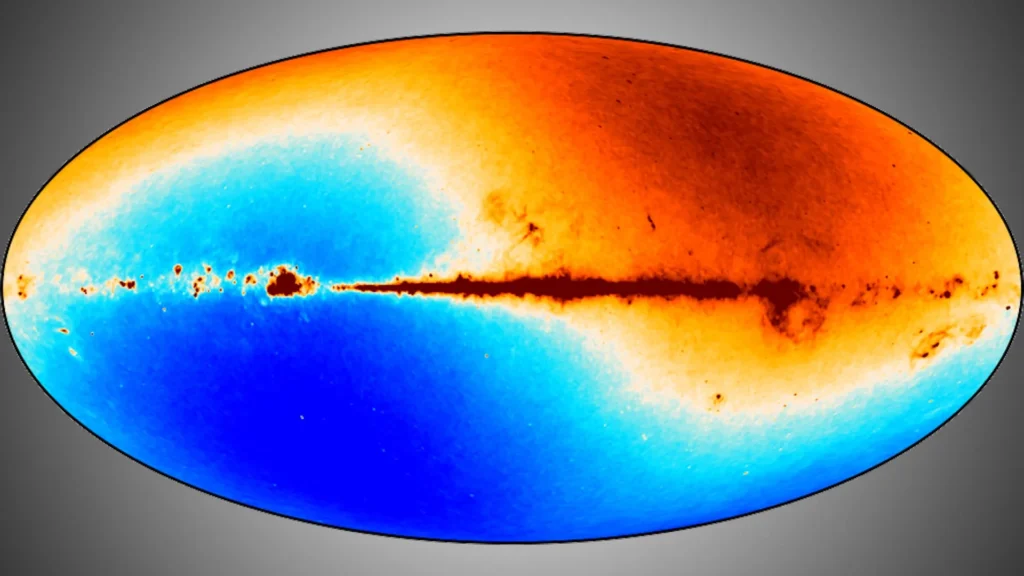
However, even within this remarkable uniformity, subtle variations exist. One of the most significant of these is the CMB dipole anisotropy. This phenomenon manifests as a slight temperature difference in the CMB across the sky: one side appears marginally hotter, and the opposite side cooler, by approximately one part in a thousand. This specific anisotropy has traditionally been interpreted as a consequence of our own local motion – the Solar System, along with the Milky Way galaxy, moving through the cosmic rest frame defined by the CMB. In this interpretation, the CMB dipole is a kinematic effect, akin to the Doppler shift of sound waves, and thus does not challenge the fundamental assumptions of the Lambda-CDM model or the FLRW description. It merely indicates our velocity relative to the cosmic background.
Emerging Tensions: Cracks in the Standard Model
Despite the successes of the Lambda-CDM model, several "tensions" or disagreements in cosmological data have emerged over the past two decades, posing significant challenges to its completeness and accuracy. These tensions represent inconsistencies between measurements derived from different cosmic epochs or different observational techniques.
One of the most widely debated of these is the "Hubble tension." Named after Edwin Hubble, who famously discovered the expansion of the universe in 1929, this tension refers to a persistent discrepancy in the measured rate of cosmic expansion, known as the Hubble constant ($H_0$). Measurements of $H_0$ derived from the early universe (e.g., from CMB data, assuming the Lambda-CDM model) are significantly lower than those obtained from observations of the nearby, more recent universe (e.g., using supernovae and Cepheid variables, primarily from the Hubble Space Telescope and recent data from the Gaia satellite). This mismatch, often differing by about 8-10%, suggests that either there’s new physics at play, or there’s a systematic error in our measurements, or the standard cosmological model itself requires modification. The Hubble tension has spurred intense research, with cosmologists exploring various avenues for resolution, from modifications to dark energy to new fundamental particles.
However, the new study highlights a different, and potentially even more fundamental, challenge: the cosmic dipole anomaly. While it has received less public and scientific attention than the Hubble tension, its implications could be far more profound, striking at the very core of the universe’s assumed symmetry.
Unpacking the Cosmic Dipole Anomaly: The Ellis-Baldwin Test
To understand the cosmic dipole anomaly, we must return to the CMB dipole anisotropy. While the traditional explanation attributes it solely to our local motion, a critical question arises: if the universe is truly isotropic and homogeneous on large scales, then this observed CMB dipole should have a corresponding imprint on the distribution of matter throughout the cosmos.
In 1984, cosmologists George Ellis and John Baldwin formalized this expectation into what is now known as the "Ellis-Baldwin test." They proposed that if the FLRW assumption of a symmetrical universe is correct, then the large-scale distribution of distant astronomical sources – such as radio galaxies and quasars – should exhibit a similar "dipole anisotropy" that is directly consistent with the observed CMB dipole. The crucial caveat is that these sources must be extremely distant. Nearby sources could create a spurious "clustering dipole" due to local gravitational inhomogeneities, which would not reflect the intrinsic large-scale structure of the universe.
The essence of the Ellis-Baldwin test is elegant:
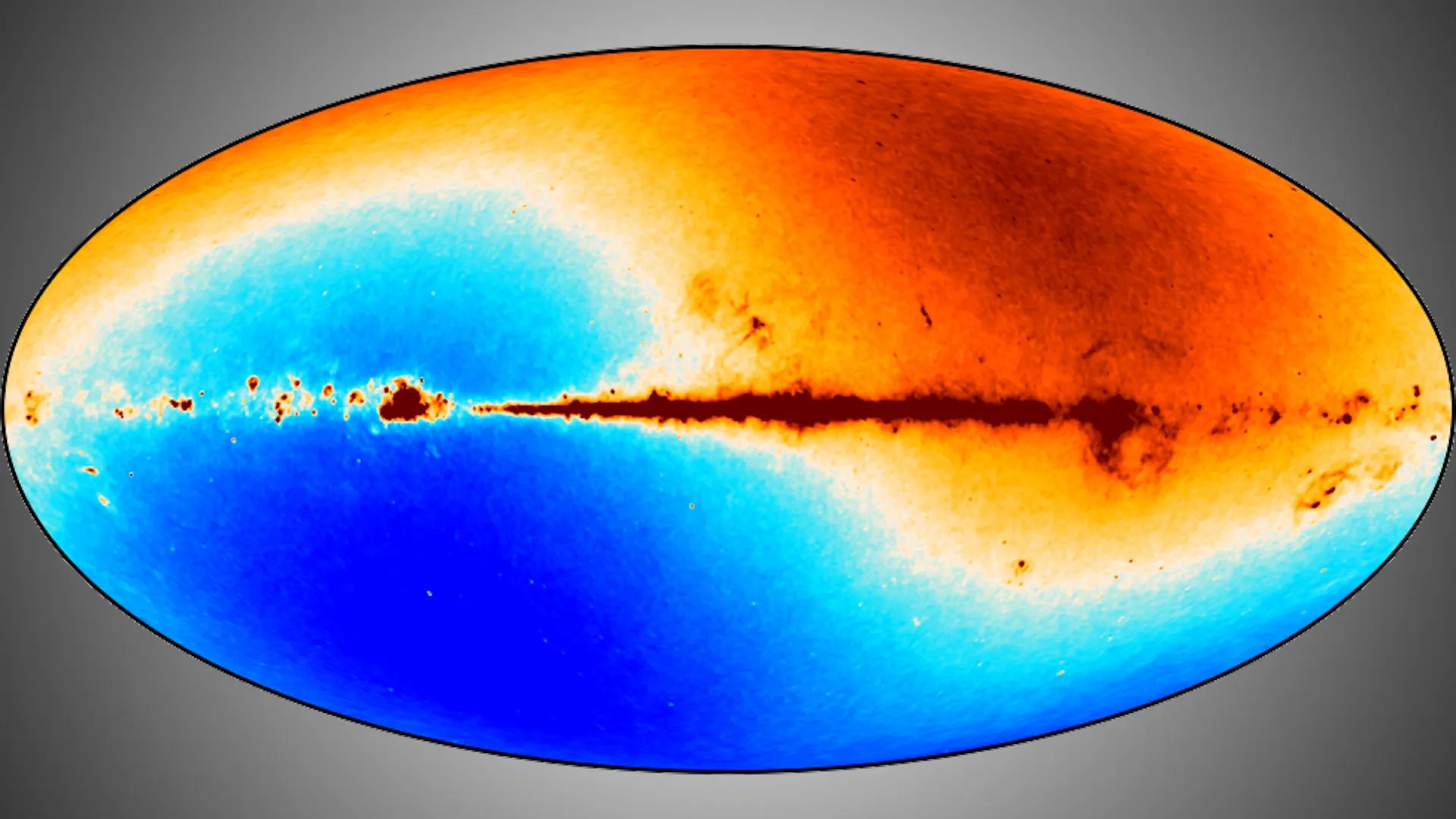
- We observe a dipole in the CMB, attributed to our peculiar velocity.
- If the universe is FLRW, then our motion should also manifest as an apparent dipole in the number counts and brightness of distant objects. Objects in the direction of our motion would appear blueshifted (brighter and more numerous), and those opposite would appear redshifted (dimmer and fewer).
- The direction and magnitude of this "matter dipole" should precisely match that of the CMB dipole, as both are consequences of the same local motion within a globally symmetric universe.
For decades, performing the Ellis-Baldwin test with sufficient precision was challenging due to the lack of extensive, deep, and uniform astronomical catalogues of distant sources. However, recent advances in observational astronomy, with powerful terrestrial radio telescopes and orbiting satellites capable of observing at various wavelengths (from radio to mid-infrared), have finally provided the necessary data.
The Universe Fails: Evidence of Intrinsic Asymmetry
The new paper, based on an exhaustive analysis of these newly available data catalogues, delivers a startling conclusion: the universe fails the Ellis-Baldwin test. The variation in the distribution of distant matter, specifically the observed dipole anisotropy in radio galaxies and quasars, does not match the variation observed in the Cosmic Microwave Background.
This discord is not easily dismissed. The study emphasizes that the results are robust, showing consistency across different observation methods and wavelengths. Whether using terrestrial radio telescopes to map radio galaxies or satellites observing at mid-infrared wavelengths for other distant sources, the same fundamental discrepancy emerges. This cross-validation strengthens the findings, reducing the likelihood that the anomaly is merely an artifact of a specific instrument or observational technique.
The implications are profound. If the matter dipole does not align with the CMB dipole, it suggests that the CMB dipole might not be solely due to our local motion, or, more drastically, that the underlying assumption of an isotropic and homogeneous universe (the FLRW description) itself is flawed. Instead of merely moving through a symmetrical universe, we might be residing in a universe that is intrinsically "lopsided" – a cosmic landscape where fundamental properties vary depending on the direction of observation, even after accounting for local motion.
Profound Implications for Fundamental Physics
The cosmic dipole anomaly, therefore, establishes itself as a major challenge to the standard cosmological model, the Lambda-CDM framework. Unlike the Hubble tension, which might be resolved by tweaking parameters or introducing minor modifications within the existing framework (e.g., an early dark energy component), the cosmic dipole anomaly strikes at a more fundamental level. It challenges the very geometry of space-time that underpins the FLRW metric.
If the FLRW description is indeed inadequate, it means that the universe’s largest scales might not be well-described by a perfectly uniform and isotropic model. This is not an easy problem to patch up. It would require abandoning not just the Lambda-CDM model as we know it, but potentially going "back to square one" in our fundamental understanding of cosmology.
What would "going back to square one" entail?
- Revisiting General Relativity: While General Relativity remains incredibly successful on solar system scales, its application to the entire cosmos under the FLRW assumption might need reconsideration. Could there be an intrinsic asymmetry or preferred direction in the universe that necessitates a more complex solution to Einstein’s equations?
- Rethinking Dark Energy and Dark Matter: The Lambda-CDM model relies heavily on the FLRW framework to infer the existence and properties of dark energy and dark matter. If the spatial geometry is different, the interpretations of these mysterious components could also change dramatically.
- New Cosmological Models: Cosmologists might need to explore "anisotropic" or "inhomogeneous" cosmological models, which are far more complex mathematically but could better fit the observed data. These models would depart from the simple, symmetrical universe that has guided research for so long.
- The Early Universe: The conditions of the very early universe, particularly the inflationary epoch believed to smooth out initial inhomogeneities, might need to be re-examined if the universe retains an intrinsic lopsidedness today.
The reluctance of some in the astronomical community to fully embrace this anomaly might stem from its sheer disruptive potential. The FLRW framework is deeply embedded in nearly all theoretical and observational cosmological work, and dismantling it would require a massive intellectual overhaul.
The Scientific Community’s Response and Future Outlook
While the cosmic dipole anomaly has historically received less attention than other cosmological tensions, its increasing observational robustness means it can no longer be ignored. The scientific community is now faced with a fundamental question: how to reconcile this observed asymmetry with a model built on perfect symmetry.
The coming years are poised to deliver an unprecedented "avalanche of data" from a new generation of sophisticated observational facilities. Missions like the European Space Agency’s Euclid satellite, NASA’s SPHEREx mission, the Vera C. Rubin Observatory, and the Square Kilometre Array (SKA) will provide vastly more precise and extensive catalogues of distant galaxies and quasars. This deluge of information will allow for even more rigorous testing of the Ellis-Baldwin criterion and other probes of cosmic isotropy.
Crucially, these vast datasets are also expected to drive innovation in data analysis. Advanced computational methods, particularly in the realm of artificial intelligence (AI) and machine learning, are becoming indispensable tools for sifting through petabytes of astronomical data, identifying subtle patterns, and potentially constructing entirely new cosmological models. AI could help explore complex, non-FLRW geometries and parameter spaces that are beyond the reach of traditional analytical methods.
The implications of confirming an intrinsically asymmetric universe would be truly monumental, echoing paradigm shifts in physics history such as the Copernican revolution or Einstein’s theory of relativity. It would not only reshape our understanding of the universe’s large-scale structure and evolution but also force a re-evaluation of fundamental physical laws on cosmic scales. Such a discovery would fundamentally alter our perception of our place in the cosmos, moving from a perfectly uniform and directionless backdrop to one that possesses an inherent cosmic orientation. This period of cosmological research, driven by both persistent anomalies and powerful new observational tools, promises bold new insights into the ultimate nature of our universe.