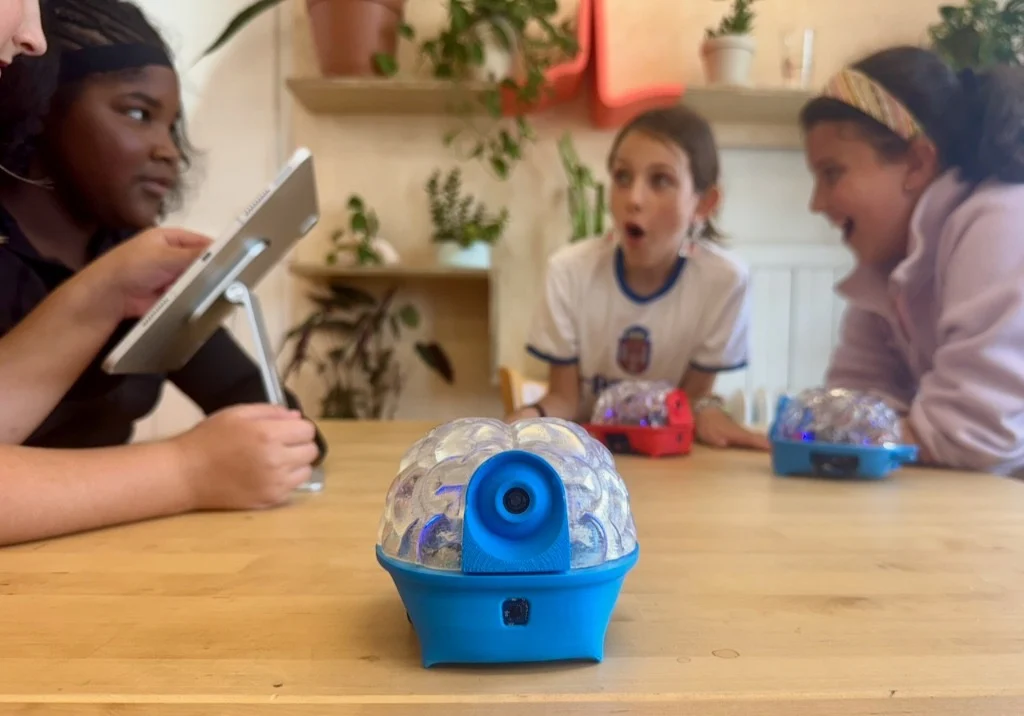
A groundbreaking educational robot, SpikerBot, developed by Backyard Brains, is poised to revolutionize how students and enthusiasts engage with neuroscience and robotics. This innovative device offers an unprecedented opportunity to program life-like behaviors using a novel, neuron-based interface, effectively demystifying complex biological principles and making robotics more intuitive and accessible. Departing from traditional text-based coding or abstract logical statements, SpikerBot’s app allows users to construct virtual neural circuits, fostering an understanding of how intelligence and behavior emerge from interconnected neurons and synapses.
Bridging the Neuroscience Education Gap
Backyard Brains, co-founded by CEO Greg Gage, along with designer Alex Hatch, has consistently aimed to democratize neuroscience education. Their latest creation, SpikerBot, directly addresses a critical gap in scientific literacy. As Gage and Hatch explain, conventional education often teaches students about individual neurons in elementary school, but then largely neglects the subject until higher education, where the intricate workings of millions of neurons are explored. This creates a vast chasm in understanding, akin to learning about a single transistor and then immediately jumping to advanced Python programming without any foundational knowledge of electronics. SpikerBot seeks to bridge this divide, offering a tangible, interactive platform for understanding the intermediate complexities of neural networks.
The challenge of neuroscience literacy is significant. According to the National Academies of Sciences, Engineering, and Medicine, public understanding of brain science lags behind other scientific disciplines, despite the profound impact neurological conditions have on society. Statistics from organizations like the World Health Organization indicate that neurological disorders affect over one billion people worldwide, underscoring the urgent need for greater public awareness and scientific engagement. By making neural circuit design hands-on and experiential, SpikerBot provides a foundational understanding that can foster future scientists, medical professionals, and informed citizens.

Inspired by Biological Principles: The Braitenberg Legacy
The philosophical underpinning of SpikerBot draws heavily from Valentino Braitenberg’s seminal 1984 book, Vehicles: Experiments in Synthetic Psychology. Braitenberg demonstrated how remarkably complex and "lifelike" behaviors could emerge from simple connections between sensors and motors in a robot, without the need for sophisticated internal logic or memory. His "vehicles" responded directly to stimuli, creating seemingly intelligent actions purely through their architecture. SpikerBot embodies this principle, allowing users to design robots that react to their environment in ways that feel organic and intuitive, rather than pre-programmed.
This bio-inspired approach contrasts sharply with traditional robotics programming, which often requires a strong grasp of computational logic, algorithms, and debugging. While these skills are valuable, they can be a significant barrier to entry for many, potentially draining the fun out of robotics for beginners. SpikerBot bypasses this initial hurdle, enabling users to witness emergent behaviors almost immediately, reinforcing the idea that complex systems can arise from simple, interconnected components – a core concept in neuroscience.
A Revolutionary Visual Programming Language
At the heart of SpikerBot’s accessibility is its unique app, which serves as a visual programming environment. Instead of lines of code, users interact with a digital "brain" where they can drag, drop, and connect virtual neurons and axons. This interface is less like a text editor and more like a modular synthesizer patch bay, where the entire circuit is visible at a glance. The developers proudly state, "there’s no code, no LLMs, just neurons, synapses, and behavior emerging from a circuit a kid designed." This declaration highlights their commitment to a biologically authentic and intuitive learning experience.

The visual nature of the app allows for an immediate, holistic understanding of the robot’s "brain." Users can observe how changes to a single neuron or synaptic connection propagate through the system, influencing the robot’s movement and reactions. This real-time feedback mechanism is a crucial pedagogical tool. As soon as a user alters a neuron from excitatory to inhibitory, for instance, they can instantly observe the corresponding change in the robot’s behavior. This rapid iteration encourages experimentation, allowing for a fast-paced cycle of hypothesis, test, and observation, which is fundamental to scientific discovery. This instant gratification is designed to keep users engaged longer, fostering a deeper, more intuitive grasp of neural function.
Interestingly, this neuron-centric programming paradigm flips traditional robotics challenges. Behaviors that are typically difficult for beginner robotics, such as a robot following a person, become remarkably simple with SpikerBot – achievable with as few as two neurons. Conversely, tasks that are trivial in traditional computer programming, like counting in binary, become surprisingly intricate when mapped onto a neural network, requiring a complex web of connections. This inversion provides a fresh perspective on computational thinking and highlights the inherent differences between algorithmic and biological intelligence.
Hardware and Sensory Integration for Dynamic Interaction
The SpikerBot itself is a testament to thoughtful design, both aesthetically and functionally. Modeled after Backyard Brains’ brain-shaped logo, the robot is equipped with an array of sensors that allow it to perceive and react to its real-world environment. These include a camera for visual input, a microphone for auditory cues, and a distance sensor for spatial awareness. Its outputs are equally well-crafted, featuring lights that fade in and out like bioluminescent cells and charming, quirky sound effects designed to mimic natural responses rather than mechanical ones.
The physical chassis also incorporates connection points for 3D-printed attachments, encouraging further customization and creative expression. This feature allows users to personalize their SpikerBot, transforming it into a "dragon," a "cat," or any other creature, further enhancing the imaginative play and learning experience. For instance, a "cat behavior" model demonstrates how a SpikerBot can track a ball of yarn or react to a real feline, showcasing the flexibility and responsiveness of its neural programming.

Beyond its internal sensors, SpikerBot supports peripherals, including Backyard Brains’ existing Spiker:bit board. This expandability allows for even more advanced experimentation, such as controlling the robot using muscle signals from a user’s own arm, bridging the gap between biological signals and robotic action. This integration of human biometrics with robotics offers a truly immersive and personal learning experience, deepening the understanding of electromyography and neural interfaces.
Curriculum and Long-Term Educational Impact
The development of SpikerBot was informed by extensive feedback from both child educators and professional neuroscientists, ensuring its pedagogical soundness and scientific accuracy. The app includes a library of sample brain models, allowing users to deconstruct, modify, and learn from pre-built circuits. This curated learning path guides users through fundamental neurological patterns, such as recurrent pairs, lateral inhibition, and the mechanics of working memory, providing a hands-on introduction to concepts typically reserved for advanced courses.
The broader implications of SpikerBot extend beyond traditional STEM education. By fostering an intuitive understanding of basic brain patterns, the robot can significantly contribute to neuroscience literacy. Given that approximately 1 in 5 people experience some form of neurological condition – ranging from epilepsy and Parkinson’s disease to autism spectrum disorders and depression – a shared language and foundational understanding of brain function can lead to greater empathy, reduced stigma, and an informed public capable of engaging with complex health discussions. It provides a tangible way to understand "what’s happening with various neurological conditions" by demystifying the underlying neural mechanisms.
Designed for Longevity and Community Engagement

Backyard Brains has also demonstrated a commitment to long-term sustainability and user accessibility. The SpikerBot app is completely free, eliminating subscription barriers, and notably, it does not require cloud-based authentication to function. This ensures that the learning experience remains independent of internet connectivity or server availability, providing reliable access for all users.
Furthermore, the robot itself is designed with longevity in mind. It operates on easily-swappable AA batteries, consciously eschewing the trend of non-replaceable, constantly decaying lithium-ion cells. To support optimal performance and environmental responsibility, Backyard Brains offers its own custom, high-performance NiMH AA batteries, providing a rechargeable and sustainable power solution. These design choices reflect a philosophy that prioritizes user empowerment and product lifespan over planned obsolescence.
The SpikerBot project launched on Kickstarter, with the campaign concluding on June 14. Early backers could secure a SpikerBot for $219, a significant discount from the eventual retail price of $299. Backyard Brains has a proven track record of successfully delivering on crowdfunding campaigns, inspiring confidence in their ability to bring this ambitious project to fruition. Their previous educational tools, like the SpikerBox, have garnered critical acclaim and widespread adoption in classrooms and homes globally.
Looking ahead, the development team envisions an evolving platform. While SpikerBot already boasts a rich set of behaviors and capabilities, much of its potential remains to be unlocked by the user community. As Alex Hatch aptly puts it, "a lot we haven’t seen because you guys haven’t built anything yet." This open-ended approach encourages creativity and collaborative discovery, positioning SpikerBot not just as a product, but as a dynamic tool for collective exploration into the fascinating world of emergent intelligence and biological computation. The future capabilities of SpikerBot will undoubtedly be shaped by the ingenuity and imagination of its users, making it a truly interactive and evolving educational platform.