In the intricate world of motion control, where precision and safety are paramount, fractional-horsepower gearmotors serve a myriad of specialized applications. Among the various gear configurations, worm gearing is often selected by OEM design engineers for its distinctive "self-locking" characteristic. This property, seemingly advantageous for maintaining a position without continuous power input, is, however, frequently misunderstood and consequently misapplied, leading to significant safety hazards and operational inefficiencies. The critical distinction lies in recognizing that the self-locking nature of a worm gear assembly provides a static hold, not a dynamic braking capability, a nuance that carries profound implications for system design and user safety.
Understanding Worm Gear Mechanics and Self-Locking Principles
Worm gears are a specific type of gear configuration consisting of a worm (a screw-like gear) and a worm wheel (a spur gear or helical gear that is specially cut to mesh with the worm). This arrangement allows for large speed reductions in a compact space and, under certain conditions, exhibits the phenomenon known as self-locking. The mechanism behind self-locking is primarily attributed to the high friction between the worm and the worm wheel, combined with a small helix angle (or lead angle) of the worm.
When a worm gear is self-locking, it means that the worm wheel cannot drive the worm. In other words, applying torque to the output shaft (worm wheel) will not cause the input shaft (worm) to rotate. This unidirectional power flow is highly desirable in applications where a load must be held in position without constant motor engagement. The degree of self-locking depends on several factors, including the lead angle of the worm, the coefficient of friction between the worm and wheel materials, and the reduction ratio. Generally, a smaller lead angle and higher friction increase the likelihood and effectiveness of self-locking. For instance, lead angles typically below 5 degrees, coupled with appropriate material selection and lubrication, often result in a self-locking condition. Common material pairings like bronze worm wheels with hardened steel worms are chosen for their wear resistance and frictional properties that support this characteristic.

However, this inherent friction, while enabling self-locking, also contributes to lower efficiency compared to other gear types like spur or helical gears. A significant portion of the input power is converted into heat due to sliding friction, which must be managed through proper design and cooling. This trade-off between self-locking capability and efficiency is a critical consideration for engineers. Crucially, the "locking" behavior is contingent on the system being in a static, or stopped, state.
Static Hold vs. Dynamic Braking: A Crucial Delineation
The core of the misunderstanding surrounding self-locking gearmotors lies in conflating a static holding capability with dynamic braking. When engineers envision a "self-locking gearbox," they might mistakenly assume that cutting power will cause a moving axis to rapidly decelerate and then hold its position. This assumption is fundamentally flawed.
A worm gearmotor-driven axis possesses inertia – the tendency of a moving object to continue in motion unless acted upon by an external force. If electrical input to the motor is removed while the system is in motion, the inertia of the load will cause the axis to continue turning. The self-locking characteristic of the worm gear assembly only manifests after the system has already come to a complete stop. It is a mechanism for maintaining a static position, not for achieving a static position from a dynamic state.
To clarify, in this context, "dynamic braking" refers to an electromechanical design’s ability to actively slow or stop a moving axis. This is distinct from electrical braking methods like regenerative braking (where the motor acts as a generator, dissipating kinetic energy through resistors or feeding it back to the power supply) or dynamic braking via DC injection. True dynamic braking in a mechanical system requires a dedicated braking mechanism, such as an electromagnetic brake, a friction brake, or a hydraulic brake, specifically engineered to absorb and dissipate the kinetic energy of the moving load. These devices apply a counter-force to bring the system to a controlled halt, irrespective of the gear train’s inherent properties.

The consequences of misapplying self-locking gearmotors as dynamic brakes are severe. In safety-critical applications, such a misunderstanding could lead to uncontrolled motion, potential equipment damage, and, most importantly, serious injury or even fatalities. The uncontrolled coasting of a heavy load, even for a short duration, can have catastrophic results. Therefore, it is imperative for design engineers to clearly differentiate between the passive static holding offered by certain worm gear geometries and the active dynamic stopping provided by a dedicated braking system.
Applications Where Both Self-Locking and Dedicated Braking Are Essential
Many critical applications demonstrate the necessity of combining a self-locking gearbox with an actual, dedicated brake to ensure both dynamic control and static positional integrity. This hybrid approach leverages the strengths of each component for optimal performance and safety.
Stair Lifts and Mobility Applications
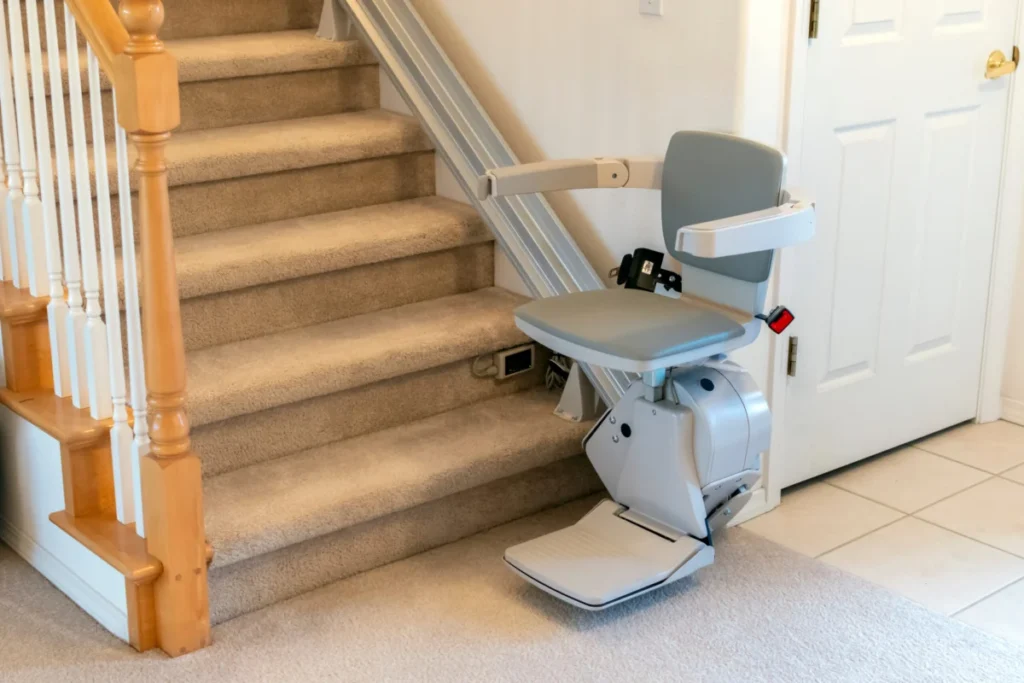
Consider stair lifts, which transport individuals up and down staircases. These systems demand exceptional safety and reliability. When a stair lift is in operation, it needs to move smoothly, but when it needs to stop—whether at the top, bottom, or an intermediate position—it must do so quickly and precisely. This rapid deceleration and stopping power are provided by an active brake, typically an electromagnetic brake. Once stopped, the system must hold its position securely, even if power is lost, to prevent the carriage from drifting or rolling back down the stairs due to gravity. This sustained, power-independent static hold is where the self-locking worm gearbox becomes invaluable. The brake handles the dynamic stopping, and the self-locking gear ensures the lift remains safely in place, prioritizing the passenger’s safety and comfort. Regulatory bodies, such as those enforcing ASME A17.1 (Safety Code for Elevators and Escalators) in North America or EN 81-40 (Stairlifts and Inclined Lifting Platforms) in Europe, mandate stringent safety requirements for such devices, often requiring redundant braking and holding mechanisms.
Commercial Rotisserie Ovens
In commercial kitchens, rotisserie ovens are used to roast meats, requiring the spits to rotate continuously. However, for safety reasons, when an oven door is opened for basting, checking, or removal, the rotation must cease immediately to prevent burns or contact injuries. Furthermore, if the load on the spits is unbalanced (e.g., two chickens on one side, none on the other), gravity can cause the spits to continue turning slowly even after the motor power is cut. Here, a dedicated brake is essential to bring the rotisserie spits to a complete and immediate halt when the door opens. Once stopped, the self-locking gearbox then takes over, ensuring the unbalanced load remains stationary, preventing any slow rotation that could still pose a burn risk or make meat removal difficult. This combination ensures operator safety and efficient operation.

Industrial Conveyor Systems
Another common application is industrial conveyor systems, especially those operating on inclines. To prevent items from rolling back down the conveyor when the system stops, particularly during power outages or emergency stops, a dedicated brake is crucial for dynamic stopping. This brake quickly brings the conveyor belt to a standstill. The self-locking worm gearbox then maintains the static position of the belt and its load, preventing rollback and ensuring that products remain securely in place until operations resume. This setup is vital for preventing product damage, maintaining operational flow, and ensuring worker safety around heavy or delicate loads.
Medical and Laboratory Equipment
In certain medical and laboratory equipment, such as adjustable patient tables, surgical robots, or precision microscopes, both dynamic stopping and static holding are critical. A brake ensures rapid and accurate positioning, stopping movement on command. The self-locking gear then holds the precise position without consuming continuous power, preventing drift or unwanted movement that could compromise medical procedures or experimental integrity.
Applications Demanding Backdrivability: When Gears Must Yield
Conversely, there are applications where the very opposite of self-locking is required: full backdrivability. In these scenarios, the gearmotor assembly must offer minimal resistance to external forces, allowing the driven axis to be easily moved or returned to a fail-safe position without power. While engineers may not explicitly ask for "backdrivable gearing," the need for low resistance to backdriving is often expressed through other operational requirements.
Railroad Crossing Gates
Railroad crossing gates represent a quintessential example of an application where backdrivability is a critical safety feature. In the event of a power failure, these gates must immediately fall down and block vehicle traffic. This is a crucial fail-safe mechanism because a power failure also means no other warning signals (lights, bells) will alert drivers to an oncoming train. This function relies on a gearbox that is designed to be easily backdriven, allowing the weight of the gate arm itself to bring it down into its protective, blocking position. The engineering challenge is significant, as the arms are often fitted with counterbalances to allow a relatively small, low-power motor to lift them. However, these counterbalances must not impede the gravity-assisted descent in an emergency. The Federal Railroad Administration (FRA) in the United States, and similar bodies globally, impose strict regulations on the reliability and fail-safe operation of such critical infrastructure, making backdrivability a non-negotiable design parameter.

Parking Garage Barrier Arms
Similar to railroad gates, barrier-arm gates on parking garages often require backdrivability. If the power fails, or if a driver loses their ticket and needs manual assistance, an attendant must be able to manually lift the gate. This necessitates an electromechanical assembly, including the motor’s gearbox, that offers minimal resistance to manual manipulation. Some designs might incorporate electronics with manual override mechanisms, but a mechanically backdrivable system provides a simpler, more robust solution for emergency access or operational flexibility. This ensures public convenience and prevents traffic bottlenecks during system malfunctions.
Manual Override Systems in Industrial Machinery
Many industrial machines, particularly those with automated positioning or clamping, incorporate manual override capabilities. For maintenance, setup, or in emergency situations, operators might need to manually adjust a component. A backdrivable gearbox allows for this manual intervention without requiring power or complex disengagement mechanisms, enhancing usability and safety. This is especially true for equipment that needs to be "parked" or moved to a safe position by hand after a power cut.
Industry Consensus and Best Practices for OEM Design Engineers
The persistent confusion surrounding "self-locking" gearmotor behavior has led some manufacturers, like Bodine Electric Co., to deemphasize the term in their marketing materials, opting instead for clearer descriptions of static holding capabilities. This reflects an industry-wide recognition of the need for greater clarity in technical specifications and application guidance.
OEM design engineers play a pivotal role in ensuring the correct application of these technologies. It is their responsibility to thoroughly understand the operational requirements of their systems, including dynamic braking needs, static holding requirements, and fail-safe mechanisms. Relying solely on a gear’s perceived self-locking property for dynamic stopping is a critical design flaw. Instead, engineers should:

- Clearly Define Requirements: Articulate whether dynamic stopping, static holding, or backdrivability is needed.
- Consult Application Engineers: Work closely with manufacturers’ application engineers, who possess deep expertise in gearmotor characteristics and suitable applications. Terry Auchstetter of Bodine Electric Co., for instance, highlights the value of such collaborations in guiding OEMs toward proper use.
- Specify Dedicated Components: If dynamic braking is required, specify a dedicated braking system. If static holding is paramount, confirm the gear geometry and reduction ratio ensure true self-locking under expected loads.
- Adhere to Safety Standards: Design always with relevant industry safety standards and regulations in mind (e.g., machinery directives, lift safety codes).
The emphasis should always be on a holistic system-level design that integrates all necessary components—motors, gearboxes, and brakes—to achieve the desired performance, efficiency, and, most importantly, safety profile.
The Broader Impact: Safety, Efficiency, and Engineering Responsibility
The nuanced understanding of self-locking gearmotors extends beyond mere technical correctness; it profoundly impacts safety, operational efficiency, and the professional responsibility of design engineers. Incorrect application can lead to preventable accidents, costly equipment damage, increased maintenance, and significant liability issues for manufacturers and end-users alike.
On the other hand, the judicious and informed application of self-locking worm gears, when combined with appropriate braking systems, offers real benefits. It can lead to more energy-efficient designs by eliminating the need for continuous motor power to hold a load, reduce wear on motor components, and simplify control systems for static positioning. The compact nature of worm gear drives, combined with their ability to provide high reduction ratios, makes them attractive for space-constrained applications, further underscoring the importance of their correct utilization.
In an increasingly automated world, where precision motion control is fundamental to industries ranging from manufacturing and robotics to healthcare and infrastructure, the education and adherence to best practices in mechanical engineering remain paramount. The ongoing evolution of gearmotor technology, including advancements in materials, lubrication, and integrated control systems, will continue to offer new possibilities. However, the foundational principles of mechanical operation, such as the distinction between static holding and dynamic braking, will remain timeless. Engineers must consistently exercise diligence in their specifications and design choices, ensuring that components are selected not just for their individual characteristics, but for how they contribute to the overall safety and functionality of the integrated system. This commitment to precision and safety is the bedrock of reliable and responsible engineering. For more information and detailed technical guidance, resources like Bodine Electric Co.’s website (bodine-electric.com) offer valuable insights from industry leaders.