The 2026 edition of Maker Faire Tokyo has once again transformed the halls of the Tokyo Big Sight into a sprawling laboratory of creativity, engineering, and whimsical innovation. As one of the premier events in the global maker movement, this year’s gathering emphasizes the unique intersection of high-precision Japanese engineering and the playful spirit of "Chindogu"—the art of inventing ingenious but seemingly unpractical gadgets. From industrial-grade button displays to autonomous miniature vehicles, the event serves as a critical barometer for the health of the grassroots innovation ecosystem in Asia.

The Tactile Revolution: Shimada Corporation’s OSEBA Exhibit
At the heart of this year’s interactive showcases is the OSEBA exhibit, a pop-up activation by the Shimada Corporation that builds upon the foundational human impulse to interact with the physical world. Under the provocative theme "No Push, No Life," the exhibit challenges the increasingly digital nature of modern existence by celebrating the tactile feedback of the physical button.
The centerpiece, titled "1000 Buttons," provides a massive array of switches, toggles, and push-buttons of varying sizes, resistances, and colors. This exhibit is not merely a novelty; it represents a sophisticated study in haptic feedback and user interface design. Accompanying the main array are competitive installations such as the "333 Heartbeat Button," a high-speed reflex challenge where participants attempt to illuminate as many buttons as possible within a 30-second window, and "Light Up and Pop," which tests the limits of human reaction time.

Industry analysts suggest that the popularity of such exhibits reflects a broader societal trend: a "digital fatigue" that is driving consumers and makers alike back toward physical, mechanical interfaces. For Shimada Corporation, the exhibit serves as a bridge between industrial manufacturing and public engagement, showcasing the precision required to produce components that humans interact with thousands of times daily.
Engineering the Mundane: The Evolution of Automatic Chopstick Splitting
Kazuya Shibata, a perennial favorite at Maker Faire Tokyo, returned in 2026 with the "Fully Automatic Chopstick Splitting Machine 2." This project exemplifies the "over-engineering" subculture within the maker community, where creators apply advanced robotics to solve trivial daily inconveniences with extreme precision.

Shibata’s latest iteration is a complete redesign of his 2019 prototype. The machine does more than simply split disposable wooden chopsticks; it automates the entire preparation process, including cutting and polishing. By utilizing sensors to detect the grain of the wood, the device minimizes the risk of uneven splits and splinters—a common frustration in Japanese dining. The 2026 model features improved torque control and a more refined user interface, demonstrating how hobbyist projects can evolve through iterative engineering into sophisticated pieces of mechatronics.
Transportation and Kinetic Innovation: From Beer Crates to Self-Balancing Cycles
The 2026 event also highlights a surge in DIY transportation and kinetic art. The "Beeeer-Car Club" introduced a German-inspired phenomenon to the Japanese public with the "Fahrende Bierkiste." This go-kart, built around a standard beer crate, is powered by a high-output internal combustion engine capable of reaching speeds of 60 km/h. While the gasoline-powered versions have gained a following on international social media platforms, the club used the Tokyo event to debut a safe, electric-powered prototype designed for urban environments and indoor exhibitions.

In the realm of miniaturized robotics, the "ROBOBIKE" stands as a testament to long-term technical dedication. A 160-gram mini bicycle robot, it utilizes an advanced angular velocity sensor for autonomous stability. The creator first devised the posture control algorithm 30 years ago, securing a utility model patent at the time. In 2026, the project has been fully realized through modern micro-controllers and lightweight materials, allowing the tiny bicycle to navigate complex paths without falling—a feat of balance that mimics the physics of full-scale motorcycles.
Pop Culture and Mixed Reality: The Omicro Flux
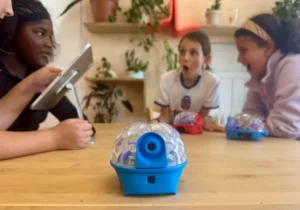
Bridging the gap between cinematic imagination and physical reality, the "Omicro Flux" spherical robot has drawn significant attention from fans of science fiction franchises like Star Wars and Gundam. The challenge of creating a rolling sphere that can stop, turn, and accelerate realistically is a complex problem in physics and robotics. The Omicro Flux utilizes a 10-wheel internal drive system to maintain momentum while keeping its internal components stable.

To enhance the experience for younger attendees, the developers released "Boundary Blur," a mixed reality (MR) application. By using MR headsets or smartphones, users can interact with the physical robot in a gamified environment, overlaying digital obstacles and objectives onto the physical floor of the convention center. This integration of physical hardware and augmented software represents a growing trend in the maker community toward multi-medium storytelling.
The Intersection of Gastronomy and Sound
Tokyo’s world-renowned food culture provided the inspiration for several media art installations that blend culinary arts with electronic music. The "Yakitori DJ" booth allows participants to "mix" tracks by arranging skewers on a grill-style turntable. Each skewer’s position corresponds to different audio samples and visual projections, turning the act of grilling into a performance art piece.

Similarly, freelance engineer Fumitaka Kimizuka, in collaboration with Yamato Honda, presented "Sequencer and Electric Relay." Following the success of a Chinese restaurant-style revolving table sequencer at a previous event, the 2026 iteration utilizes a revolving sushi (kaiten-zushi) belt. The system uses optical sensors to read the color, position, and speed of sushi plates, translating these variables into complex musical compositions. The speed of the belt dictates the tempo, while the specific "toppings" act as different synthesizers or drum kits.
Educational Foundations: Plarail and LEGO Automation
Maker Faire Tokyo continues to place a heavy emphasis on STEAM (Science, Technology, Engineering, Arts, and Mathematics) education through familiar toys. The University of Tokyo’s engineering club showcased a sophisticated "Automatic Turnaround Operation" system using Plarail, Japan’s iconic model train brand. By integrating micro-controllers and Bluetooth connectivity, the students implemented a railway block system—the same logic used in real-world train networks—to prevent collisions and allow for fully automated, bidirectional travel.

In the world of brick-building, the maker known as Tsubasa debuted the "LEGO Cashless Payment Vending Machine." Built almost entirely from LEGO components, including the internal motors and sensors, the machine integrates with modern smartphone payment systems. This project highlights the increasing accessibility of IoT (Internet of Things) technology, demonstrating that even traditional toys can be integrated into the modern digital economy with enough technical ingenuity.
Chronology and Context: The Growth of the Maker Movement
The Maker Faire brand, which originated with Make: Magazine in the United States in 2006, found a particularly fertile ground in Japan. The first "Make: Tokyo Meeting" was held in 2008, and it officially transitioned to "Maker Faire Tokyo" in 2012. Over the past 14 years, the event has grown from a small gathering of electronics enthusiasts to a massive multi-day festival attracting tens of thousands of visitors.

The 2026 event marks a significant milestone in the post-pandemic recovery of the maker scene. Attendance figures suggest a 15% increase in international exhibitors compared to 2024, with significant delegations from Germany’s Maker Faire Hannover and various maker spaces across Southeast Asia. This cross-pollination of ideas is evident in projects like the "Music Train" from the Music Research Institute, which recently debuted in Germany before arriving in Tokyo. The "Music Train" uses 12 rails tuned to the chromatic scale, creating a literal "symphony on tracks."
Broader Impact and Economic Implications
Beyond the spectacle, Maker Faire Tokyo 2026 has significant implications for Japan’s industrial future. The event serves as an informal incubator for startups and a recruitment ground for major technology firms seeking talent with hands-on prototyping experience.

The emphasis on "open-source hardware" and "distributed manufacturing" seen at the Faire aligns with global shifts toward localized production. As supply chains become more volatile, the ability for individuals and small collectives to design and build complex machines—like the LEGO vending machines or the autonomous ROBOBIKE—demonstrates a growing resilience in the grassroots technological sector.
Furthermore, the participation of established entities like the Shimada Corporation and the University of Tokyo indicates that the "maker" ethos is no longer confined to hobbyist garages. It has permeated academia and industry, fostering a culture of rapid prototyping and user-centric design that is essential for remaining competitive in the global tech landscape.

As the 2026 Faire concludes, the message is clear: the future of innovation is not just about digital code, but about the physical, tactile, and often whimsical ways in which we interact with our environment. Whether it is splitting a chopstick or racing a beer crate, the makers of Tokyo continue to prove that the most profound technological advancements often begin with the simple act of pushing a button.