In a landmark study that challenges long-standing assumptions in condensed matter physics, an international team of researchers has demonstrated that electrical resistance driven by particle collisions does not increase indefinitely but instead reaches a fundamental maximum limit. This discovery, achieved through the observation of ultracold potassium atoms, provides a new microscopic understanding of how resistivity develops in materials and could have profound implications for the development of future quantum technologies and more efficient energy transmission systems.
The research was a collaborative effort involving experimental atomic physicists from the University of Toronto, L’École Normale Supérieure in Paris, and Lehigh University in Pennsylvania. By cooling atoms to temperatures just fractions of a degree above absolute zero, the team was able to simulate the behavior of electrons in a solid with unprecedented precision. Their findings, published in the prestigious journal Physical Review Letters, reveal a phenomenon known as resistivity saturation, where the resistance of a system plateaus even as the frequency and strength of particle interactions continue to rise.
The Fundamental Challenge of Electrical Resistance
To understand the significance of this discovery, one must first consider the nature of electrical resistance. In conventional conductors, such as the copper wiring found in household electronics, resistance is caused by electrons bumping into impurities, defects in the crystal lattice, or other electrons. These collisions impede the flow of charge, and the kinetic energy of the moving particles is converted into heat.
According to Professor Joseph Thywissen of the Department of Physics and the Centre for Quantum Information and Quantum Control at the University of Toronto, the senior author of the study, this process is responsible for significant energy waste. "Electron-on-electron collisions are known to increase resistivity in some pure materials," Thywissen explains. "The energy produced by electrical resistance shows up as heat. Transmission lines, for instance, lose up to eight per cent of generated electrical power. Resistivity is also interesting to study because it can be a signature of new physics in materials."
For decades, physicists have sought to understand the limits of this resistance. In many "strange metals" or high-temperature superconductors, the relationship between temperature, particle density, and resistance behaves in ways that traditional theories cannot fully explain. The discovery of a maximum limit to collision-based resistance provides a critical piece of the puzzle, suggesting that there is a "speed limit" to how much particles can obstruct one another in a quantum system.
The Experimental Framework: Ultracold Atoms and Optical Lattices
The primary difficulty in studying electron collisions in solid materials is the inherent complexity of the environment. In a standard metal, electrons interact with a vibrating lattice of ions, impurities, and other electrons simultaneously, making it nearly impossible to isolate a single mechanism of resistance.
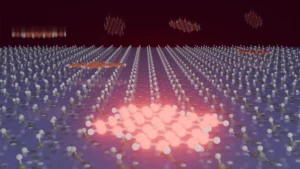
To overcome this, the research team utilized an "optical lattice"—a sophisticated experimental setup where counter-propagating laser beams create a standing wave of light. This light structure acts as a synthetic crystal, trapping ultracold potassium atoms in a grid that mimics the arrangement of atoms in a solid material. In this analogy, the neutral potassium atoms play the role of electrons, while the light grid plays the role of the metallic lattice.
The atoms were cooled to temperatures in the nanokelvin range, effectively stripping away thermal noise and allowing quantum mechanical effects to dominate. By adjusting the intensity of the lasers and the magnetic fields surrounding the atoms, the researchers could precisely control the frequency and strength of the collisions between the atoms. This level of control allowed them to recreate extreme physical conditions that are impossible to achieve in ordinary solid-state materials.
Observations of Quantum Enhancement and Saturation
As the experiment progressed, the team observed a surprising behavior in the "resistivity" of the atomic gas. Initially, as the frequency of collisions between the potassium atoms was increased, the resistance rose in a predictable, linear fashion. This aligned with classical expectations: more collisions equal more resistance.
However, as the interactions grew stronger, a quantum effect began to emerge. "We observed that the atoms, which are only a few nanometers in size, bump into each other as if they were much larger," says Thywissen. This phenomenon, referred to as the quantum enhancement of the effective atom size, makes collisions on any given site of the optical lattice much more likely.
Despite this increased likelihood of interaction, the resistance did not continue its upward trajectory. Beyond a specific threshold of interaction strength, the resistivity leveled off, reaching a plateau. This saturation suggests that there is a fundamental physical constraint on how much resistance can be generated by particle-to-particle scattering. Even when the "effective size" of the atoms grew and the system became more "crowded," the flow of particles could not be further impeded.
Chronology of the Discovery
The path to this discovery involved several years of theoretical modeling and experimental refinement. The timeline of the project highlights the rigorous nature of modern quantum research:
- Phase 1: Theoretical Modeling: Researchers at the University of Toronto and L’École Normale Supérieure began by developing mathematical models to predict how low-density fermions (the class of particles to which both electrons and potassium atoms belong) would behave in a periodic potential.
- Phase 2: Experimental Setup: The team at Toronto spent months calibrating the optical lattice and cooling systems to ensure the potassium atoms could be maintained at near absolute zero without escaping the light trap.
- Phase 3: Data Collection: Over several series of experimental runs, the team varied the "s-wave scattering length"—a parameter that dictates how strongly atoms interact—using Feshbach resonances. This allowed them to move from a regime of weak interaction to one of strong interaction.
- Phase 4: Discovery of the Plateau: In late 2023, the data clearly showed that the resistivity was no longer responding to increases in interaction strength. This prompted a deep dive into the microscopic data to confirm that the saturation was a real physical effect and not an experimental error.
- Phase 5: Validation and Publication: The results were cross-referenced with theoretical predictions from Lehigh University and eventually submitted for peer review, culminating in the publication in Physical Review Letters.
Supporting Data and Technical Analysis
The data gathered by the researchers indicates that the saturation occurs when the mean free path of the particles—the average distance a particle travels before colliding with another—becomes comparable to the wavelength of the particles themselves or the spacing of the lattice.
In the context of solid-state physics, this is related to the "Mott-Ioffe-Regel" limit, a theoretical boundary where the concept of a "particle" moving through a lattice starts to break down because the collisions are so frequent. However, the Toronto-led experiment is unique because it demonstrates this limit in a highly controlled, low-density gas, proving that the saturation is a fundamental property of quantum transport rather than a specific quirk of dense metals.
Key data points from the study include:
- Temperature: Potassium-40 atoms were cooled to approximately 50 nanokelvin.
- Lattice Spacing: The optical lattice had a periodicity of roughly 500 nanometers.
- Resistivity Rise: In the weak-interaction regime, resistivity was found to be proportional to the square of the scattering length.
- Saturation Point: The transition to the plateau occurred when the scattering cross-section reached a value approximately equal to the square of the lattice constant.
Broader Impact and Future Implications
The discovery of a maximum limit to collision-driven resistance has wide-ranging implications for both fundamental science and applied engineering.
Energy Infrastructure
By understanding the fundamental limits of resistivity, engineers may be able to design materials that operate closer to these limits or bypass them entirely. While the 8% energy loss in global power grids is largely due to traditional resistive heating, the insights gained from ultracold atom experiments could inform the development of room-temperature superconductors or "ballistic" conductors where electrons flow without scattering.
Quantum Materials
The study provides a "microscopic window" into the world of quantum materials. These materials, which include high-temperature superconductors and topological insulators, often exhibit "strange metal" behavior where resistance changes linearly with temperature. The observation of resistivity saturation in a controlled atomic system gives theorists a new benchmark to test their models of how electrons behave in these complex environments.
Advanced Computing
As transistors shrink to the atomic scale, the way electrons collide and move through confined spaces becomes the primary bottleneck for processing speed and heat management. The discovery of a saturation limit helps define the ultimate constraints on electronic transport in nanoscale devices.
Perspectives from the Scientific Community
While the researchers themselves remain focused on the data, the broader scientific community has reacted with significant interest. Dr. Thywissen’s assertion that this work opens the door to new studies of "strongly correlated atomic systems" suggests a new era of "quantum simulation," where light and cold atoms are used to solve problems that are too complex for even the most powerful supercomputers.
"Our results provide a clear microscopic understanding of how resistivity works in low-density metals," says Thywissen. This sentiment is echoed by colleagues in the field who view the optical lattice approach as a "quantum wind tunnel." Just as aerospace engineers use wind tunnels to test aircraft designs before they fly, physicists can now use ultracold atoms to test the "flight" of electrons through new, theoretical materials.
As the research moves forward, the team plans to investigate how this saturation limit changes in the presence of disorder—such as when the grid of light is intentionally made imperfect. This will more closely simulate real-world materials and could lead to the discovery of even more exotic quantum states, further bridging the gap between the abstract world of atomic physics and the tangible world of electronic engineering.