The allure of the five-star hotel experience is a potent one, a meticulously curated environment designed to evoke a sense of luxury, relaxation, and even a touch of escapism. For many, this includes the sensory symphony of a grand lobby – the gentle cadence of a piano, the hushed murmur of conversation, the subtle chime of an arriving elevator. The ritual extends to the private sanctuary of the hotel room, where the prospect of a view, the comfort of a plush bathrobe, and the indulgence of turndown and room service contribute to an elevated state of being. Yet, for a particular segment of enthusiasts, the pinnacle of this hotel experience lies in a less obvious, yet equally cherished, pursuit: the observation of timepieces, particularly within the vibrant and sun-drenched milieu of the hotel swimming pool.
This fascination with "pool watches" and the broader luxury watch market often traces its roots to formative experiences. For some, like the author of the original piece, these memories are vividly etched from childhood visits to opulent hotels. The Dubai hotel pool, in particular, served as an early tableau of conspicuous consumption and horological display. A youthful observer, scanning the poolside scene, would have witnessed a dazzling array of luxury watches adorning the wrists of a diverse clientele. From the classic Rolex Day-Date on the wrist of a "fat cat" to the contemporary flash of a Hublot Big Bang on a Russian playboy, or the understated elegance of a Patek Philippe Nautilus on an older principality member, the scene was a testament to a specific era of horological appreciation. This was a time characterized by overt displays of wealth and status, a stark contrast to the more subdued trends that might emerge later. The absence of smartwatches and the focus on high-grade metals, without any hint of irony or "stealth wealth," defined this period.
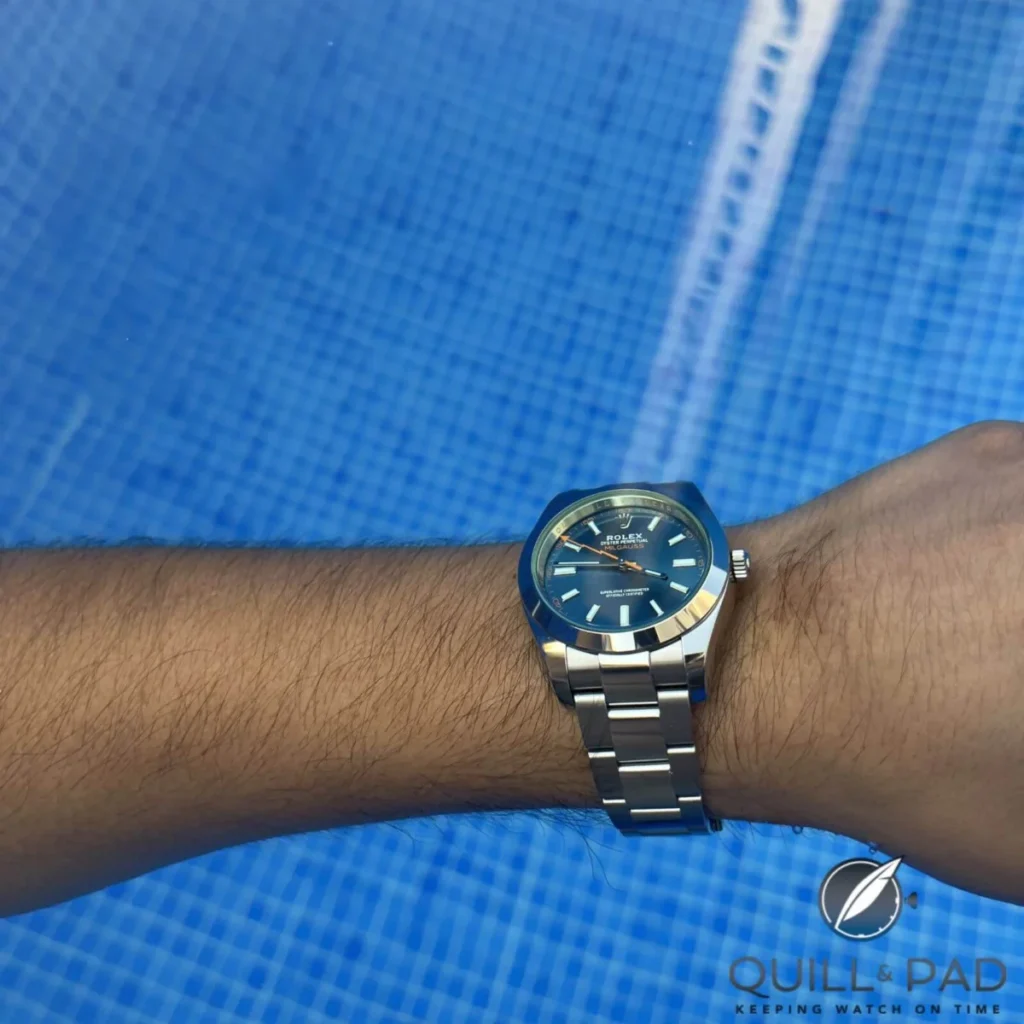
The author’s personal journey reflects this early inspiration. The desire, sparked at the age of twenty, to own a luxury watch, initially conceived as a singular acquisition, has evolved into a collection. However, this evolution has not been without its challenges. The Rolex Milgauss, specifically the "Z Blue" iteration, has, over time, become a point of contention. Initially purchased in 2019 for over $7,000 with the expectation of its value outperforming its peers, the watch has presented a series of practical and aesthetic issues.
The Milgauss: A Case of Ill-Fitted Luxury
The primary concern with the Z Blue Milgauss, as articulated by the author, lies in its dimensions. For a wrist measuring a mere 16 centimeters, the watch’s substantial size and thickness present significant ergonomic challenges. While it technically fits, the fit is far from ideal, leading to a sense of imbalance. The watch is described as "top-heavy," causing it to shift and flap uncomfortably with arm movements. This persistent feeling of not being able to "pull it off" detracts from the ownership experience.
Furthermore, the expectation of the Milgauss retaining or increasing its value has not materialized as anticipated, adding another layer of dissatisfaction. The notion that "these things are meant to be worn" is acknowledged, yet the accumulation of scuffs and scratches on the watch’s highly polished surfaces has further diminished the author’s enjoyment. This duality – the desire to wear a treasured object versus the inherent wear and tear that compromises its aesthetic appeal – creates a dissonance for the owner. The watch, once a symbol of aspiration, now evokes a sense of self-consciousness, prompting it to be worn discreetly, often under a cuff, to avoid unwanted attention from potential thieves. This pragmatic concern, a reflection of the current security climate in some urban centers, starkly contrasts with the uninhibited display of luxury observed in earlier times.
The Transformative Power of the Poolside
The narrative shifts dramatically with the introduction of a specific setting: a luxury hotel pool during the "magic hour." This is where the Z Blue Milgauss, and indeed the concept of the "pool watch," undergoes a remarkable metamorphosis. The act of shedding inhibitions – represented by removing a shirt and kicking off flip-flops – and immersing oneself in the cool water triggers a sensory recalibration. As the author luxuriates in the water, the usual anxieties and contemplative thoughts associated with daily life (frequent flyer miles, the cost of a boat, elephant prices in India, career prospects, spousal activities, and the time) recede.
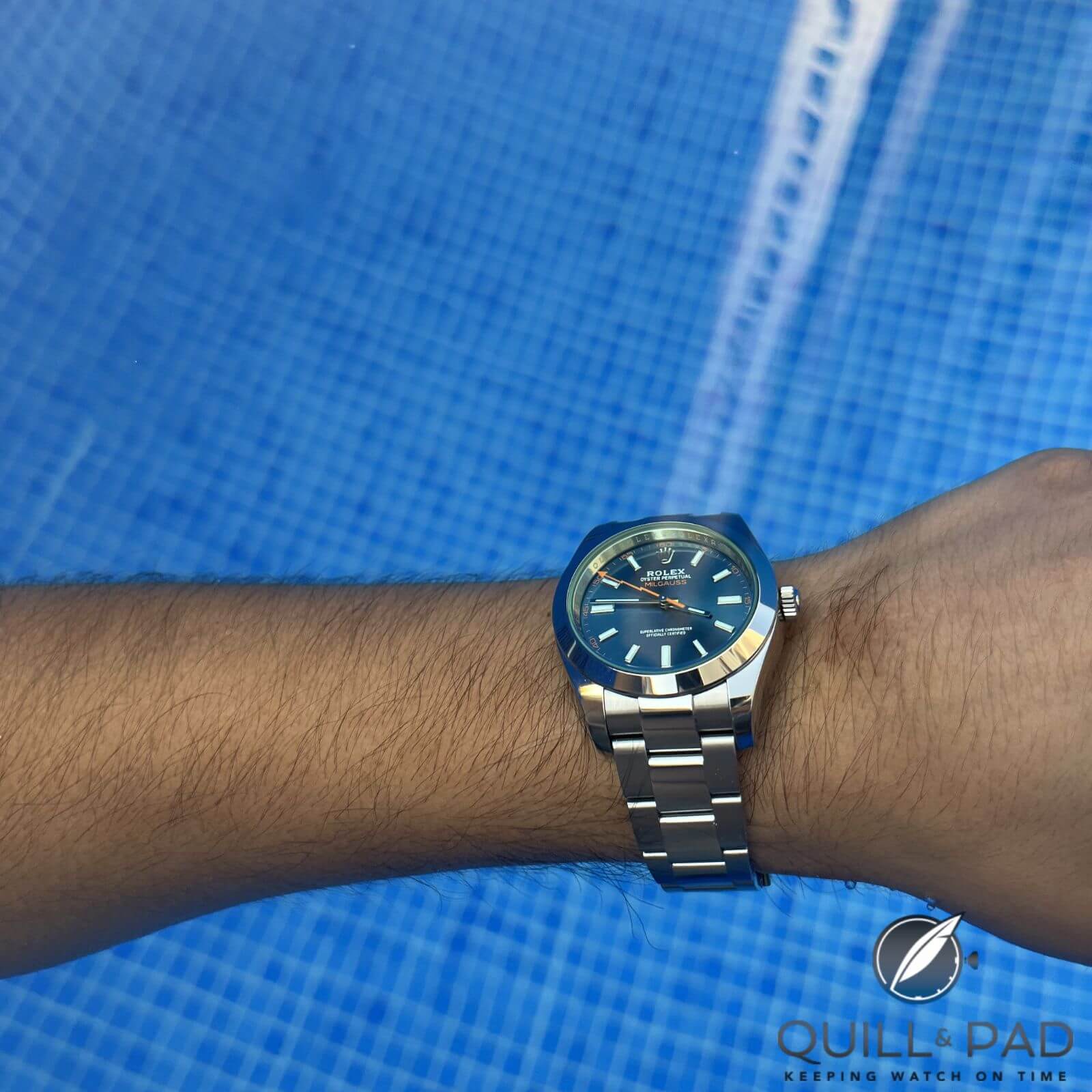
It is at this precise moment of relaxed contemplation, with the warm sunlight filtering through palm trees and a gentle breeze present, that the Z Blue Milgauss is rediscovered. A water droplet tracing a path down the crystal transforms the watch from a potentially problematic accessory into an object of renewed fascination. The author is no longer focused on the time, but rather on the aesthetic spectacle presented by the watch. The interplay of light on the dial, particularly the vibrant jade and aquamarine hues of the "Z Blue" dial, is amplified by the rippling blue of the pool water. This visual phenomenon evokes a sense of nostalgia, conjuring memories of childhood experiences like skateparks, aquariums, and shared car journeys.
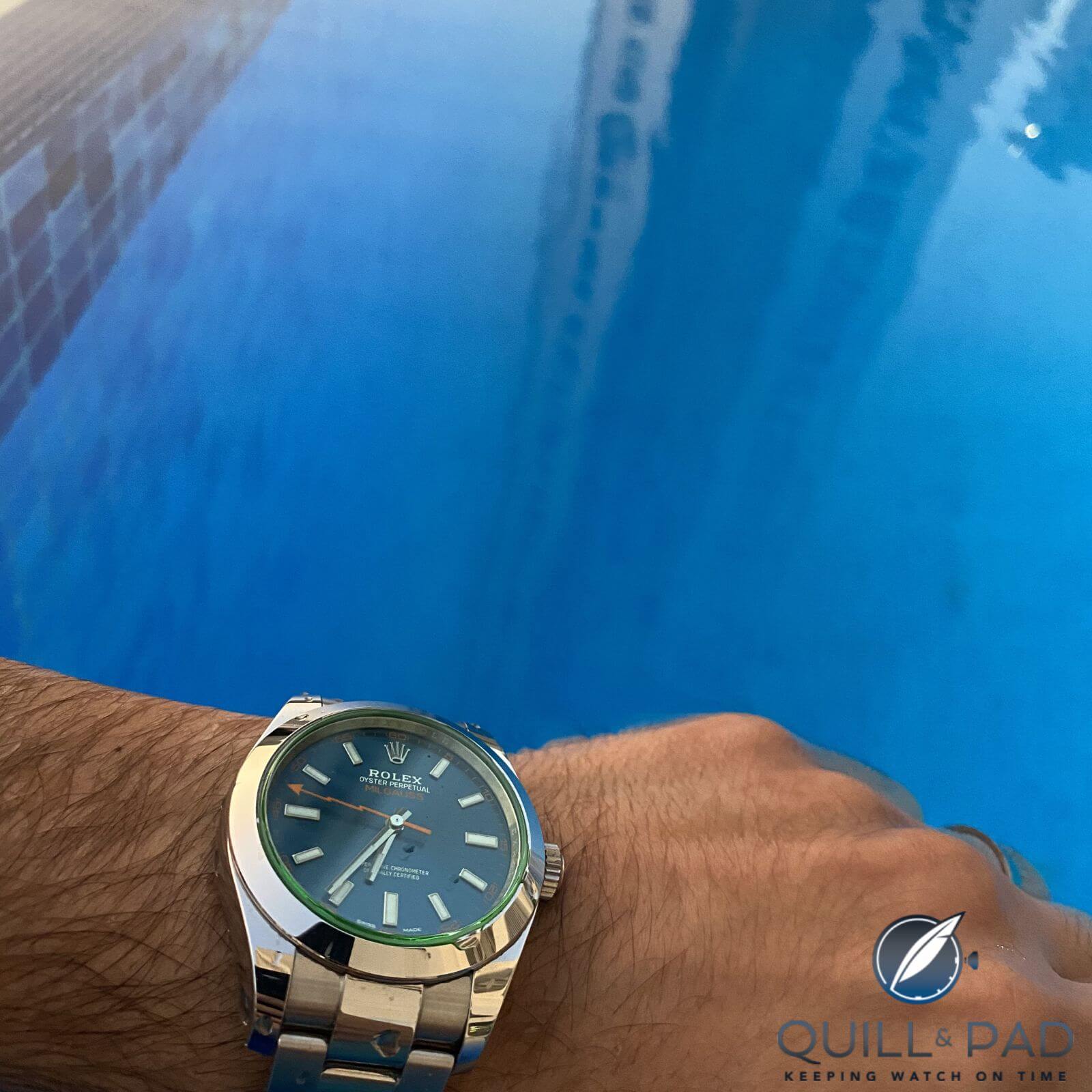
The watch’s design, with its distinctive green crystal, becomes a focal point. When angled, the green hue contrasts dramatically with the mosaic tiling of the pool, creating an almost ethereal effect. The round edge of the crystal appears to glow, while the dial beneath, described as a "prism-lit disc," exhibits shifting, iridescent blues reminiscent of a dragonfly’s wing. The bright orange, lightning-bolt-shaped seconds hand adds a dynamic element, a vibrant streak against the cool tones of the dial.
The article posits that plunging this specific watch into a clear, sun-dappled body of chlorinated water is akin to "running a current through it." This is where the watch, in the author’s view, truly comes alive. The water seems to miraculously diminish the visibility of the scratches and scuffs that have accumulated on the case, restoring a sense of its original luster. When worn with swimming shorts, the fit is perceived to improve, and the wearer feels more at ease, less self-conscious. In this environment, the market value becomes irrelevant, and the perceived threat of theft diminishes, contributing to a sense of peace and contentment.
The Return to Reality: The Pool Watch’s Limitations
However, this idyllic scene is transient. As the author dries off, the watch’s luster fades with the water. The harsh reality of artificial indoor lighting and the return of clothing accentuate the Milgauss’s perceived shortcomings. The fit becomes awkward again, and the dial and crystal appear dull and uninspired, "holding on to it timidly." The once-exciting seconds hand becomes "jagged and jarring." The watch, once revived by its aquatic environment, is now "out of its element" when dry and indoors.
This realization leads to a broader argument: the Rolex Milgauss, particularly in its Z Blue configuration, is, in essence, a "pool watch." While not explicitly designed for aquatic use beyond its water resistance rating, its true potential for aesthetic impact is unlocked in this specific context. This concept extends beyond the Milgauss. The author draws parallels to other iconic watches whose "natural habitats" do not necessarily translate to their most visually compelling display. The Breitling Cosmonaut or the Omega Speedmaster Moonwatch, designed for space, or F1-themed watches, intended for the racetrack, are cited as examples. While their functional context is undeniable, their visual appeal may be more striking in other settings.
The "Natural Habitat" Paradox in Horology
The author employs analogies to illustrate this point. A peacock, while naturally inhabiting forests, is most striking on a manicured lawn. Timberland boots, designed for construction sites, often gain a different aesthetic when worn by a fashion-conscious individual in an urban setting. Similarly, blue jeans, originating from gold prospectors, have found a powerful style statement in contemporary fashion. This suggests that the intended environment for a piece of design or apparel does not always equate to its most visually impactful or aesthetically pleasing presentation.
Therefore, the advice is to embrace this paradox: forget the original purpose of the Milgauss (its intended use at CERN) and bring the Z Blue Milgauss to the pool. For those without such a watch, the suggestion is to find a timepiece that fulfills a similar role, regardless of its "natural habitat."
The Hotel Pool as a Stage for Horological Statement Pieces
The hotel pool, according to the article, is presented as a unique stage for horological display. It is a space where "status symbols and statement pieces" thrive. The author advocates for watches that possess significant "nameplate cachet" and are immediately recognizable. This is not the venue for niche brands or understated pieces. The expectation is for watches that are universally acknowledged as desirable and aspirational.
The author humorously dismisses brands like Parmigiani, Czapek, Bremont, Carl F. Bucherer, and Sinn in this context, suggesting they would "kill the mood." Even an Apple Watch is deemed inappropriate, with a sarcastic query about counting laps. The implication is that the hotel pool, particularly at a high-end establishment, is akin to a W Hotel rather than a YMCA – a place where the display of luxury is expected and appreciated.
The "Hits" of the Horological World
The article advocates for playing to the crowd at the hotel pool, drawing a parallel to attending a concert and expecting to hear the popular hits rather than obscure "deep cuts." While the author, as a writer and enthusiast, typically appreciates the nuanced and less-traveled paths within the watch world, the hotel pool demands a different approach. The preference shifts from "quirky, offbeat, slept-on" watches to "unimaginative eye rollers" and "starter-kit luxury." These are the "old school staples," the horological equivalent of a Beef Wellington.
Specific examples of watches that fit this criteria include:
- Audemars Piguet Royal Oak Offshore and Vacheron Constantin Overseas: These models are considered suitable due to their recognizable designs and luxury status.
- Pre-Kern Breitling B01 Chronomat: This specific iteration is noted as qualifying.
- Rolex Speedmaster Moonwatch: While the standard version might be questioned for its water resistance, a yellow gold variant is deemed acceptable.
- Rolex Daytona: Particularly in yellow gold, this is considered a strong contender.
- Most Rolex Sports Models: Two-tone "bluesies" and similar iterations are generally well-suited.
- Richard Mille (+10 bar water resistance): These high-end, often avant-garde watches are considered appropriate.
- Hublot Big Bang: Positioned as a more accessible alternative to some other high-end pieces, it also fits the criteria.
- Virtually any Patek Philippe Nautilus and, to a lesser extent, Aquanaut: These iconic luxury sports watches are highly regarded.
The article highlights a pragmatic observation: watches that might attract unwelcome attention or risk theft in cities like London or Paris are precisely the kind of statement pieces that belong by the hotel pool, provided they have adequate water resistance. The advice is to keep such valuable timepieces in the hotel safe when not in use, taking them for a dip when desired and returning them to safety before venturing out for dinner. This suggests a strategic approach to enjoying high-value watches in a controlled and secure environment.
In conclusion, the concept of the "pool watch" transcends mere water resistance. It embodies a specific context where a luxury timepiece can transcend its practical limitations and re-emerge as a source of aesthetic pleasure and personal enjoyment. The hotel pool, with its unique blend of relaxation, luxury, and social observation, provides the ideal backdrop for certain watches to truly shine, transforming them from potentially problematic possessions into vibrant, captivating accessories.