A groundbreaking innovation from the Massachusetts Institute of Technology (MIT) promises to transform everyday objects into dynamic canvases, allowing for on-demand customization of designs on clothing, home décor, and office items. Researchers at MIT’s Computer Science and Artificial Intelligence Laboratory (CSAIL) have developed a portable device named "ChromoLCD," which combines advanced liquid-crystal display (LCD) technology with precision LED lighting to reprogram the appearance of surfaces coated with photochromic dyes. This development moves beyond previous iterations, offering a user-friendly and portable solution for dynamic surface customization.
The Vision of Reprogrammable Aesthetics
The core concept behind ChromoLCD is to imbue static objects with a fluid, digital identity. Imagine a world where a favorite t-shirt could display a new artistic pattern daily, or a coffee mug could change its graphic to match your mood. This vision, championed by researchers like Yunyi Zhu, an MIT electrical engineering and computer science PhD student, aims to blur the lines between physical objects and digital content, making personal expression and environmental interaction more dynamic and accessible.
Zhu and her team have built upon prior work at CSAIL, including the "PhotoChromeleon" device, which utilized a projector to activate photochromic inks. While PhotoChromeleon demonstrated the potential of this technology, its lack of portability limited its practical application. This led to the development of "PortaChrome," a portable, LED-based tool capable of reprogramming lower-resolution imagery. ChromoLCD represents the next significant leap, integrating the sharpness of LCDs with precise LED illumination to achieve high-resolution, dynamic design changes on a variety of surfaces.
How ChromoLCD Works: A Symphony of Light and Chemistry
At its heart, ChromoLCD is a sophisticated yet remarkably user-friendly system. The device, resembling a compact printer, houses a powerful combination of components: a computer chip, a backlight assembly featuring ultraviolet (UV) and red, green, and blue (RGB) LEDs, and an LCD panel. This intricate setup orchestrates a "light show" behind the scenes to precisely imbue objects with new designs.
The process begins when a user selects a desired image or design via a connected computer or mobile device. This digital artwork is then uploaded to ChromoLCD, typically through a Bluetooth or USB connection. The device’s internal computer chip generates a black-and-white representation of the image, detailing the precise brightness levels of each pixel. This grayscale map is crucial for controlling the subsequent light interactions.
Next, the UV LEDs play a critical role in activating the photochromic dye that has been applied to the object’s surface. Photochromic dyes are compounds that undergo a reversible chemical change when exposed to specific wavelengths of light, altering their color. The UV light effectively "darkens" or saturates the dye, preparing it to receive color information.
Following the UV activation, the RGB LEDs emit light at specific frequencies, precisely mapped by the LCD panel onto the target surface. This controlled illumination "colors in" each pixel, bringing the selected design to life. The process is analogous to how light gradually reveals color and detail as daylight increases in a room. The precision of the LED frequencies and the mapping by the LCD panel ensure that the resulting imagery is sharp and vibrant, even on flexible materials like fabric.
The entire reprogramming process for a new design typically takes approximately 15 minutes, after which the object displays the newly applied graphic. Crucially, the process is reversible; the photochromic dye can be reset, allowing users to apply entirely new designs at their leisure, fostering a truly dynamic and personalized aesthetic experience.
From Concept to Tactile Reality: Demonstrating Versatility
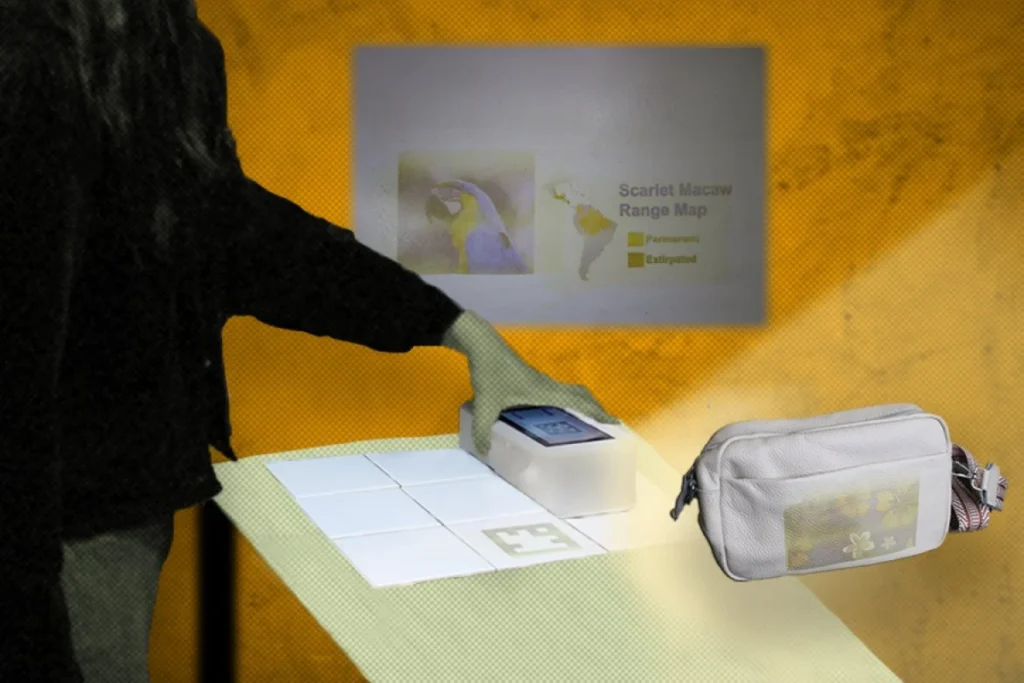
The research team has showcased ChromoLCD’s remarkable versatility through a series of compelling demonstrations. On fabric items like hoodies, the device has successfully embedded intricate digital artwork, such as a detailed rose. The application process is straightforward: after coating the fabric with the photochromic ink, users simply upload their chosen image, preview it on the ChromoLCD’s display menu, and then "stamp" the device onto the item.
Beyond apparel, ChromoLCD has proven effective on a variety of flat and soft surfaces. Handbags have been adorned with colorful, custom drawings of fish and flowers, illustrating the device’s ability to add personalized artistic flair to accessories. The researchers also demonstrated the integration of augmented reality (AR) tags – akin to QR codes – onto a kitchen countertop. These tags, once programmed, could link to external digital content, such as cooking tutorials, creating an interactive culinary experience.
Whiteboards have also been transformed by ChromoLCD, capable of displaying high-resolution reference images. This opens up possibilities for whiteboards to become interactive canvases that seamlessly blend digital visuals with traditional physical sketching, enhancing collaboration and brainstorming sessions in academic and professional settings.
The User Experience: Simplicity and Accessibility
Yunyi Zhu emphasizes the user-centric design of ChromoLCD. "We see ChromoLCD as a bridge between consumers and photochromic dyes," Zhu stated. "It’s basically a stamp, and it’s very easy to use. There are no alignment requirements, no 3D object texture creation. You just upload the image you’d like to put on your bag, place it on there, and then you’d have a personalized accessory." This focus on intuitive operation is key to widespread adoption.
The device’s portability is a significant advancement, allowing for customization beyond the confines of a laboratory or a fixed workstation. This mobile capability means that users can potentially alter the appearance of their belongings in various environments, from their homes to public spaces.
Future Trajectories: Expanding the Canvas and Enhancing Creativity
The development of ChromoLCD is part of a broader research initiative at CSAIL focused on digitizing and dynamically reprogramming our physical surroundings. Building upon PortaChrome and PhotoChromeleon, the team is now looking towards the next evolutionary steps.
One of the primary areas of focus is on streamlining the creative process itself. Currently, users need to provide existing images or create texture maps for 3D objects. However, with the rapid advancements in Artificial Intelligence (AI) for generative art and texture creation, the researchers envision a future where users can simply describe their desired design, and AI systems will generate it. For instance, a user might point their smartphone camera at a cup and request, "turn this cup into a medieval-style tankard." The AI would then generate the appropriate design for ChromoLCD to apply.
The scope of application is also expanding. Researchers are developing a wall-roller-shaped reprogrammer, analogous to a paint roller, which will enable the application of larger designs onto vertical surfaces. This could transform entire walls into dynamic displays, capable of showcasing artwork, information, or ambient visuals.
Furthermore, CSAIL is exploring the integration of this technology into robotics. Imagine a robotic vacuum cleaner, like a Roomba, able to communicate its operational status or cleaned areas by stamping high-resolution messages onto the floor. This form of visual communication could significantly enhance human-robot interaction and coordination in complex environments.
Narges Pourjafarian, a postdoctoral researcher at Northeastern University who was not involved in the study, commented on the significance of ChromoLCD. "It reframes monochromatic LCD panels as wavelength-selective fabrication tools, rather than merely display endpoints," Pourjafarian noted. "This approach expands how we think about reprogrammable surface appearance, enabling high-resolution, reconfigurable graphics to be embedded directly into physical environments without the need for stationary projection enclosures. It opens a path toward compact, portable augmentation of garments, countertops, and shared surfaces."
The Researchers and Their Contribution
The paper presenting the ChromoLCD technology was authored by a collaborative team of MIT researchers and affiliates. Co-lead authors include MIT undergraduates Qingyuan Li, Katherine Yan, Alex Luchianov, and Eden Hen, alongside Harvard University graduate student and former visiting researcher Emily Guan. The work was overseen by MIT Associate Professor Stefanie Mueller, a principal investigator at CSAIL and senior author on the paper. The research team is scheduled to present their findings at the upcoming ACM International Conference on Tangible, Embedded, and Embodied Interaction, a prominent venue for research at the intersection of technology and human interaction.
Broader Implications and the Future of Interactive Surfaces
The development of ChromoLCD and related technologies signals a significant shift in how we interact with our physical environment. By enabling dynamic and on-demand customization of surfaces, these innovations have the potential to:
- Democratize Design: Empowering individuals to express their creativity and personalize their belongings without requiring specialized skills or expensive equipment.
- Enhance Environmental Responsiveness: Allowing spaces to adapt to changing needs or moods, from dynamic signage in public areas to personalized greetings at home.
- Facilitate Communication: Providing new avenues for visual communication, particularly in human-robot interaction and collaborative work environments.
- Promote Sustainability: Potentially reducing the need for disposable printed materials by allowing for reusable and reconfigurable designs.
The research journey from PhotoChromeleon to PortaChrome and now ChromoLCD highlights a consistent drive at MIT CSAIL to push the boundaries of interactive and reconfigurable technologies. As AI continues to advance and the physical integration of digital information becomes more seamless, the vision of a world where any surface can be a dynamic display is rapidly moving from science fiction to tangible reality. The implications for retail, interior design, personal expression, and even industrial applications are profound, suggesting a future where our environments are not just static backdrops but active participants in our daily lives.