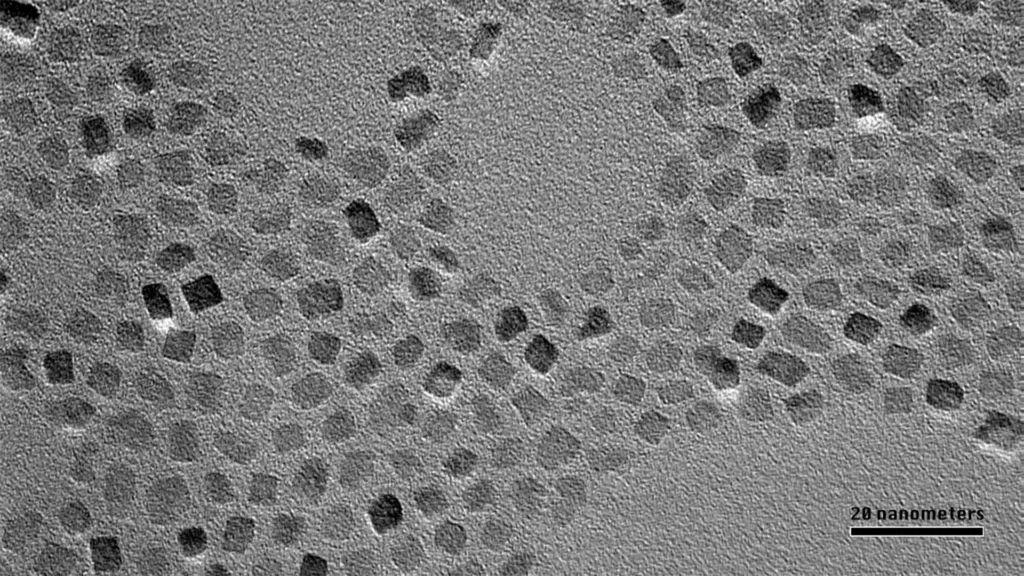
Nanocrystals, microscopic crystalline structures with extraordinary properties that have revolutionized materials science and even inspired the 2023 Nobel Prize in Chemistry for quantum dot discoveries, have historically been limited to a comparatively narrow spectrum of materials. However, a groundbreaking advancement by chemists at the University of Chicago and Argonne National Laboratory promises to shatter these limitations, opening the door to the creation of nanocrystals from metal nitrides—a class of technologically vital materials that have long resisted conventional synthesis methods. This pioneering study, published in the prestigious journal Nature, is poised to dramatically expand the horizons for applications ranging from advanced electronics and flexible lighting to sophisticated medical implants.
The development marks a significant leap forward in materials science, building upon decades of research into the unique characteristics of nanocrystals. The 2023 Nobel Prize in Chemistry, awarded to Moungi Bawendi, Louis Brus, and Alexei Ekimov, underscored the profound impact of quantum dots—a specific type of nanocrystal—on fields such as quantum computing, LED technology, and biomedical imaging. This latest research, however, tackles a different, yet equally critical, frontier by enabling the precise engineering of nanocrystals from a material family that has remained stubbornly out of reach.
"We have successfully demonstrated a method capable of producing nearly a dozen new metal nitride materials in nanocrystal form, materials that were previously considered unsynthesizable by traditional techniques," stated Ruiming Lin, a graduate student at the University of Chicago and the lead author of the Nature paper. This breakthrough addresses a long-standing challenge in materials synthesis, offering a pathway to harness the inherent strengths of metal nitrides at the nanoscale.
Unlocking the Potential of Metal Nitride Nanocrystals
Metal nitrides are not new to the technological landscape; they are already integral to numerous high-tech applications. Gallium nitride (GaN), for instance, is a cornerstone of modern illumination, powering everything from energy-efficient LED bulbs that have transformed home and industrial lighting to the vibrant displays found in laptops and smartphones. Its exceptional properties, including high thermal conductivity and electron mobility, make it ideal for high-power electronics and optoelectronics.
The ability to transform these robust materials into nanocrystals, however, represents a paradigm shift. Currently, metal nitrides are primarily utilized in rigid film formats. By reducing them to nanocrystals, researchers envision a future where these materials can be seamlessly integrated into diverse matrices. This could include embedding them within flexible polymers to create bendable electronic components, printing them using advanced inkjet technologies for novel device fabrication, or even weaving them into fabrics for smart textiles and wearable electronics.
Dmitri Talapin, the Ernest DeWitt Burton Distinguished Service Professor of Chemistry and Molecular Engineering at the University of Chicago and a senior scientist at Argonne National Laboratory, who served as the senior author of the study, emphasized the transformative nature of this achievement. "This research fundamentally expands the boundaries of what was previously thought to be possible in nanocrystal synthesis," Professor Talapin remarked. "It removes inherent constraints and lays a crucial foundation for the widespread utilization of nitrides as functional nanomaterials."
The Enduring Allure and Challenge of Nanocrystals
Nanocrystals, by definition, are exceptionally small crystalline structures. Billions of them could fit on the head of a pin, and millions can reside on the tip of a fingernail. At this infinitesimally small scale, materials often exhibit drastically altered physical and chemical properties compared to their bulk counterparts. These quantum mechanical effects can lead to phenomena such as enhanced light emission—the principle behind quantum dots—or a significant increase in catalytic activity, making them invaluable for a wide array of scientific and technological pursuits.
Theoretically, the potential to create nanocrystals from virtually any substance is vast. However, in practice, the stringent conditions required for controlled crystallization at the nanoscale have proven to be an insurmountable hurdle for many materials. The delicate balance of thermodynamics and kinetics must be precisely orchestrated to allow atoms or molecules to arrange themselves into the desired crystalline lattice without forming defects or uncontrolled aggregates.
Lin and his colleagues within Professor Talapin’s research group were motivated to overcome these long-standing limitations. Their attention was drawn to metal nitrides, compounds formed by the chemical union of metals and nitrogen. These materials are celebrated for their remarkable robustness, biocompatibility, and resistance to extreme temperatures and corrosive environments. These very qualities, however, contribute to the formidable challenge of synthesizing them as nanocrystals.
The Strong Bond Conundrum
The fundamental obstacle in creating metal nitride nanocrystals lies in the exceptionally strong chemical bonds between the metal and nitrogen atoms. During the conventional synthesis of nanocrystals, a critical step involves the rearrangement of ions or atoms in a liquid precursor phase to form a stable crystalline structure. This process is analogous to partners in a dance gracefully moving to new positions before settling into formation. In metal nitrides, however, the covalent and ionic character of the metal-nitrogen bonds is so pronounced that the constituent ions possess very limited mobility. They are reluctant to break apart and reconfigure.
"If the bonds cannot break and reform during the critical nucleation and growth stages, it effectively becomes a death sentence for nanocrystal formation," explained Professor Talapin. "Once an incorrect bond is formed, or the structure fails to achieve the desired atomic arrangement, the entire process falters, leading to amorphous powders or undesirable bulk phases rather than well-defined nanocrystals."
The research team’s success hinged on a two-pronged strategic advancement that effectively circumvented this inherent stability.
Firstly, the Talapin lab built upon prior discoveries demonstrating the utility of molten salts as reaction media for nanocrystal synthesis. Molten salts can provide a unique liquid environment that helps to stabilize nascent nanocrystals during their formation, preventing uncontrolled aggregation and promoting controlled growth. This provided a crucial foundation for their approach.
Secondly, and most critically, the researchers embarked on an extensive empirical investigation, systematically testing a wide range of reaction conditions. Through meticulous experimentation, they identified a precise "sweet spot" involving specific temperature ranges and controlled ammonia pressures. Under these meticulously calibrated conditions, the formidable metal-nitrogen bonds were rendered sufficiently labile. This allowed them to break and reform at the necessary rate, enabling the metal nitride structures to organize correctly into discrete, well-defined nanocrystals.
"This process is highly unconventional and, frankly, goes against much of the established intuition in the field of nanocrystal synthesis," Professor Talapin admitted. "We had to fundamentally rethink the underlying principles and develop an entirely novel approach to achieve this."
A New Dawn for Nearly a Dozen Nanocrystal Materials
The efficacy of this innovative method extended far beyond a single material. The team successfully synthesized nanocrystals not only from gallium nitride but also from a suite of related nitride compounds, each possessing significant technological relevance. These included:
- Titanium Nitride (TiN): Known for its exceptional hardness, wear resistance, and biocompatibility, TiN is already employed in high-performance coatings for cutting tools and, importantly, in medical implants such as artificial joints and dental prosthetics. Nanocrystal TiN could lead to even more robust and bio-integrated implants.
- Niobium Nitride (NbN): This material is a crucial superconductor, exhibiting zero electrical resistance below a critical temperature. It finds applications in sensitive magnetic field detectors (SQUIDs), high-frequency electronics, and particle accelerators. NbN nanocrystals could enhance the performance and miniaturization of superconducting devices.
- Molybdenum Nitride (MoN): Commonly utilized as a catalyst in various chemical reactions, including ammonia synthesis, MoN nanocrystals could offer significantly increased surface area and tailored catalytic activity, leading to more efficient industrial chemical processes.
- Other Nitrides: The method also proved effective for other metal nitrides, the specific identities of which are detailed in the Nature publication, further broadening the scope of accessible nanomaterials.
These newly accessible metal nitride nanocrystals are not only intrinsically useful but also, in many cases, relatively inexpensive in their bulk forms. The researchers are optimistic that their conversion into nanocrystals will unlock their potential for deployment in an even more diverse and advanced array of technologies.
Ruiming Lin shared his enthusiasm for the practical implications of their work. "I vividly recall the moment I first examined the synthesized crystals under the electron microscope," he recounted. "There’s an inherent hope that one’s discoveries will eventually translate into tangible applications. I am confident that these new nanocrystals will find numerous uses across various industries."
The research involved a collaborative effort with several other authors from the University of Chicago, including Ningxin Jiang, Wooje Cho, Zirui Zhou, Di Wang, Justin Ondry, Zehan Mi, James Cassidy, Alex Hinckle, Alexander Filatov, and John S. Anderson. The scientists leveraged state-of-the-art facilities at the University of Chicago-based National Science Foundation Materials Research Science and Engineering Center, the UChicago Soft Matter Characterization Facility, and Argonne’s Center for Nanoscale Materials, underscoring the importance of interdisciplinary collaboration and advanced infrastructure in driving scientific innovation.
Broader Implications and Future Outlook
The ability to synthesize metal nitride nanocrystals is more than just a scientific curiosity; it represents a significant stride towards realizing advanced materials with tailored properties. The implications of this breakthrough are far-reaching:
- Enhanced Electronics: Flexible and transparent electronic devices could become more feasible, with applications in wearable technology, foldable displays, and novel sensors. The inherent stability of nitrides, combined with the tunable electronic properties of nanocrystals, could lead to more durable and efficient components.
- Next-Generation Lighting: Beyond current LED technology, metal nitride nanocrystals could enable entirely new forms of illumination, potentially with unprecedented color control and energy efficiency, perhaps even in bio-integrated lighting solutions.
- Advanced Medical Technologies: The biocompatibility of many metal nitrides, coupled with their nanoscale properties, opens avenues for improved medical implants, targeted drug delivery systems, and advanced diagnostic tools. For instance, TiN nanocrystals could offer enhanced osseointegration in orthopedic implants, leading to faster healing and greater longevity.
- Catalysis and Energy: More efficient catalysts for industrial chemical processes, including those related to sustainable energy production and carbon capture, could be developed. NbN nanocrystals could also play a role in developing next-generation superconducting wires for energy transmission and storage.
This research, supported by funding from the U.S. Department of Energy, the Samsung QD Cluster Collaboration, the National Science Foundation, and the Air Force Office of Scientific Research, signifies a pivotal moment in materials science. It not only expands the toolkit available to researchers and engineers but also inspires new avenues of inquiry into the fundamental nature of materials at the nanoscale. As scientists continue to explore the vast potential of these newly accessible metal nitride nanocrystals, we can anticipate a wave of innovations that will shape the technological landscape of the future. The journey from understanding quantum dots to unlocking the synthesis of robust metal nitrides at the nanoscale highlights the continuous evolution and profound impact of materials science on our world.