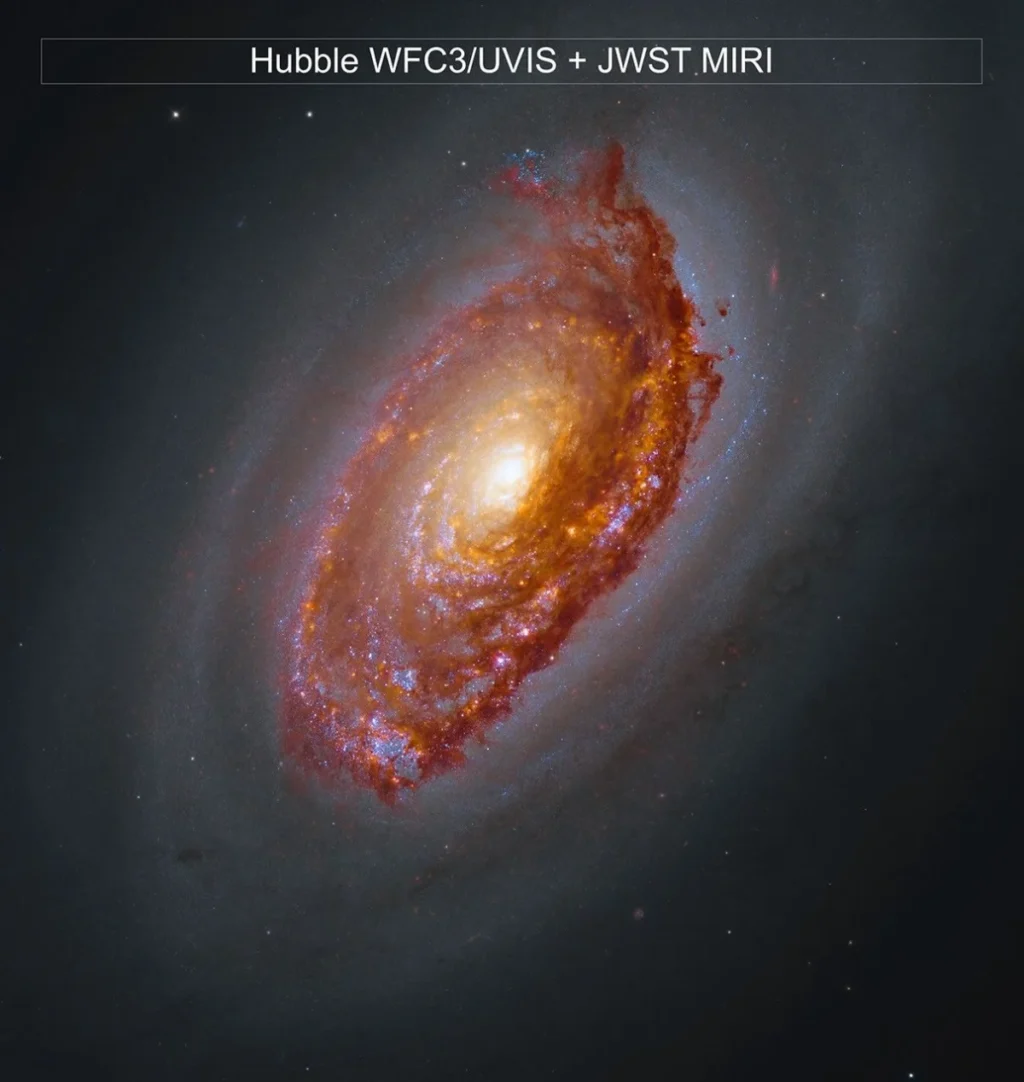
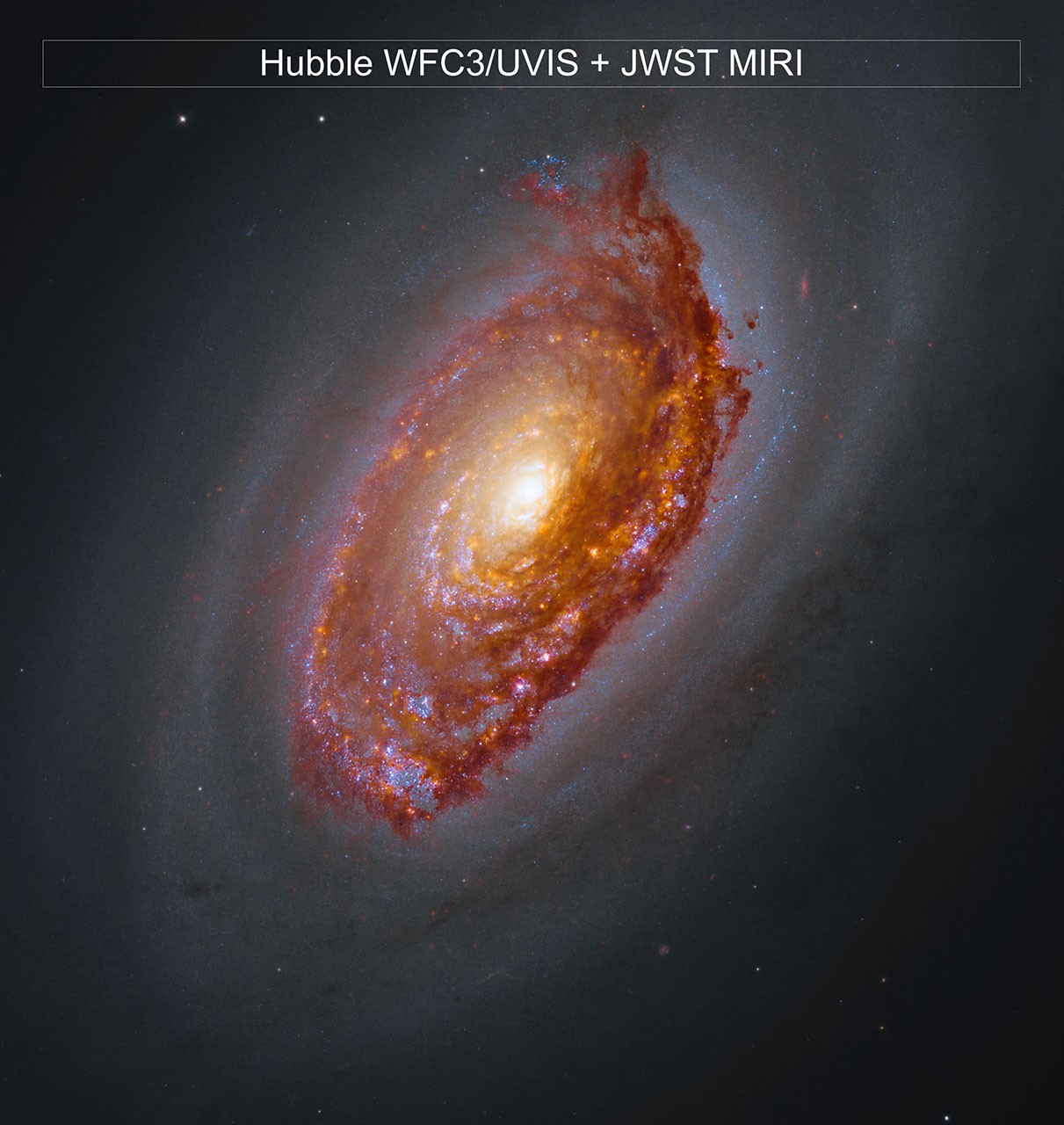
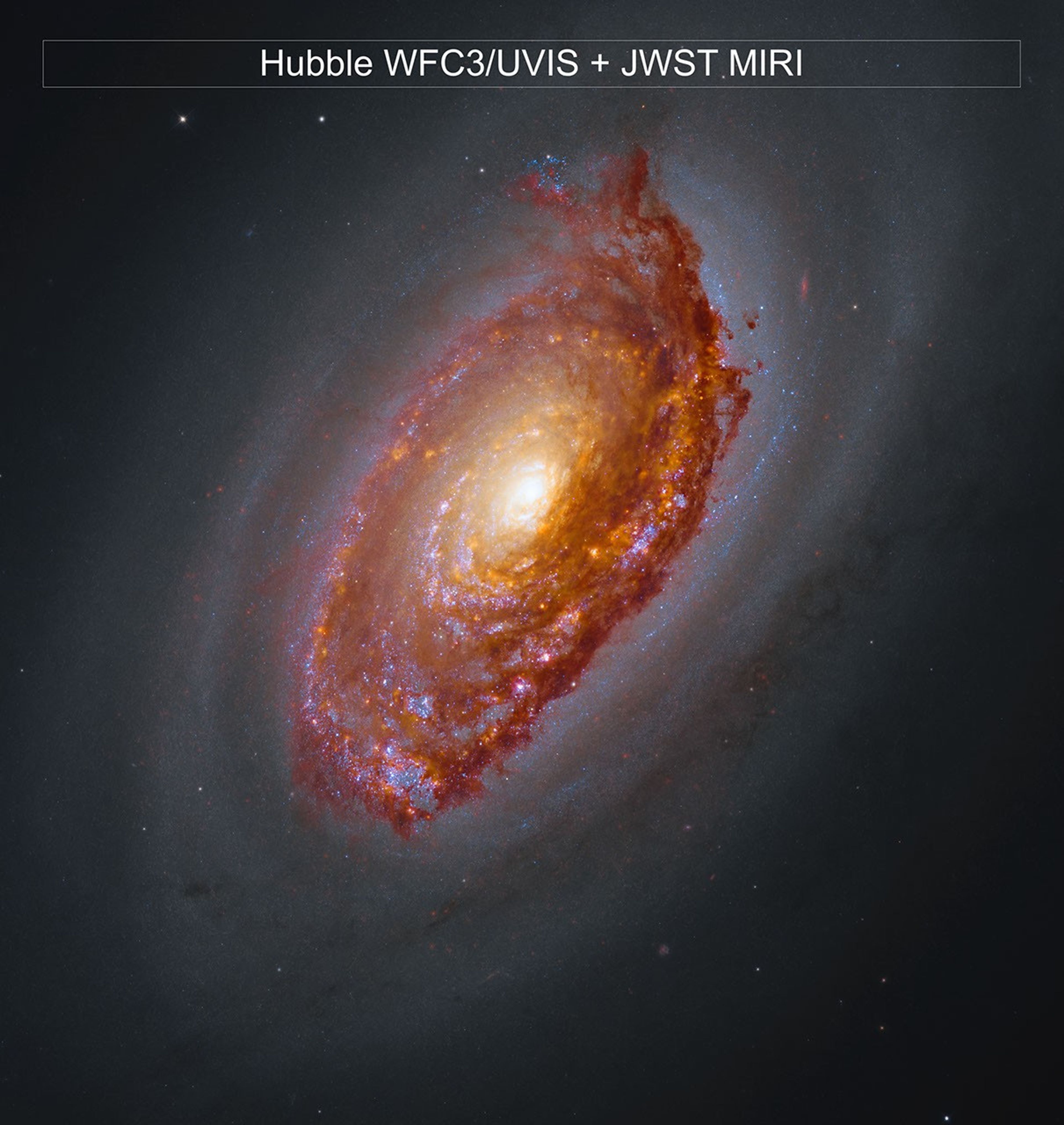
The cosmos continues to unveil its secrets, and a remarkable new composite image of Messier 64 (M64), affectionately known as the Black Eye Galaxy, offers an unprecedented glimpse into the intricate workings of a nearby spiral galaxy. This groundbreaking visualization, combining the distinct observational capabilities of the Hubble Space Telescope and the James Webb Space Telescope (JWST), highlights how different celestial observatories can complement each other to paint a more complete picture of the universe.
The Black Eye Galaxy, a spiral galaxy situated approximately 24 million light-years away in the constellation Coma Berenices, has long captivated astronomers. Its most striking feature is a prominent dark band of dust that obscures its luminous core, earning it the evocative moniker "Black Eye." This latest image, released as part of NASA’s Astronomy Picture of the Day (APOD) initiative for September 16, 2026, leverages the unique infrared vision of the JWST’s Mid-InfraRed Instrument (MIRI) alongside Hubble’s optical and ultraviolet capabilities. The synergy between these powerful telescopes provides a multifaceted view of M64, revealing details previously hidden from single instruments.
A Tale of Two Telescopes: Unveiling M64’s Secrets
The composite image effectively showcases the distinct perspectives offered by Hubble and Webb. Hubble’s contribution, captured in visible light, highlights the galaxy’s structure with sharp detail, illuminating the vibrant pink and blue patches of active star formation within its spiral arms. These regions represent stellar nurseries, where new stars are being born from clouds of gas and dust.
However, it is the JWST’s infrared gaze that offers a revolutionary new layer of understanding. The MIRI instrument on Webb penetrates the obscuring dust clouds that often shroud celestial objects in visible light. In this image, the dust itself, a crucial component in star formation and galactic evolution, is rendered in vivid reds. This infrared view reveals how this dust absorbs and re-emits light from surrounding newborn stars, providing vital information about the thermal properties and composition of these cosmic clouds. The pink star-forming regions, visible in Hubble’s image, are shown by Webb to be embedded within this dusty material, underscoring the complex interplay between dust, gas, and stellar birth.
The Counter-Rotating Mystery and Galactic Evolution
M64 is not just visually striking; it is also a scientifically significant object due to its unique internal dynamics. Astronomers have discovered that the inner and outer gas regions of M64 rotate in opposite directions. This phenomenon, first identified in detailed studies published in the early 1990s, is a key piece of evidence suggesting that M64 has experienced a violent past, likely involving a merger with a smaller galaxy.
This counter-rotation creates regions where the two gas "currents" meet and compress, leading to increased star formation. The presence of these opposing gas flows challenges earlier assumptions about the peaceful evolution of spiral galaxies. Prior to observations like those of M64, the prevailing view was that spiral galaxies primarily grew through gradual accretion and internal processes, with mergers being a less significant factor. M64 provided some of the earliest and most compelling evidence that mergers are a fundamental driver of galactic evolution, even for galaxies as seemingly serene as our own Milky Way.
The JWST’s MIRI observations are poised to significantly enhance our understanding of this merger history. By mapping the distribution, motion, and composition of the galaxy’s dust, astronomers can gain deeper insights into the mechanics of the merger event and its long-term impact on M64’s structure and star formation history. This detailed infrared data will add crucial context to existing models of galactic evolution, which are increasingly incorporating the role of mergers in shaping galaxies across the universe.
A Legacy of Cosmic Discovery: The Astronomy Picture of the Day
The Astronomy Picture of the Day (APOD) program, a cornerstone of NASA’s public outreach for decades, serves as a daily window into the wonders of the universe. Launched in 1995, APOD features a different astronomical image or photograph each day, accompanied by a brief explanation written by a professional astronomer. This initiative has been instrumental in making complex astronomical concepts accessible to a global audience, fostering a widespread appreciation for science and space exploration.
The APOD website, historically hosted at apod.nasa.gov, has recently undergone a transition to science.nasa.gov/apod, a move designed to consolidate NASA’s extensive science content and enhance user experience. This relocation is part of a broader effort by NASA to streamline its digital presence and ensure that its vast scientific resources are readily available to the public. The September 16, 2026, feature of M64 is a prime example of the caliber of content APOD continues to deliver, showcasing cutting-edge research and breathtaking imagery.
Supporting Data and Context
- Distance: M64 is located approximately 24 million light-years from Earth. This relatively close proximity makes it an ideal target for detailed study by powerful telescopes.
- Size: M64 is estimated to be around 40,000 light-years in diameter, comparable in size to our own Milky Way galaxy.
- Star Formation Rate: The galaxy exhibits active star formation, particularly in the regions where its inner and outer gas disks meet. This rate can be quantified through observations of specific emission lines and infrared radiation.
- Telescope Specifications:
- Hubble Space Telescope (HST): Launched in 1990, Hubble operates in visible, ultraviolet, and near-infrared wavelengths. Its sharp imaging capabilities have revolutionized our understanding of the universe.
- James Webb Space Telescope (JWST): Launched in 2021, Webb is the most powerful space telescope ever built, operating primarily in infrared wavelengths. Its MIRI instrument is crucial for observing dusty and cooler regions of the universe, as well as the light from the very first stars and galaxies.
- Merger Evidence: The counter-rotation of gas in M64 is a strong indicator of a past merger event. Such events are common in the universe and play a significant role in the evolution of galaxies, often triggering bursts of star formation and altering galactic structures.
Official Statements and Expert Analysis
The collaborative effort behind this M64 image underscores the international nature of space exploration. The data was processed by Dr. G. Kober of NASA/Catholic University, utilizing observations from multiple space agencies. This exemplifies the spirit of scientific cooperation that drives modern astronomy.
"The ability to combine the exquisite detail from Hubble with the infrared sensitivity of Webb is a game-changer for understanding galactic structure and evolution," stated Dr. F. Belfiore, an astronomer at the European Southern Observatory (ESO) and a contributor to the M64 research. "Webb’s MIRI allows us to peer through the dust that often hides the most dynamic processes within galaxies, like the active star formation in M64. This image is not just beautiful; it’s a powerful scientific tool."
Dr. J. Lee from the Space Telescope Science Institute (STScI), also involved in the project, added, "M64 has been a key object in our understanding of galactic mergers for decades. The new data from Webb will allow us to refine our models of how these events shape galaxies, providing crucial context for the evolution of our own Milky Way."
Broader Implications and Future Research
The insights gained from this detailed study of M64 have far-reaching implications for our understanding of galaxy formation and evolution across the cosmos. By studying galaxies like M64, astronomers can:
- Refine Cosmological Models: Understanding the frequency and impact of galactic mergers helps refine simulations of the universe’s evolution.
- Investigate Star Formation Processes: The detailed mapping of dust and gas allows for a deeper analysis of the conditions necessary for stars to form, a fundamental process in the universe.
- Understand Galactic Diversity: Studying a variety of galaxies, each with unique histories and structures, helps us comprehend the vast diversity of galactic forms observed throughout the universe.
- Contextualize Our Own Galaxy: M64’s merger history provides a tangible example of how galaxies, including our own Milky Way, have been shaped by cosmic collisions. This helps demystify the dynamic and often turbulent past of our galactic home.
The ongoing analysis of the M64 data by researchers like those listed as authors and editors—Keighley Rockcliffe, Robert Nemiroff, Jerry Bonnell, and Cecilia Chirenti—promises to yield further revelations. Future research will likely focus on detailed spectroscopic analysis of the dust and gas, further mapping of stellar populations, and comparative studies with other galaxies that have undergone similar merger events. The combined power of Hubble and Webb ensures that the exploration of the universe continues to push the boundaries of human knowledge, one stunning image at a time.