Engineers at RMIT University in Melbourne, Australia, have achieved a significant breakthrough in additive manufacturing, developing a novel 3D-printable titanium alloy that promises to be approximately one-third cheaper than conventional titanium alloys currently in widespread use. This innovation, born from a strategic re-evaluation of material composition and manufacturing processes, holds immense potential for the aerospace and medical device industries, sectors that rely heavily on the unique properties of titanium but are often constrained by its high cost.
The core of this advancement lies in the team’s ingenious approach to replacing vanadium, a critical but increasingly expensive element in standard titanium alloys. By utilizing readily available and more cost-effective alternative materials, RMIT’s researchers have managed to circumvent the escalating price of vanadium without compromising, and in many cases, enhancing, the alloy’s performance characteristics. This strategic material substitution not only drives down production costs but also addresses supply chain vulnerabilities associated with reliance on a single, fluctuating commodity.
A Strategic Shift in Alloy Design
The development of this new titanium alloy is not merely an incremental improvement; it represents a fundamental re-thinking of how titanium alloys are designed and manufactured for 3D printing. Traditionally, the aerospace and medical sectors have relied on established titanium alloys like Ti-6Al-4V (titanium-aluminum-vanadium), which, while well-understood and proven, possess limitations when it comes to fully exploiting the advantages of additive manufacturing.
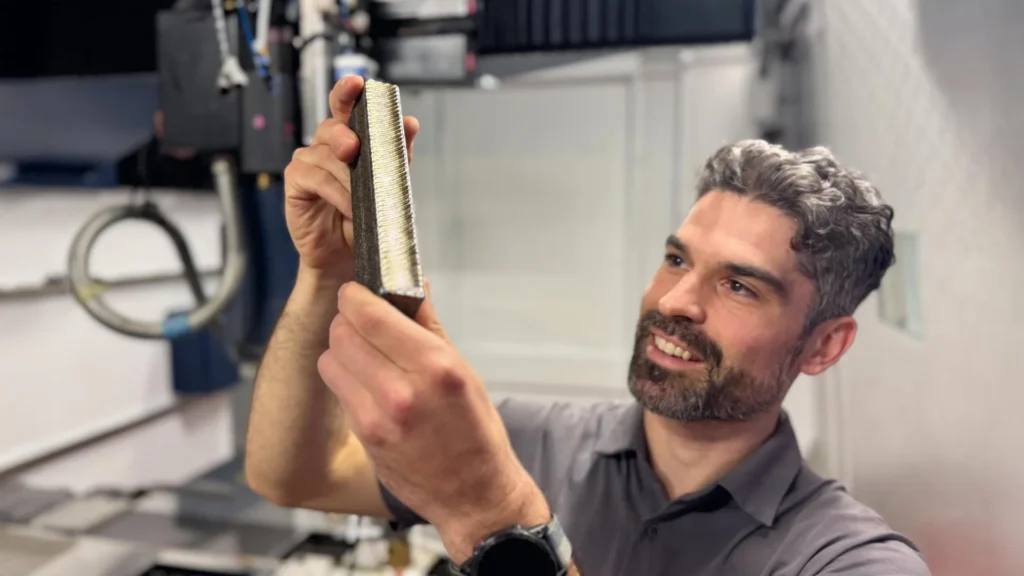
Ryan Brooke, a PhD candidate at RMIT’s Centre for Additive Manufacturing (RCAM) and the lead author of the study, articulated this challenge. "3D printing allows faster, less wasteful and more tailorable production yet we’re still relying on legacy alloys like Ti-6Al-4V that doesn’t allow full capitalization of this potential. It’s like we’ve created an aeroplane and are still just driving it around the streets," Brooke explained. He emphasized that the true power of 3D printing, with its ability to create complex geometries and customized parts with minimal material waste, has been held back by the inherent properties of existing alloys.
The RMIT team’s research, now detailed in the prestigious scientific journal Nature Communications, outlines a methodical framework for selecting alloying elements. This framework prioritizes time and cost savings, specifically tailored to leverage the capabilities of emerging 3D printing technologies. The outcome is an alloy that is not only cheaper to produce but also exhibits improved mechanical properties.
Enhanced Performance and Manufacturing Efficiency
Crucially, testing of the newly developed alloy has demonstrated superior strength and performance characteristics when compared to standard 3D-printed titanium alloys such as Ti-6Al-4V. This is a critical factor for industries where material integrity and reliability are paramount. The alloy has shown a remarkable ability to print more evenly, avoiding the formation of undesirable columnar microstructures. These column-shaped grains, often observed in some 3D-printed alloys, can lead to uneven mechanical properties, creating weak points within a component.
"By developing a more cost-effective formula that avoids this columnar microstructure, we have solved two key challenges preventing widespread adoption of 3D printing," stated Brooke. He further elaborated that the team’s alloy achieves a uniform grain structure, which is vital for consistent mechanical performance. This, combined with reduced costs, makes the innovation a significant leap forward. The alloy is reportedly 29% cheaper to produce than standard titanium, a substantial cost saving that can translate into more affordable end products and broader market accessibility.
Beyond cost and structural integrity, the new alloy also boasts enhanced ductility, meaning it can be deformed under tensile stress without fracturing. This is a valuable attribute for applications requiring components that can withstand significant stress and strain, such as in aircraft engines or implantable medical devices.
Patent Protection and Commercialization Outlook
Recognizing the transformative potential of their discovery, RMIT University has taken steps to protect its intellectual property. The university has filed a provisional patent for its innovative approach to alloy design and production. This move signals a strong commitment to commercializing the technology and bringing it to market.
The research team is actively exploring commercial opportunities, engaging with industry leaders to gauge demand and identify strategic partnerships. Brooke, who has recently secured a Research Translation Fellowship at RMIT, is dedicated to steering the technology through its next developmental phases towards commercial viability. His engagement with industry representatives through programs like CSIRO’s ON Prime initiative has provided valuable market insights.
"What I heard loud and clear from end users was that to bring new alloys to market, the benefits have to not just be minor incremental steps but a full leap forward, and that’s what we have achieved here," Brooke commented, underscoring the significant impact of their breakthrough. The feedback from aerospace, automotive, and MedTech industries has consistently pointed towards a need for substantial advancements, not just marginal gains, to justify the adoption of new materials and manufacturing processes.
A Framework for Future Innovation
The Nature Communications publication serves not only to showcase the specific alloy but also to present a broader, reproducible framework for designing new metallic alloys for additive manufacturing. This framework provides a clearer pathway for predicting the printed grain structure of metallic alloys, a crucial aspect for controlling the final properties of 3D-printed parts. By understanding and controlling grain structure, engineers can precisely tailor the mechanical behavior of components to meet specific application requirements.
Professor Mark Easton, the corresponding author of the study and a key figure at RCAM, expressed enthusiasm for the future prospects of this new alloy. "We are very excited about the prospects of this new alloy, but it requires a team from across the supply chain to make it successful. So, we are looking for partners to provide guidance for the next stages of development," he stated. This call for collaboration highlights the understanding that innovation in additive manufacturing often requires a multi-disciplinary effort, involving material scientists, engineers, manufacturers, and end-users.
The research and development leading to this breakthrough were conducted at RMIT’s state-of-the-art Advanced Manufacturing Precinct, equipped with cutting-edge facilities for materials processing and characterization. The ability to produce and rigorously test samples in-house has been instrumental in validating the alloy’s performance and potential.
Implications for Key Industries
The implications of this cost-effective, high-performance 3D-printable titanium alloy are far-reaching:
-
Aerospace: The aviation industry is a major consumer of titanium due to its high strength-to-weight ratio, essential for reducing aircraft mass and improving fuel efficiency. Lowering the cost of 3D-printed titanium could enable the production of lighter, more complex, and highly customized aircraft components, such as engine parts, structural elements, and interior fittings. This could lead to significant savings in manufacturing and operational costs for airlines. The ability to print intricate designs also opens doors for more aerodynamic and integrated component solutions.
-
Medical Devices: Titanium is widely used in medical implants, prosthetics, and surgical instruments due to its biocompatibility and durability. The development of a cheaper, yet stronger and more ductile, 3D-printable titanium alloy could make advanced custom implants more accessible and affordable for patients. It could also accelerate the development of novel medical devices with enhanced functionality and patient-specific designs, improving surgical outcomes and patient recovery. The uniform grain structure is particularly beneficial for implants, ensuring long-term stability and reducing the risk of fatigue failure.
-
Automotive: While perhaps not as prevalent as in aerospace, the automotive sector is increasingly exploring titanium for high-performance applications, especially in racing and luxury vehicles where weight reduction and durability are critical. The cost reduction offered by this new alloy could make titanium a more viable option for a wider range of automotive components, contributing to improved fuel efficiency and performance.
-
Broader Additive Manufacturing Adoption: This innovation contributes to the ongoing maturation of the 3D printing industry. By addressing key barriers such as cost and material limitations, it paves the way for wider adoption of additive manufacturing across various sectors, fostering a more agile, sustainable, and innovative manufacturing landscape. The framework for alloy design also empowers future research and development, accelerating the creation of next-generation advanced materials.
A Look Ahead
The RMIT team’s achievement marks a significant milestone in the pursuit of advanced materials for additive manufacturing. The combination of reduced cost, enhanced mechanical properties, and a systematic approach to alloy design positions this new titanium alloy as a potential game-changer. As RMIT actively seeks industry partners, the path forward involves rigorous testing, scaling up production processes, and navigating the regulatory landscape for specific applications. The successful commercialization of this technology could usher in a new era of design possibilities and manufacturing efficiencies, driven by the unique capabilities of 3D printing and the innovative spirit of Australian engineering. The journey from laboratory breakthrough to widespread industrial application is complex, but the fundamental advancements made by the RMIT engineers have laid a robust foundation for a more accessible and advanced future for titanium in additive manufacturing.