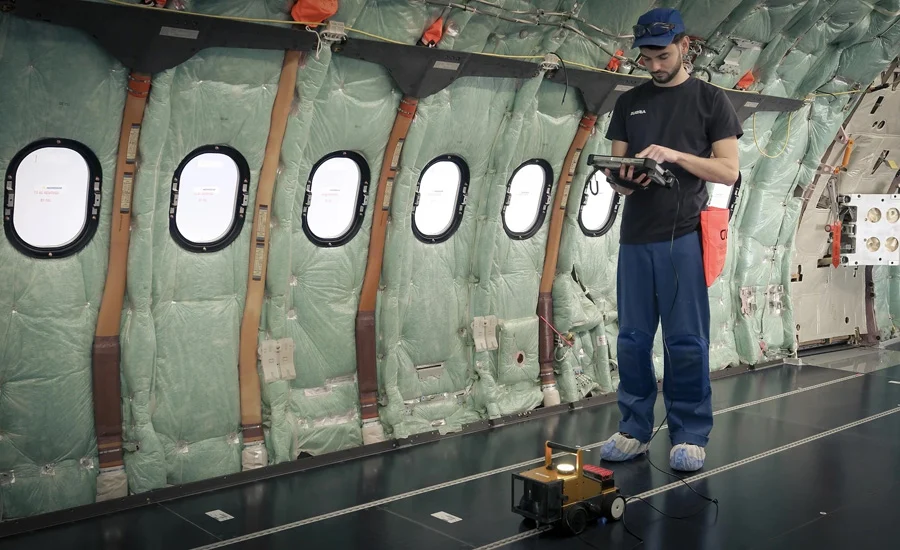
TOULOUSE, France — A compact, highly autonomous mobile robot, weighing just 4 kilograms, is making a monumental impact at the Airbus assembly plant in Toulouse, fundamentally transforming the labor-intensive process of marking passenger seat locations within unfinished aircraft. Named CabinMarker, this innovative robotic solution independently navigates the aircraft interior, precisely identifying and marking bolt positions for each passenger seat, a task that historically presented significant challenges in terms of time, accuracy, and worker ergonomics. Its introduction marks a pivotal advancement in Airbus’s ongoing commitment to leveraging cutting-edge automation for enhanced manufacturing efficiency and quality within its expansive global operations, particularly for high-volume programs like the A320 family.
The Genesis of Innovation: Addressing Deep-Rooted Industry Challenges
The aviation industry, characterized by its stringent safety standards and the immense scale of its products, has long grappled with the complexities inherent in aircraft manufacturing. Among the myriad tasks involved in assembling a modern jetliner, the interior outfitting—specifically the precise installation of thousands of passenger seats—has remained a particularly demanding and often manual endeavor. The configuration of seating within an aircraft is not static; it varies significantly based on the purchasing airline’s specifications, the aircraft model, and the intended route network. This bespoke nature necessitates highly accurate marking of seat bolt locations to ensure compliance with design schematics and regulatory requirements.
Prior to the advent of CabinMarker, this critical process was predominantly manual, requiring skilled technicians to meticulously crawl along the aircraft floor. These workers would use physical templates, painstakingly positioning them across the vast cabin expanse, and then marking each individual bolt location with a felt-tip pen. This method was not only physically arduous, demanding hours of uncomfortable postures and repetitive movements that put strain on workers’ knees and backs, but also inherently prone to human error. Even with the aid of templates, slight misalignments or inconsistencies could lead to inaccuracies that would require rework, further delaying production and increasing costs. The sheer scale of an aircraft cabin, capable of accommodating hundreds of passengers, meant that this single task could consume several hours, often up to 150 minutes for a single aircraft. The aerospace manufacturing sector, always under pressure to optimize production cycles and reduce costs while maintaining uncompromising quality, recognized this as a ripe area for innovative intervention. Airbus, a leader in aerospace manufacturing, sought a solution that could not only alleviate the physical burden on its workforce but also enhance precision and dramatically cut down production time.
CabinMarker: A Closer Look at the Technology
The CabinMarker robot emerges as a direct response to these long-standing challenges, embodying the principles of Industry 4.0 and advanced robotics. Programmed directly from the comprehensive Computer-Aided Design (CAD) files of each specific aircraft configuration, the wheeled robot is equipped with sophisticated navigation systems that allow it to autonomously glide through the aircraft cabin. Its ability to interpret CAD data directly ensures that each bolt location is marked with pinpoint accuracy, eliminating the variances inherent in manual templating and marking.
The robot’s compact size and light weight (just 4 kilograms) are critical design features. This allows it to maneuver effortlessly within the confined spaces of an aircraft interior, including narrow aisles and around existing structural elements, without requiring heavy-duty infrastructure or extensive modifications to the assembly line. Its autonomous operation means that once initiated, it can complete its task without continuous human intervention, freeing up highly skilled technicians to focus on more complex, value-added tasks that still require human dexterity and cognitive judgment. The transformation in efficiency is stark: what once took a human worker approximately 150 minutes, the CabinMarker now completes in an astonishing 30 minutes – an 80% reduction in time for this specific task. This substantial time saving directly translates into faster production cycles, increased throughput, and ultimately, a more competitive manufacturing operation for Airbus.
A Chronology of Development and Deployment
The journey of the CabinMarker robot from concept to operational reality underscores Airbus’s methodical approach to innovation and its long-term vision for advanced manufacturing. The initial prototype of the robot was first unveiled in 2018, signaling Airbus’s intent to explore autonomous solutions for interior assembly. This initial phase involved rigorous testing, refinement, and validation, ensuring the robot met the stringent safety and performance standards required for aerospace applications. The development process, conducted entirely in-house by Airbus engineers, reflects the company’s deep expertise in both aircraft design and manufacturing processes.
Following several years of intensive development and validation, the CabinMarker robot achieved a significant milestone in December 2025, when it was officially certified for industrial use. This certification was a critical step, confirming its reliability, accuracy, and safety for integration into the demanding environment of a final assembly line. Immediately following certification, the first two production units of the CabinMarker were deployed onto the final assembly line for the A321 aircraft at the Toulouse facility. The A321, a stretched variant of the popular A320 family, represents a high-volume production program for Airbus, making it an ideal candidate for demonstrating the robot’s immediate impact on efficiency and quality. This strategic deployment allows Airbus to gather real-world performance data, further optimizing the robot’s operation and preparing for broader implementation across its global manufacturing network.
Transformative Impact on Production and Workforce
The impact of the CabinMarker robot extends far beyond mere time savings. Its deployment has catalyzed improvements across several critical dimensions of aircraft manufacturing:
- Increased Quality and Accuracy: By leveraging CAD data and precision robotics, CabinMarker virtually eliminates the potential for human error in marking seat bolt locations. This translates into higher quality installations, reducing the likelihood of rework and ensuring that aircraft interiors meet design specifications with unparalleled consistency. For an industry where precision directly correlates with safety and operational longevity, this is an invaluable asset.
- Improved Ergonomics and Worker Safety: One of the most significant benefits is the alleviation of ergonomic strain on workers. The manual process of crawling, bending, and repetitive marking was physically taxing, leading to potential long-term health issues for employees. By automating this task, CabinMarker enhances workplace safety and improves the overall working conditions for technicians, allowing them to perform their duties in a more comfortable and sustainable manner.
- Enhanced Production Efficiency: The dramatic reduction in marking time from 150 minutes to 30 minutes per aircraft directly contributes to faster assembly times. This accelerated pace helps Airbus meet its ambitious production targets, especially crucial given the strong demand for the A320 family of aircraft.
- Resource Reallocation: With the CabinMarker handling the marking task, only a handful of operators are needed to oversee its operation, monitor its progress, and perform routine maintenance. This frees up a significant portion of the skilled workforce who were previously engaged in the manual marking process. These valuable human resources can now be redeployed to higher-value, more complex tasks within the assembly process that require human problem-solving, critical thinking, and fine motor skills, thereby optimizing the utilization of Airbus’s highly trained personnel.
"The introduction of CabinMarker represents a significant leap forward in our pursuit of manufacturing excellence," stated an inferred Airbus spokesperson, possibly a Head of Manufacturing or Chief Operating Officer. "It’s not merely about automating a task; it’s about elevating the quality of our product, safeguarding the well-being of our employees, and strategically reallocating human ingenuity to areas where it can create the most value. This robot is a testament to our vision of a smarter, more efficient, and more human-centric ‘Factory of the Future’."
Strategic Vision: Airbus’s Digital Transformation
The CabinMarker robot is not an isolated innovation but a tangible manifestation of Airbus’s broader "Digital Factory" and Industry 4.0 initiatives. Airbus has been a vocal proponent of integrating digital technologies, automation, and advanced analytics into its production systems to create highly flexible, efficient, and interconnected manufacturing environments. This strategy aims to enhance productivity, reduce costs, improve quality, and ensure the company remains at the forefront of aerospace manufacturing innovation.
The successful in-house development and deployment of CabinMarker underscore Airbus’s internal capabilities in robotics and automation. It signifies a strategic decision to cultivate proprietary technological solutions that are perfectly tailored to the unique complexities and demands of aircraft production. This approach not only provides Airbus with a competitive edge but also allows for greater control over intellectual property and future development pathways. Industry analysts view such targeted automation as critical for major aerospace players. "The aerospace industry is notoriously complex, with high capital costs and long production cycles," remarked an inferred aerospace industry analyst. "Solutions like CabinMarker, which address specific, high-labor, high-error-potential bottlenecks, are key to unlocking greater efficiency and flexibility. Airbus is clearly investing in intelligent automation to maintain its competitive position in a demanding global market."
Beyond Seat Marking: Future Applications and Scalability
The initial success and proven versatility of the CabinMarker robot have already inspired Airbus engineers to envision a future where its capabilities extend far beyond seat marking. The modular design and autonomous navigation platform make it an ideal candidate for a variety of additional tasks within the aircraft interior.
Airbus plans to introduce the robot at other assembly plants over the next several months, standardizing this efficiency gain across its global production network. Furthermore, the engineers are actively exploring new functionalities for the CabinMarker platform:
- Automated Corrosion Detection: By swapping its current marking pen for a high-resolution camera and integrating advanced image processing algorithms, CabinMarker could be repurposed as an automated corrosion detection scout. It could systematically scan vast interior surfaces, identifying early signs of corrosion or structural fatigue that might be missed by the human eye or require more invasive inspection methods. This application would significantly enhance aircraft maintenance efficiency and safety.
- Automated Cleaning and Taping: Another proposed enhancement involves equipping the robot with a vacuum and tape mechanism. This would allow it to automate the tedious and time-consuming process of cleaning aircraft floor rails and applying protective tape during various stages of assembly or maintenance. Such tasks, while seemingly minor, contribute significantly to overall labor hours and can be physically repetitive for human workers.
"The CabinMarker platform is designed with adaptability in mind," an inferred R&D lead at Airbus commented. "Its core strength lies in its autonomous navigation and precision manipulation. By leveraging this, we can rapidly develop new modules and applications, transforming it into a multi-functional interior assistant. This vision extends to enhancing not just assembly, but also maintenance and even potential cabin preparation tasks." These planned expansions highlight Airbus’s long-term strategy to maximize the return on its robotics investment, demonstrating the potential for mobile, adaptable robots to become indispensable tools across the entire lifecycle of an aircraft.
Broader Implications for Aerospace Manufacturing
The successful deployment of the CabinMarker robot by Airbus holds significant implications for the broader aerospace manufacturing industry. It sets a new benchmark for how manufacturers can address labor-intensive, repetitive tasks with precision automation. Other major aircraft manufacturers and even suppliers may look to emulate this model, driving further innovation in mobile robotics and intelligent automation within their own facilities.
The trend towards increased customization in aircraft interiors, driven by airline demands for unique branding and passenger experience, makes automated solutions like CabinMarker even more critical. The ability to rapidly reconfigure production systems based on digital design files allows manufacturers to respond to these bespoke requirements without incurring significant time or cost penalties. This flexibility is a key differentiator in a highly competitive market.
Moreover, the emphasis on improving worker ergonomics is gaining traction across all heavy industries. As the global workforce ages and awareness of occupational health and safety increases, companies are actively seeking ways to reduce physical strain on employees. Robotics and automation play a crucial role in achieving this, allowing human workers to transition from physically demanding roles to supervisory, programming, or maintenance positions that require different, often higher-level, skill sets.
The Evolving Role of Human Labor
The introduction of robots like CabinMarker inevitably sparks discussions about the future of human labor. However, in the context of advanced manufacturing, the prevailing trend is not outright job displacement but rather job transformation and upskilling. By taking over the repetitive, physically taxing tasks, robots free up human workers to focus on activities that demand cognitive skills, problem-solving, quality assurance, and direct human interaction.
"Our goal is not to replace our skilled workforce, but to empower them," emphasized an inferred representative from a union or human resources department at Airbus. "We are investing in training programs to equip our employees with the skills needed to operate and maintain these advanced robots, to analyze the data they generate, and to take on new, more intellectually stimulating roles. This shift enhances job satisfaction and contributes to a safer, more technologically advanced workplace." This perspective highlights the need for continuous learning and adaptation within the workforce, a critical component of successful industrial automation strategies.
In conclusion, the CabinMarker robot represents a significant milestone for Airbus and a powerful demonstration of the transformative potential of targeted automation in heavy industries. By addressing a specific, historically challenging task with innovative robotic technology, Airbus has not only dramatically improved efficiency and quality on its A321 final assembly line but has also significantly enhanced worker ergonomics and set a clear path for future applications of this versatile platform. As Airbus continues to roll out CabinMarker across its facilities and explore its expanded capabilities, it reinforces its position at the vanguard of the digital transformation reshaping the future of aerospace manufacturing.