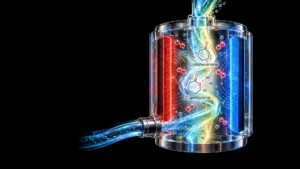
Nagoya University, Japan – Scientists at Nagoya University have achieved a groundbreaking milestone in solid-state battery technology, reporting a record-high lithium-ion conductivity of 16.3 millisiemens per centimeter (mS/cm) for an oxyfluoride solid electrolyte, known as LLNOF. This unprecedented performance, the highest ever recorded for an oxide-related solid electrolyte, was attained after researchers meticulously uncovered the intricate mechanism by which lithium ions navigate through the material. The discovery not only sets a new benchmark for conductivity but also fundamentally redefines understanding of ion transport in solid materials, potentially accelerating the development of next-generation batteries that combine unparalleled safety with high energy density and rapid charging capabilities.
Unveiling the Record: LLNOF’s Remarkable Conductivity
The 16.3 mS/cm conductivity achieved by the Nagoya University team represents a significant leap forward in the quest for practical solid-state batteries. To put this figure into perspective, conventional liquid electrolytes in current lithium-ion batteries typically exhibit conductivities ranging from 10 to 20 mS/cm. While some sulfide-based solid electrolytes have approached or even surpassed these values, they often come with inherent safety drawbacks, such as the release of toxic hydrogen sulfide gas upon exposure to moisture. The LLNOF material, an oxyfluoride, offers the robust electrochemical stability and safety profile characteristic of oxide-based materials, which have historically suffered from lower conductivity.
This achievement did not emerge in isolation. The LLNOF material had already garnered significant attention within the scientific community earlier in 2024 when researchers first reported a conductivity of 7 mS/cm. While this initial finding was promising, the precise reason behind its unusually rapid lithium-ion movement remained an enigma. The latest breakthrough not only explains this phenomenon but also dramatically enhances its performance, moving solid-state technology closer to widespread commercial viability. This record-setting conductivity positions LLNOF as a leading contender in the global race to develop solid-state batteries, which are widely considered the holy grail of energy storage.
The Ingenious Mechanism: Fluoride’s Dynamic Role in Ion Transport
The core of this breakthrough lies in the detailed understanding of how lithium ions achieve such high mobility within the LLNOF crystal structure. Through rigorous analysis, the research team, led by Associate Professor Takeshi Yajima of Nagoya University’s Department of Materials Design Innovation Engineering, discovered a subtle yet profoundly impactful interaction. They found that a fluoride ion, centrally located within a tetrahedral arrangement of atomic sites, plays an active role in facilitating lithium-ion movement.
Specifically, whenever a lithium ion prepares to jump from its current position into an adjacent vacant site, the fluoride ion within the local structure shifts slightly. This minute, dynamic movement effectively "clears a path" for the migrating lithium ion, significantly lowering the energy barrier required for its hop. In essence, the fluoride ion is not merely a static spectator in the ionic transport process but an active participant, dynamically reconfiguring the local environment to enable faster lithium-ion diffusion.
This finding challenges a long-held conventional wisdom in solid-state electrolyte design, which often posits that high conductivity primarily depends on the presence of highly deformable negative ions, such as the larger sulfide ions found in sulfide-based electrolytes. The LLNOF discovery demonstrates that even less deformable anions, like fluoride, can contribute to exceptional conductivity through a dynamic, structural rearrangement mechanism. This paradigm shift in understanding opens entirely new avenues for designing and optimizing solid-state electrolyte materials, particularly within the safer and more stable oxide and oxyfluoride families.
Addressing the "Trade-Off": Bridging Safety and Conductivity
The development of advanced energy storage systems has long been plagued by a fundamental trade-off between safety and performance. Traditional lithium-ion batteries, ubiquitous in consumer electronics and electric vehicles, rely on flammable liquid electrolytes. While these electrolytes offer high conductivity, they pose significant safety risks, including thermal runaway, fire, and explosion, particularly if the battery is physically damaged or overcharged. The infamous incidents of battery fires in various applications underscore the urgent need for safer alternatives.
Solid-state batteries, which replace the liquid electrolyte with a solid material, inherently address many of these safety concerns. By eliminating the flammable liquid component, the risk of thermal runaway is drastically reduced, making them intrinsically safer. However, the journey to practical solid-state batteries has been fraught with challenges, primarily the difficulty in achieving sufficient ionic conductivity in solid materials at room temperature and ensuring stable interfaces with electrodes.
While sulfide-based solid electrolytes have shown promise in terms of high conductivity, they introduce another set of safety issues. Many sulfide materials react with moisture to release toxic hydrogen sulfide gas, posing environmental and health hazards. Oxide and oxyfluoride materials, like LLNOF, offer superior chemical and electrochemical stability, making them robust and environmentally benign. Their Achilles’ heel, however, has traditionally been their lower lithium-ion conductivity compared to their sulfide counterparts.
Associate Professor Takeshi Yajima articulated this dilemma, stating, "At this stage, safety and ionic conductivity are a trade-off. Oxyfluorides are safer but have low conductivity, while sulfides have high conductivity but can be dangerous." The LLNOF breakthrough directly confronts this trade-off, demonstrating that it is possible to achieve both high conductivity and inherent safety within a single material. This dual advantage positions LLNOF as a strong candidate for overcoming one of the most significant hurdles in solid-state battery commercialization.
The Rigorous Journey: From Hypothesis to High-Quality Crystals
Achieving this breakthrough was far from trivial, demanding meticulous experimental work and advanced analytical techniques. A critical first step for Yajima’s team was the successful synthesis of high-quality single crystals of LLNOF, which are indispensable for detailed structural analysis. Unlike polycrystalline materials, single crystals offer a uniform atomic arrangement, allowing for precise determination of atomic positions and movements.
The researchers spent more than a year developing millimeter-sized single crystals using a sophisticated technique known as the Bridgman method. This crystal growth technique involves slowly cooling a molten material from one end, allowing a single crystal to nucleate and grow progressively. The demanding nature of this process underscores the patience and precision required to create samples suitable for atomic-level investigation.
Once high-quality single crystals were obtained, the team employed single-crystal diffraction to probe the material’s atomic structure. This technique involves bombarding the crystal with X-rays or neutrons and analyzing the diffraction patterns produced. By studying these patterns, scientists can deduce the arrangement of atoms within the crystal lattice and, crucially, observe subtle changes in their positions as lithium ions move. It was through this detailed structural analysis that the dynamic role of the fluoride ion in facilitating lithium-ion transport was conclusively identified, moving the understanding from mere observation to mechanistic explanation.
Optimizing Performance: The Impact of Material Composition
Beyond understanding the fundamental mechanism, the Nagoya University team further optimized the LLNOF material’s performance by strategically adjusting its chemical composition. The material’s formula can be represented with a variable, ‘x’, which dictates the relative amounts of lithium, lanthanum, and vacant sites within the crystal structure. The presence of vacant sites is crucial for ion transport, as lithium ions must jump into these empty positions.
By carefully lowering the value of ‘x’, the researchers were able to increase the concentration of these critical vacant sites, thereby facilitating even faster lithium-ion movement. This compositional tuning directly led to the astonishing conductivity of 16.3 mS/cm. This result highlights the importance of not only understanding the fundamental transport mechanisms but also of precise materials engineering to leverage these mechanisms for optimal performance. The ability to manipulate conductivity through compositional adjustments provides a powerful design principle for developing future generations of solid-state electrolytes.
Broader Implications for Solid-State Battery Development
The implications of this breakthrough extend far beyond the laboratory, potentially revolutionizing multiple sectors that rely on advanced energy storage.
- Electric Vehicles (EVs): Safer, higher-energy-density batteries could translate into longer driving ranges, faster charging times, and reduced fire risks for electric vehicles. This could accelerate EV adoption and alleviate range anxiety among consumers. The ability to pack more energy into a smaller, lighter battery would also improve vehicle performance and design flexibility.
- Grid Storage: For large-scale energy storage systems supporting renewable energy grids, solid-state batteries could offer enhanced safety, longer lifespan, and higher efficiency compared to current technologies. This would make renewable energy sources like solar and wind more reliable and dispatchable.
- Portable Electronics: Higher energy density would enable smaller, lighter, and more powerful smartphones, laptops, and wearable devices, while the inherent safety would mitigate concerns about battery swelling or overheating.
- Market Projections: The global market for solid-state batteries is projected to grow exponentially, with some estimates predicting it to reach tens of billions of dollars by the next decade. Breakthroughs like the one from Nagoya University are critical drivers of this growth, attracting significant investment and fostering innovation across the industry. Major automotive companies like Toyota, Volkswagen, and Ford, alongside dedicated battery startups such as QuantumScape and Solid Power, are heavily invested in solid-state battery development, recognizing their transformative potential.
Challenging Conventional Wisdom: A Paradigm Shift in Electrolyte Design
The discovery that fluoride ions actively participate in facilitating lithium-ion transport in LLNOF fundamentally challenges the conventional understanding that high conductivity in solid electrolytes is primarily contingent on highly deformable negative ions, such as those found in sulfide-based materials. For years, the scientific community largely believed that the "soft" and larger sulfide ions provided a more flexible lattice through which lithium ions could easily migrate.
This new mechanism demonstrates that even "harder" and smaller anions like fluoride can enable exceptional conductivity through a dynamic structural re-arrangement. As Yajima noted, "The general understanding has been that sulfide-based materials are better conductors because of their anion character, but this mechanism challenges that understanding." This re-evaluation opens up a vast new chemical space for exploring and designing oxide-based solid electrolytes. Researchers can now look beyond anion deformability as the sole determinant of conductivity and instead focus on designing materials where dynamic ion-lattice interactions actively lower energy barriers for transport. This conceptual shift could lead to the discovery of entirely new classes of high-performance, safe solid electrolytes.
The Road Ahead: Remaining Hurdles and Future Prospects
While the achievement at Nagoya University marks a monumental step, the journey to widespread commercialization of solid-state batteries still faces several hurdles.
- Scalability and Cost: The current method of producing high-quality single crystals using the Bridgman method is often slow and expensive, making it challenging for mass production. Developing cost-effective and scalable manufacturing techniques for LLNOF or similar materials is crucial. This includes exploring alternative synthesis methods that can produce high-quality material in larger quantities at lower costs.
- Interface Stability: Ensuring a stable and low-resistance interface between the solid electrolyte and the electrodes over thousands of charge-discharge cycles remains a significant challenge. Poor interface contact can lead to increased internal resistance, reduced power output, and degradation of battery performance over time.
- Long-Term Performance: While lab results are promising, validating the long-term durability, cycle life, and performance of these materials under real-world operating conditions (varying temperatures, charge rates, mechanical stress) is essential.
- Global Competition: The race for solid-state battery dominance is intense, with numerous research institutions and companies globally pursuing different material chemistries (sulfides, polymers, oxides) and architectures. Continued innovation will be necessary to stay competitive.
Despite these challenges, the breakthrough from Nagoya University provides a clear pathway forward. By elucidating the underlying mechanism of high conductivity in a safe oxyfluoride material, the researchers have armed the scientific community with invaluable knowledge for designing future solid electrolytes. The ability to achieve high conductivity without compromising safety addresses one of the most critical challenges in developing practical solid-state batteries.
Conclusion: Paving the Way for a Safer, More Efficient Energy Future
The record-breaking 16.3 mS/cm conductivity in the LLNOF oxyfluoride solid electrolyte, coupled with the detailed understanding of its dynamic ion transport mechanism, represents a pivotal moment in battery research. This achievement by Nagoya University scientists offers a compelling solution to the long-standing trade-off between battery safety and performance, promising a future where electric vehicles can travel farther and charge faster, grid storage systems are more reliable, and portable electronics are safer and more powerful. As research continues to tackle the remaining engineering and manufacturing challenges, this fundamental discovery stands as a testament to human ingenuity, paving the way for a safer, more efficient, and sustainable energy landscape for generations to come.