The exponential growth in digital information generation, processing, and storage has ushered in an era defined by data. From the intricate algorithms powering internet searches to the visual marvels of AI-generated images, the precision of recommendation systems, the complexity of scientific simulations, and the transformative capabilities of large language models, every facet of modern digital existence hinges on colossal amounts of information being created, moved, stored, and meticulously analyzed. As artificial intelligence continues its profound integration into the fabric of everyday life, across diverse industries, and within the vanguard of scientific research, the global demand for sheer computing power and robust data storage capacities is escalating at an unprecedented rate. This relentless upward trajectory, while heralding unparalleled advancements and efficiencies, concurrently casts a long shadow, revealing a major and increasingly urgent challenge: the burgeoning demand for electricity.
The Escalating Energy Challenge of the Digital Age
Data centers, the physical infrastructure housing the computational engines of the digital world, already consume prodigious amounts of power. Their collective energy demands are not merely substantial but are projected to rise dramatically over the coming decades, threatening to strain global energy grids and exacerbate environmental concerns. Without concerted and significant improvements in energy efficiency across the entire spectrum of information and communication technologies, these critical digital infrastructures could eventually account for a substantial, indeed alarming, share of worldwide electricity consumption and, consequently, global carbon emissions. The implications are stark: an unsustainable growth trajectory that necessitates immediate and innovative solutions. Therefore, the quest for methods to render computing more energy-efficient has transitioned from an academic pursuit to an economic, environmental, and societal imperative as the demand for digital services accelerates without pause.
This escalating challenge underscores the profound significance of recent research breakthroughs aimed at fundamentally rethinking how digital information is handled at its most basic level. In a significant development, researchers at the University of Edinburgh have unveiled a novel theoretical framework designed to drastically reduce the energy expenditure associated with storing and manipulating digital information—the ubiquitous "bits," represented as "0"s and "1"s—within future generations of magnetic memory technologies. This work promises to bring the digital world closer to a sustainable future by tackling the energy problem at its core.
Understanding the Core Problem: The Energy Cost of a Bit
To appreciate the magnitude of this breakthrough, it’s essential to understand the fundamental mechanics and current limitations of digital memory. At its heart, all digital memory relies on the ability to represent and switch between two distinct states, typically 0 and 1. In magnetic memory, this involves changing the magnetic orientation of tiny domains within a material. This "switching" action is the basic mechanism behind data manipulation – writing, reading, and erasing information. Every time a bit is flipped, energy is consumed. With trillions upon trillions of these operations occurring every second across the globe, the cumulative energy cost becomes staggering.
Current memory technologies, while powerful, operate far from the theoretical minimum energy required.
- Dynamic Random-Access Memory (DRAM): The workhorse of modern computing, DRAM is fast but volatile, meaning it requires constant refreshing (and thus constant power) to retain data. This refreshing process is inherently energy-intensive. A single DRAM cell might consume picojoules (pJ) of energy per bit for a write operation, and even more for constant refreshing.
- Spin-Transfer Torque Magnetic Random-Access Memory (STT-MRAM): An emerging non-volatile memory, STT-MRAM offers advantages like data retention without power. However, the process of switching magnetic states in STT-MRAM still requires a relatively high current density, leading to significant energy dissipation during write operations, often in the order of hundreds of femtojoules (fJ) to a few picojoules per bit.
- Spin-Orbit Torque Magnetic Random-Access Memory (SOT-MRAM): Building on STT-MRAM, SOT-MRAM aims for even faster and more efficient switching by leveraging spin-orbit coupling. While promising a reduction in energy consumption compared to STT-MRAM, it still operates well above the fundamental limits, typically consuming tens to hundreds of femtojoules per bit.
The cumulative energy footprint of these technologies, multiplied by the sheer volume of data operations globally, contributes significantly to the 1-2% of global electricity currently consumed by data centers, a figure projected to climb to 8-10% by 2030 if current trends persist without substantial efficiency gains. This makes the search for more efficient switching mechanisms not just desirable, but critical.
A Novel Approach: Optimal Control Theory for Magnetic Switching
Traditionally, the design of magnetic switching processes has relied on conventional, often heuristic, methods. These approaches, while functional, have not prioritized absolute energy minimization in the way that the accelerating demand for digital services now necessitates. The University of Edinburgh researchers, however, diverged from this established path, instead turning to a sophisticated mathematical framework known as Optimal Control Theory.
Optimal Control Theory is a branch of mathematics concerned with finding the best possible way to control a dynamic system over time to achieve a specific objective, subject to certain constraints. Imagine navigating a car from point A to point B: Optimal Control Theory could be used to calculate the most fuel-efficient route, considering factors like terrain, speed limits, and traffic. In the context of magnetic memory, the "system" is a magnetic bit, the "objective" is to switch its state (from 0 to 1 or vice versa), and the "constraints" include physical limitations of the material and the desire to minimize energy.
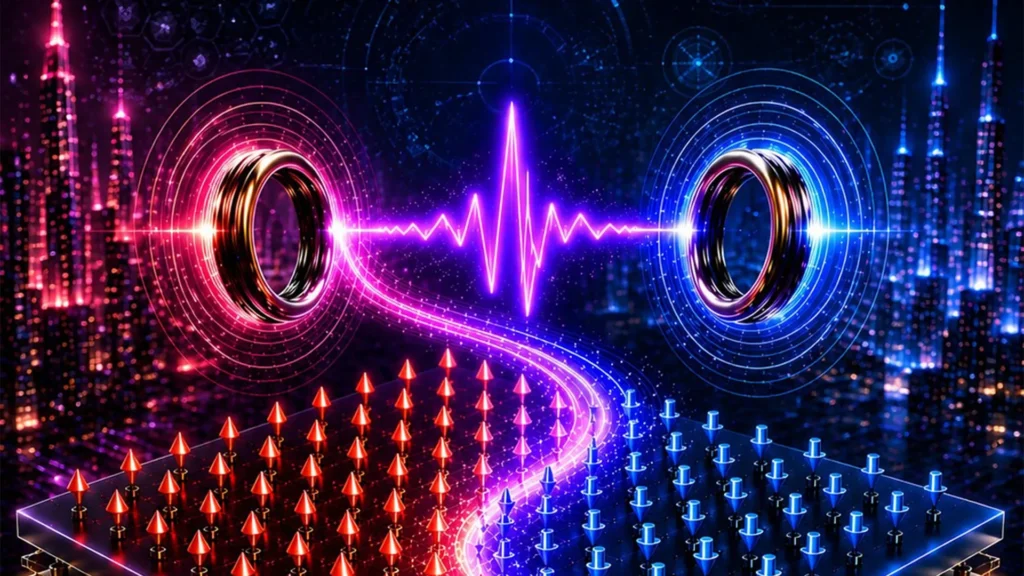
By applying this powerful mathematical approach, the research team developed a groundbreaking framework for designing ultrafast magnetic-field pulses. These pulses are not simply "on" or "off" but are intricately shaped in time, optimized to switch magnetic states with the absolute minimum energy consumption possible. Crucially, the complex calculations underpinning this framework also meticulously account for realistic experimental limitations, such as the inherent properties of magnetic materials and the practical constraints of device fabrication. This attention to real-world feasibility significantly enhances the relevance of their theoretical approach to the development of potential future devices, bridging the gap between abstract mathematics and tangible engineering solutions.
Unprecedented Efficiency: Nearing the Landauer Limit
The implications of this new theoretical framework are profound, as indicated by extensive computer simulations. These simulations suggest that the method could achieve a reduction in switching energy by several orders of magnitude when compared to leading memory technologies currently in use or under active development. This includes established technologies like DRAM, as well as more advanced non-volatile memories such as STT-MRAM and emerging SOT-MRAM devices. Such a drastic improvement could fundamentally alter the power consumption profile of future computing systems.
Even more strikingly, the predicted energy requirements for future magnetic memory, when designed using this framework, move remarkably closer to the Landauer limit. This limit, named after physicist Rolf Landauer, represents a fundamental thermodynamic boundary: the absolute minimum amount of energy required to erase a single bit of information. Specifically, the Landauer limit is defined as kT ln 2, where k is the Boltzmann constant, T is the absolute temperature, and ln 2 is the natural logarithm of 2. At room temperature, this translates to approximately 2.87 zJ (zeptojoules, 10^-21 Joules) per bit. For context, current memory technologies operate many thousands, if not millions, of times above this limit.
Approaching the Landauer limit is not merely an incremental improvement; it signifies a monumental leap in the pursuit of energy efficiency in computing. This limit is not a technological barrier but a fundamental boundary imposed by the laws of physics itself. Achieving energy consumption levels close to this theoretical minimum would mark a major advance in the decades-long global effort to make computing as energy efficient as physically possible. It suggests a future where the energy cost of digital operations is drastically reduced, enabling more powerful and sustainable computing.
From Theoretical Insight to Practical Implementation
The significance of the Edinburgh framework extends beyond mere theoretical calculations. As detailed in their publication in the prestigious journal Advanced Materials, the research also encompasses practical guidance for possible implementation. This includes specific recommendations for optimized device designs and innovative methods for delivering the precise magnetic fields required for ultra-efficient switching. These actionable recommendations are not abstract concepts but concrete pathways that could empower other researchers and engineers to eventually test the concept experimentally, transforming a mathematical ideal into a tangible technological reality. This forward-looking approach is crucial for accelerating the transition from laboratory simulations to real-world applications.
Beyond Magnetism: A Universal Principle
Dr. Elton Santos from the Institute for Condensed Matter Physics and Complex Systems at the University of Edinburgh, who spearheaded this pivotal research, articulated the broader implications of their findings: "Every digital operation has an energy cost, and that cost becomes increasingly important as AI and data-intensive technologies continue to expand. Our work shows that, by carefully designing how a magnetic field changes in time, magnetization can be switched far more efficiently than with conventional approaches." His statement succinctly encapsulates the core problem and the elegance of their solution.
Dr. Santos further elaborated on the versatility and far-reaching potential of the theoretical framework: "Although we first developed the theory using magnetic field pulses, the mathematics is far more versatile than that. The same framework can be adapted to electrical currents and even ultrafast laser pulses, which are among the most cutting-edge technologies for future data storage. That means the ideas developed here could have applications far beyond the systems we studied. It seems that we may have just found the next best thing."
This remarkable adaptability suggests that the principles uncovered by the Edinburgh team could be applied to a wide array of future memory technologies, regardless of their specific physical switching mechanism. Whether it’s through manipulating electron spins with electrical currents or exciting material properties with femtosecond laser pulses, the core mathematical approach of Optimal Control Theory offers a universal blueprint for maximizing efficiency. This expands the potential impact exponentially, offering a powerful tool for innovation across the entire landscape of non-volatile memory research and development.
Broader Impact and Implications: A Sustainable Digital Future
The implications of this research are multi-faceted and potentially transformative:
- Environmental Sustainability: A significant reduction in the energy consumption of data centers and computing devices would directly translate into a lower carbon footprint for the ICT sector. This aligns directly with global efforts to combat climate change and achieve net-zero emissions targets. It provides a tangible pathway towards a greener, more sustainable digital future.
- Economic Benefits: Lower energy consumption means reduced operational costs for data centers, which are currently battling escalating electricity bills. This could free up resources for further innovation and investment, potentially leading to more affordable digital services. It could also extend the battery life of portable devices, reducing the frequency of charging and enhancing user experience.
- Technological Advancement: By making memory operations vastly more efficient, this research could unlock new possibilities for computing. More powerful AI models could run with less energy, enabling advanced edge computing solutions closer to the data source, and fostering the development of even more sophisticated Internet of Things (IoT) devices with enhanced capabilities and longevity. It could pave the way for true ‘normally off’ computing, where devices consume negligible power when not actively in use.
- Scientific Breakthroughs: Approaching fundamental physical limits often opens new avenues for scientific inquiry and understanding. This research could inspire further exploration into the quantum mechanics of information processing and energy dissipation, pushing the boundaries of physics itself.
- Global Competitiveness: Nations and companies that successfully integrate such energy-efficient memory technologies could gain a significant competitive advantage in the rapidly evolving global technology landscape.
While the framework is currently theoretical, its robust foundation in Optimal Control Theory and its consideration of practical limitations provide a strong impetus for experimental validation. The journey from simulation to mass production is often long and challenging, involving overcoming material science hurdles, manufacturing complexities, and integration issues. However, the potential rewards are immense, promising to reshape the economics and environmental impact of the digital world.
In an era where data is the new oil, and AI the new electricity, finding ways to process and store this information with unprecedented energy efficiency is not merely an option, but a necessity. The University of Edinburgh’s breakthrough offers a beacon of hope, providing a theoretical compass to navigate towards a truly sustainable and powerful digital future, where the immense benefits of AI and ICT are not overshadowed by their environmental cost. The "next best thing" may indeed be a fundamental re-engineering of how we interact with the very bits that define our digital existence.