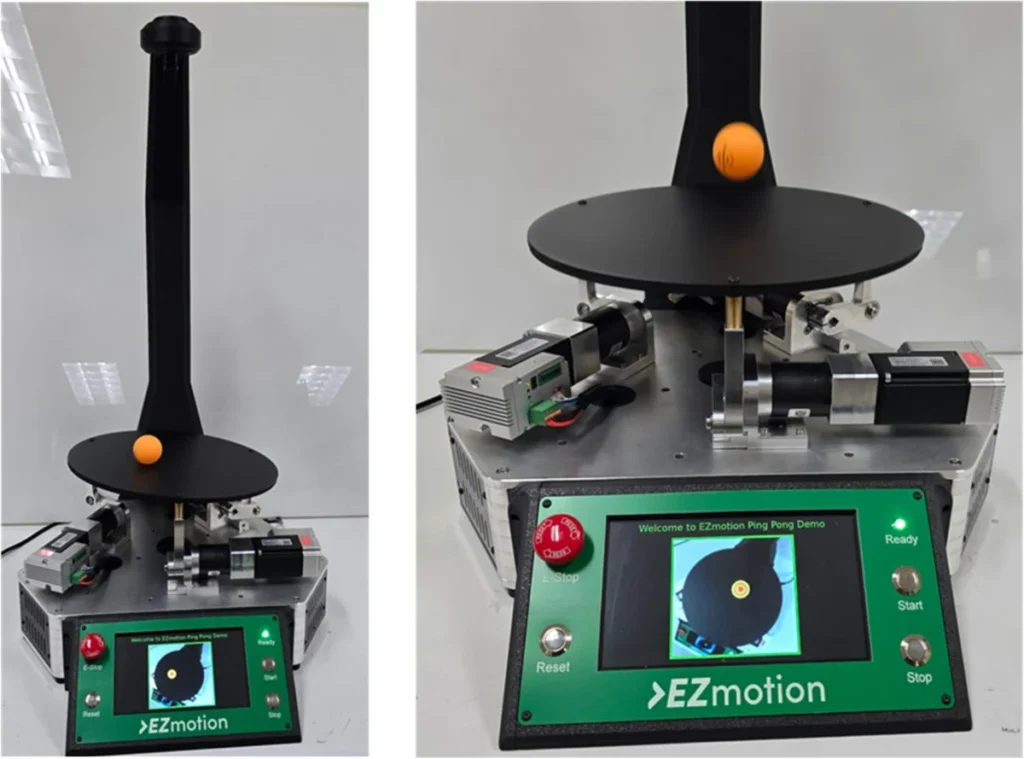
In a compelling demonstration of advanced motion control capabilities, a specialized three-axis parallel platform has been recently unveiled, showcasing the remarkable precision and real-time responsiveness of a new line of servomotors. This innovative system meticulously controls the unpredictable motion of a lightweight ping-pong ball, highlighting the motors’ prowess in dynamic balancing, swirling, and even bouncing tasks. The sophisticated setup integrates synchronized servo actuation with robust visual feedback and complex real-time kinematic computation, marking a significant stride in the development of highly accurate and responsive robotic systems.
The Demonstration Platform: A Masterclass in Precision

The core of this demonstration is a three-axis parallel platform, designed to interact with an object as delicate and reactive as a ping-pong ball. The inherent challenge in controlling such a lightweight and easily disturbed object underscores the extraordinary precision required from the underlying motion control system. Charan Bhamra, a Mechatronics engineer at Monolithic Power Systems, whose insights inform this development, emphasizes the criticality of seamless integration between hardware and software to achieve such nuanced control. The platform’s ability to maintain dynamic equilibrium, execute intricate swirling patterns, and even manage controlled bouncing of the ball serves as a vivid testament to the performance advantages offered by the featured servomotors.
Central to the platform’s functionality are integrated servomotors from EZmotion, which incorporate onboard drivers, high-resolution angle sensors, and CANopen support. These components collectively enable unparalleled motion resolution, instantaneous real-time response, and tight multi-axis synchronization. The demonstration specifically tackles complex engineering hurdles such as mitigating visual-feedback latency, ensuring precise synchronization across all three axes, and performing real-time inverse kinematics and proportional-integral-derivative (PID) control on embedded hardware. This meticulous attention to detail ensures that the system can interpret visual data, calculate necessary adjustments, and execute motor commands with minimal delay, providing a truly real-time control loop.

Integrated Servomotors: The Heart of the System
The servomotors employed in this cutting-edge platform, specifically the EZmotion MMS740100-24-C2-1, are 40-mm smart motors that represent a paradigm shift in motor design. Unlike traditional setups requiring separate motor drivers, controllers, and sensors, these units are fully integrated. Each motor houses a permanent-magnet synchronous motor, a driver module, an embedded motion controller, and a 14-bit resolution magnetic position sensor capable of tracking shaft position with sub-degree accuracy. This level of integration dramatically simplifies system architecture by eliminating the need for external boards and extensive wiring, promoting a true plug-and-play solution for complex motion control applications.

The embedded motion controller within each servomotor operates a sophisticated nested control loop, meticulously regulating current, velocity, and position in real-time. This multi-layered control ensures that the motors respond precisely to commands, maintaining stability and accuracy even under rapidly changing conditions. Furthermore, the inclusion of an onboard CAN transceiver facilitates direct integration into a CANopen network, a standardized communication protocol widely adopted in industrial automation for its reliability and deterministic characteristics. A dedicated power management solution within each motor also guarantees stable internal voltages, enhancing operational safety and longevity. This holistic integration of critical components — sensor, driver, controller, communication, and power — into a single device significantly reduces system complexity, cost, and physical footprint, making these servomotors ideal for compact and high-performance applications.
Real-time Intelligence: Vision and Kinematics

The architecture of the parallel platform is a testament to intelligent computational partitioning. A Raspberry Pi 5 device is tasked with the demanding visual feedback processing, leveraging its computational power to run a lightweight Python script utilizing OpenCV. A top-mounted USB camera captures video frames at a moderate yet effective rate of 40 frames per second. These frames undergo a series of image processing steps: a Gaussian blur is applied to reduce noise, followed by conversion to the Hue, Saturation, Value (HSV) color space.
To facilitate robust tracking, the ping-pong ball is specifically chosen for its orange color, allowing the system to apply a color mask for isolation. Contour filtering then helps precisely identify the ball’s boundaries. The system extracts the center coordinates from the smallest circle that fully encloses the largest detected contours, providing accurate XY plane position data. Crucially, the Z-position (height) of the ball is determined by its apparent diameter in the camera’s view; as the ball approaches the camera, its detected pixel diameter increases, which is then translated into a real-world Z-position in millimeters. The Raspberry Pi 5 also supports a local HDMI display for live rendering of the camera feed, showing the processed ball tracking frames to an operator. All collected position and height data is then efficiently transmitted to a Cortex M4 microcontroller unit (MCU) via a Serial Peripheral Interface (SPI) communication channel.

The Cortex M4 MCU, serving as the motors’ initiator controller, forms the brain of the platform’s core control loop. It is primarily responsible for real-time inverse kinematics and the PID-based algorithm that underpins the control strategy. The PID controller continuously calculates position errors and translates them into precise platform tilt angles. The inverse kinematic model is then employed to convert these desired platform tilt angles and Z-translation requirements into specific position targets for each of the three servomotors. These position setpoints are then transmitted to the motors via the CANopen protocol, operating in Cyclic Synchronous Position (CSP) mode.
Synchronized Motion with Cyclic Synchronous Position (CSP) Mode

Cyclic Synchronous Position (CSP) mode is a critical feature of the CANopen protocol, specifically engineered for applications demanding deterministic, position-based multi-axis control. While CANopen offers other modes like Cyclic Synchronous Velocity (CSV) for velocity-driven tasks and Cyclic Synchronous Torque (CST) for torque-based operations, CSP mode is uniquely suited for the precise, synchronized movements required by the parallel platform. In this mode, the MCU, acting as the initiator, dispatches precise position setpoints to each motor at a fixed and pre-defined update rate. This ensures a consistent and predictable communication cycle, vital for real-time control.
A key aspect of CSP mode is the internal linear interpolation performed by each motor between consecutive setpoints. This mechanism guarantees continuity and smoothness of motion, even though the position targets are sampled at discrete intervals. The motor controllers themselves do not generate their own trajectories; instead, they rely entirely on the initiator (the MCU) to continuously supply updated position targets. From a communication standpoint, this involves sending Process Data Object (PDO) messages that contain the absolute target positions. These PDOs can be mapped, configured, and stored in the motor’s non-volatile memory, further streamlining operation. By converting the calculated crank angle values from the inverse kinematics into CSP position targets and broadcasting them synchronously across the CAN bus, the system achieves highly coordinated and jitter-free motion across all three limbs of the platform. This deterministic control ensures that each motor moves in perfect harmony with the others, enabling the platform to execute complex maneuvers with exceptional accuracy.

Operational Sequence and Performance
The operation of the parallel platform follows a carefully orchestrated sequence. The system initiates with a torque-based homing routine for all servomotors. During this critical phase, each of the three limbs retracts inward at a controlled speed until it reaches its mechanical hard stop. This process establishes a repeatable and precise zero position, essential for accurate subsequent movements. Once homing is successfully completed, the platform automatically elevates to a predefined mid-height along the Z-axis. A green status LED illuminates, signaling successful initialization and indicating that a user can safely place a ping-pong ball on the platform’s surface.

Upon activation, the manipulator enters its active control sequence, commencing with a balancing mode designed to stabilize the ball at the platform’s center. Following a period of stable balancing, the system transitions into a circular swirling mode, where the platform guides the ball along a predefined circular trajectory with a 100mm radius in the XY plane for 30 seconds. This is succeeded by a bouncing mode, also lasting 30 seconds, where the platform works to sustain the ball’s bounce at a target height. To initiate bouncing, the system first enters an oscillation phase, employing rapid vertical movements to impart sufficient energy to lift the ball off the surface. Once a predefined energy threshold is met, signifying consistent bouncing, the controller shifts to a sustained bouncing mode. In this phase, the system applies minimal, synchronized vertical motion to maintain the ball’s height with optimal energy efficiency, rather than continuously increasing its bounce. This sequence continuously loops, providing a continuous demonstration of the platform’s dynamic capabilities. Throughout the entire demonstration, a 7-inch screen provides real-time visual feedback of the ball’s motion, allowing observers to monitor the system’s performance.
Broader Implications and Future Applications

The capabilities demonstrated by this parallel-kinematics platform extend far beyond the impressive feat of controlling a ping-pong ball. The underlying principles of precise, real-time, multi-axis motion control with integrated smart motors hold immense significance for a wide array of advanced technological applications, especially in fields demanding high accuracy and reliability.
In medical robotics, architectures strikingly similar to this demonstration are already being implemented to provide unprecedented stability and precision. Surgical robots utilize such systems to stabilize endoscopic instruments during minimally invasive procedures, guide delicate surgical tools with sub-millimeter accuracy, and assist in intricate micro-surgeries where jitter-free motion is paramount. The ability to precisely control motion in real-time, even in the face of external disturbances, translates directly into enhanced patient safety and improved surgical outcomes. The integration of motor, driver, and controller reduces the physical footprint and complexity of robotic arms, allowing for more agile and less intrusive surgical tools.

Industrial automation stands to benefit significantly from these integrated servomotors. In high-speed manufacturing, precision pick-and-place machines, often utilizing delta-robot kinematics, rely on such motors for rapid, accurate component placement. The enhanced synchronization offered by CSP mode ensures that multiple axes move in perfect unison, minimizing production errors and maximizing throughput. Similarly, optical alignment stages, crucial in semiconductor manufacturing and photonics, demand motion control with exceptional resolution and repeatability, areas where integrated servomotors excel. Micro-assembly manipulators, used for assembling tiny components in electronics or medical devices, also require the fine resolution and stability demonstrated by the ping-pong ball platform. Consumer-grade delta 3D printers are another burgeoning application where servo-driven parallel kinematic structures are enabling faster, more precise printing with greater reliability than stepper-motor-based systems.
The trend toward integrating all critical components into a single "smart motor" device, as exemplified by EZmotion’s offerings, represents a significant evolution in industrial equipment design. It streamlines the development process, reduces hardware complexity, lowers cabling requirements, and often decreases the overall cost of ownership. This plug-and-play approach allows engineers to focus more on higher-level system design and less on intricate wiring and component compatibility issues. This demonstration platform, therefore, serves not just as a showcase of current technological prowess but also as a blueprint for the next generation of highly integrated, intelligent, and autonomous robotic and automation systems across various critical industries. The control of a simple ping-pong ball becomes a powerful metaphor for the intricate and precise control systems that will drive the innovations of tomorrow.






