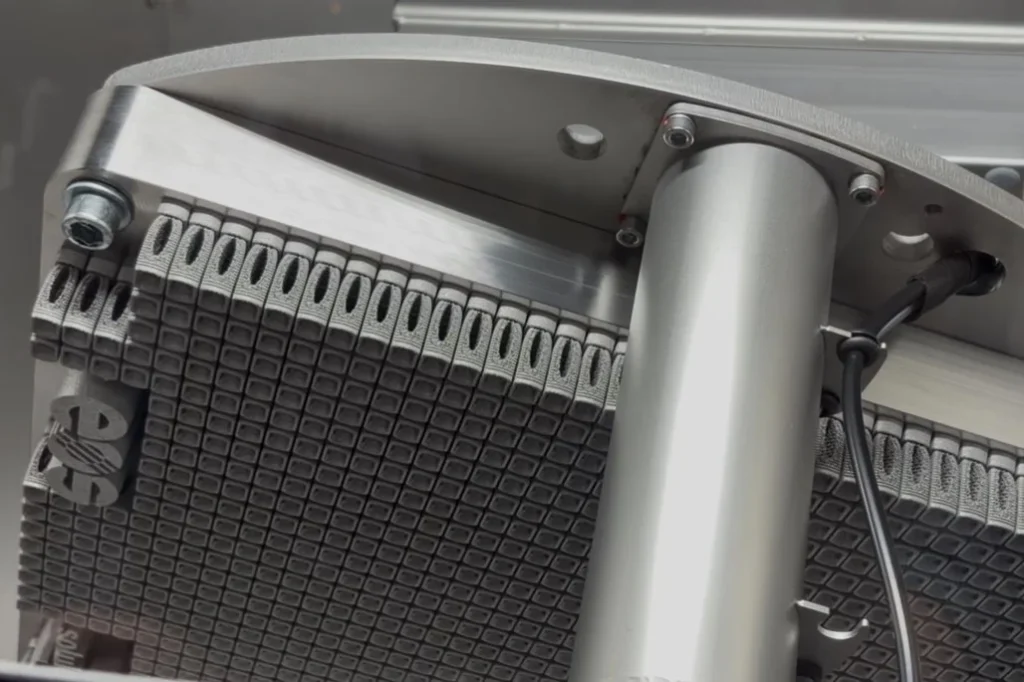
This week’s featured image showcases a meticulous post-processing operation in the additive manufacturing (AM) industry, highlighting a specialized setup designed for the intricate needs of medical component production. The image captures 1,100 compact titanium spinal cages, meticulously arranged on an EOS M4 Onyx build plate, awaiting precise powder removal. This crucial step is being performed by a specially adapted version of Solukon’s SFM-AT350-E depowdering system. The collaboration between Solukon and EOS, a prominent player in industrial 3D printing, underscores a growing trend towards integrated solutions that streamline the entire additive manufacturing workflow, from printing to final part readiness.
The depicted system is a testament to Solukon’s commitment to innovation and adaptability within the AM sector. The SFM-AT350-E unit has been specifically reconfigured to seamlessly integrate with the EOS M4 Onyx 3D printer. This powerful industrial printer boasts a substantial build volume of 17.7 x 17.7 x 15.7 inches, including the build plate, providing ample space for complex and large-scale additive manufacturing projects. The ability to accommodate such a significant build volume on the EOS M4 Onyx is particularly relevant for medical applications, where the demand for patient-specific implants and complex surgical tools is continuously growing.
Solukon, a recognized leader in automated depowdering solutions, unveiled this specialized iteration of the SFM-AT350-E at RAPID + TCT 2026, a premier industry event held in Boston, Massachusetts. This unveiling marked a significant milestone, demonstrating the company’s proactive approach to addressing the evolving challenges faced by AM users. The SFM-AT350-E, in its standard configuration, is expertly engineered to handle smaller parts with a Z-height below 250 mm and weighing up to 100 kg. The spinal cages featured in the image are a prime example of such components – intricate, lightweight, and requiring a high degree of precision during post-processing. These titanium spinal cages were produced using laser powder bed fusion (LPBF) technology, a widely adopted method in the medical field for its ability to create complex geometries and biocompatible metallic implants.
The core of the SFM-AT350-E’s effectiveness lies in its sophisticated depowdering mechanism. The system employs high, self-regulating ultrasonic vibrations to dislodge and remove residual powder from the printed parts. This advanced technique relies on the principle of piezoelectric excitation, a phenomenon where electrical energy is converted into mechanical energy. When a voltage is applied across a piezoelectric material, it vibrates, generating powerful ultrasonic waves. These vibrations are precisely controlled to ensure thorough powder removal without compromising the delicate structures or surface integrity of the 3D-printed components. While the exact cleaning time is contingent upon the specific geometry and complexity of each part, the 1,100 spinal cages in this instance were processed within approximately 30 minutes, showcasing the system’s efficiency.
The Significance of Automated Depowdering in Medical AM
The additive manufacturing of medical devices, particularly implants and surgical instruments, has witnessed exponential growth over the past decade. Titanium alloys, due to their excellent biocompatibility, strength-to-weight ratio, and resistance to corrosion, are a material of choice for many orthopedic and spinal implants. LPBF technology allows for the creation of patient-specific implants with intricate lattice structures that can promote osseointegration and reduce implant weight. However, a significant challenge in the AM workflow, especially with LPBF, is the efficient and thorough removal of unfused powder from internal channels and complex geometries. Inadequate powder removal can lead to several critical issues:
- Reduced Biocompatibility: Residual powder can act as a foreign body, potentially triggering inflammatory responses or hindering osseointegration.
- Compromised Mechanical Properties: Trapped powder can create stress risers, weakening the implant and increasing the risk of fracture.
- Aesthetic Imperfections: In residual powder can detract from the final appearance of the implant.
- Sterilization Challenges: Incomplete powder removal can impede effective sterilization processes, posing a risk of infection.
Automated depowdering systems like Solukon’s SFM-AT350-E are therefore indispensable for ensuring the safety, efficacy, and quality of 3D-printed medical devices. The precision offered by ultrasonic vibration is particularly crucial for compact parts like spinal cages, where internal voids and complex interconnectivity are common.

A Collaborative Approach to Enhancing the AM Ecosystem
The reconfiguration of Solukon’s SFM-AT350-E to integrate with the EOS M4 Onyx printer is a prime example of how different companies within the AM ecosystem are collaborating to create more seamless and efficient workflows. EOS, with its advanced LPBF printers, provides the foundational technology for producing high-quality metal parts. Solukon, by adapting its depowdering solutions, ensures that these parts can be efficiently prepared for their intended use, especially in demanding applications like medicine.
The EOS M4 Onyx, known for its innovative design and robust performance, offers a significant build volume that is well-suited for producing multiple implants in a single build. The printer’s efficient footprint and advanced filtration system, which effectively traps and neutralizes hazardous condensate, further contribute to a safe and productive manufacturing environment. The synergy between such a high-performance printer and a specialized depowdering system creates a more streamlined production line, reducing manual intervention, minimizing the risk of errors, and ultimately accelerating the time-to-market for critical medical components.
The Technology Behind Ultrasonic Depowdering
Ultrasonic vibration is a powerful cleaning technique that has been employed in various industries for decades. In the context of AM, its application for powder removal offers several advantages:
- Non-Destructive: When properly calibrated, ultrasonic vibrations are gentle enough to clean intricate parts without causing damage.
- Penetration: The high-frequency sound waves can penetrate deep into complex internal channels and cavities, reaching areas inaccessible to manual cleaning methods.
- Efficiency: Ultrasonic cleaning can significantly reduce processing times compared to traditional methods.
- Consistency: Automated systems ensure a consistent level of cleaning across multiple parts and batches.
The piezoelectric effect, the underlying principle of ultrasonic vibration, involves materials that generate an electric charge in response to applied mechanical stress, or conversely, deform mechanically when an electric field is applied. In depowdering systems, this means that applying an electrical current to piezoelectric transducers causes them to vibrate at ultrasonic frequencies. These vibrations are then transmitted to the build plate and the powder particles, causing them to loosen and be carried away by a controlled airflow or fluid.
RAPID + TCT 2026: A Hub for AM Innovation
The choice of RAPID + TCT 2026 in Boston as the debut venue for this specialized Solukon system is strategically significant. RAPID + TCT is one of North America’s largest and most influential additive manufacturing events, attracting a diverse audience of industry professionals, researchers, and potential adopters. It serves as a critical platform for companies to showcase new technologies, forge partnerships, and gauge market trends. The event’s focus on practical applications and real-world solutions makes it an ideal environment for introducing innovations that address specific industry needs, such as the precise depowdering of medical-grade titanium parts. The presence of both EOS and Solukon at such an event signals their commitment to the advancement of the AM industry and their understanding of the value of collaborative solutions.
Broader Implications for the Medical AM Landscape
The development and deployment of specialized depowdering solutions like the reconfigured SFM-AT350-E have far-reaching implications for the medical AM sector.
- Increased Adoption of Complex Designs: By enabling efficient post-processing of intricate geometries, these systems encourage the design and printing of more complex and potentially more effective medical devices. This could lead to advancements in patient-specific implants, personalized surgical guides, and novel prosthetic designs.
- Enhanced Quality Assurance: The automated and precise nature of these depowdering processes contributes to a higher standard of quality assurance in medical device manufacturing. This is crucial for meeting stringent regulatory requirements and ensuring patient safety.
- Reduced Manufacturing Costs: While the initial investment in specialized equipment may be significant, the increased efficiency, reduced waste, and lower risk of part rejection can lead to overall cost savings in the long run. This could make advanced AM solutions more accessible to a wider range of healthcare providers and manufacturers.
- Accelerated Research and Development: The ability to quickly and reliably produce high-quality, post-processed components can accelerate research and development cycles for new medical devices and treatment modalities.
The integration of advanced 3D printing technologies like the EOS M4 Onyx with specialized post-processing solutions like Solukon’s SFM-AT350-E represents a maturing of the additive manufacturing industry. It signifies a shift from viewing AM as a niche prototyping tool to recognizing its potential as a mainstream manufacturing process, particularly in high-value sectors like healthcare. The continued evolution of such integrated solutions will be pivotal in unlocking the full transformative potential of additive manufacturing.