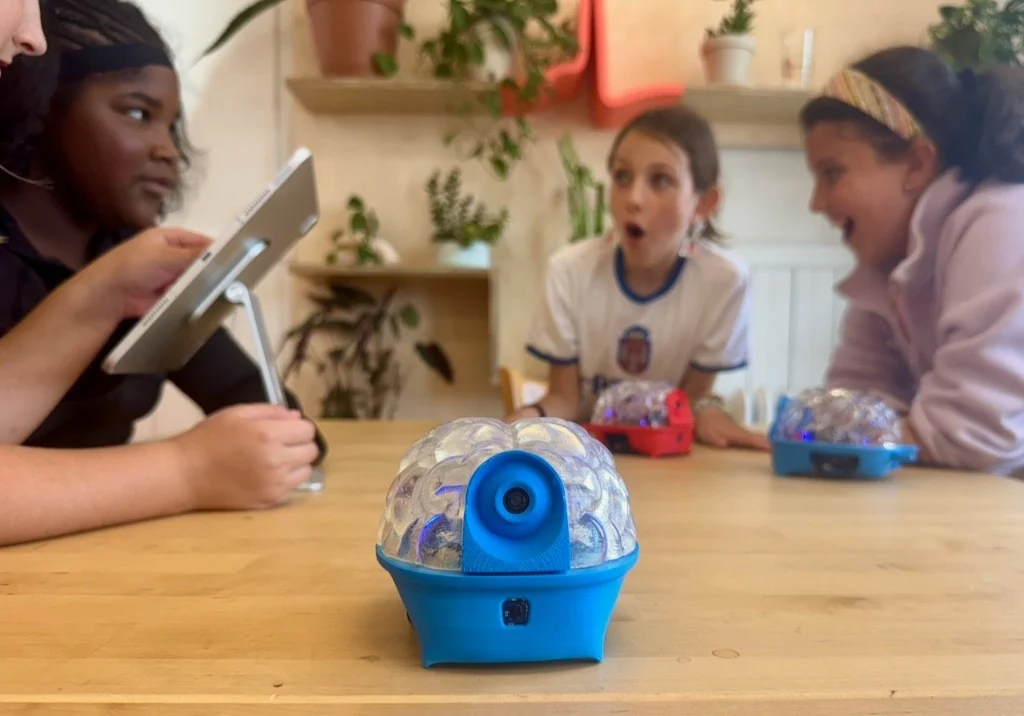
In a significant stride towards democratizing advanced scientific concepts, Backyard Brains has introduced SpikerBot, an innovative robot designed to make learning engineering and neuroscience profoundly accessible. Moving beyond the conventional complexities of programming, SpikerBot employs a groundbreaking visual interface that allows users to construct robot behaviors using virtual neurons, synapses, and circuits. This approach, which bypasses traditional lines of code and even contemporary large language models (LLMs), promises to ignite curiosity and foster a deeper understanding of how biological brains function, all while bringing robots to life with intuitive, "life-like" responses.
The unveiling of SpikerBot marks a pivotal moment for STEM education, offering a fresh perspective on how we approach the intricate fields of robotics and neurobiology. Co-Founder & CEO Greg Gage and Designer Alex Hatch from Backyard Brains championed the development of this unique platform, emphasizing its ability to transform abstract neurological concepts into tangible, interactive experiences. "There’s no code, no LLMs, just neurons, synapses, and behavior emerging from a circuit a kid designed," states the Backyard Brains team, encapsulating the essence of SpikerBot’s revolutionary design philosophy.
The Genesis of SpikerBot: Bridging a Critical Educational Chasm
Backyard Brains, renowned for its mission to make neuroscience education universally accessible, has consistently developed tools that bring the complexities of the brain into classrooms and homes. Their previous innovations, such as the SpikerBox and SpikerShield, have allowed students to record electrical activity from real neurons, fostering an early engagement with neurophysiology. SpikerBot extends this legacy by tackling a persistent gap in neuroscience education: the chasm between understanding a single neuron at an elementary level and grasping the intricate network dynamics of millions of neurons in advanced collegiate studies. This gap, akin to moving from understanding a transistor directly to coding in Python without intermediate electronics knowledge, often leaves students with a fragmented understanding of the brain’s operational principles.
This educational void contributes to what Backyard Brains terms "neuroscience illiteracy," a lack of fundamental understanding about the brain’s basic functions and the mechanisms behind various neurological conditions. The World Health Organization estimates that neurological disorders affect up to one billion people worldwide, underscoring the critical societal need for greater public understanding of brain function. By bridging this gap, SpikerBot aims to cultivate a generation more informed about neural processes, potentially fostering empathy and innovation in fields ranging from medicine to artificial intelligence.

The philosophical underpinning of SpikerBot draws inspiration from Valentino Braitenberg’s seminal 1984 book, Vehicles: Experiments in Synthetic Psychology. Braitenberg’s thought experiments demonstrated how incredibly complex, seemingly "intelligent" behaviors could emerge from surprisingly simple connections between sensors and motors. His "vehicles" showed that direct, unmediated responses to environmental stimuli, when combined in specific configurations, could simulate desires, fears, and even love. SpikerBot translates this profound insight into a hands-on learning experience, allowing users to build robots that respond directly to sensors, with intricate behaviors naturally emerging from the simplest neural sketches.
Neural Programming: A Paradigm Shift in Robot Control
At the heart of SpikerBot’s innovation lies its unique programming environment. Eschewing traditional textual coding languages or block-based programming, the SpikerBot app presents a visual workspace where users drag and drop virtual neurons and axons to construct a "brain on screen." This intuitive interface resembles manipulating cables on a modular synthesizer, where connections and parameters are adjusted visually and instantly. This "whole picture" approach, where the entire neural circuit is visible at once, eliminates the need to scroll through pages of code, making the learning process far more engaging and less daunting for beginners.
This novel programming paradigm profoundly redefines what constitutes "easy" or "difficult" in robotics. Behaviors traditionally considered complex for novice roboticists—such as a robot tracking and following a person—become remarkably straightforward to implement with SpikerBot. A creature that chases objects, for instance, can be designed with as few as two neurons. Conversely, tasks that are trivial for conventional computer logic, like programming a robot to count in binary, become a complex web of neural connections within SpikerBot’s biological-inspired architecture. This inversion highlights the fundamental difference between how digital computers process information sequentially and how biological brains operate through parallel, emergent processes.
A key feature enhancing the user experience is the instantaneous feedback loop. Any change made to a neuron, such as switching its function from excitatory to inhibitory, is reflected immediately in the robot’s behavior. There’s no compilation time, no uploading delay; experimentation happens at the pace of thought, fostering rapid iteration and discovery. This immediacy keeps users deeply engaged, allowing for continuous exploration and refinement of neural circuits without the frustration often associated with traditional programming workflows. The development team has clearly invested significant effort in refining this application, ensuring that this groundbreaking concept is delivered with a polished, user-friendly interface that is both functional and aesthetically pleasing.
Bridging the Educational Chasm with Tangible Science

SpikerBot is more than just a toy; it is a meticulously designed educational tool, developed with continuous feedback from both child educators and professional neuroscientists. This collaborative approach ensures that the platform not only captivates young minds but also imparts genuine, scientifically accurate principles of neurobiology. The app provides a curated library of sample brain models, which users can dissect, modify, and learn from. These models demonstrate fundamental neurological patterns found in real brains, such as recurrent pairs, lateral inhibition, and the mechanisms underlying working memory.
Through hands-on experimentation, users can discover how these basic neural circuits give rise to complex behaviors. For example, understanding lateral inhibition can explain how sensory systems enhance contrast, allowing the robot to better distinguish objects from their background. Exploring recurrent pairs reveals how feedback loops can create sustained activity, crucial for short-term memory or persistent actions. This experiential learning approach transforms abstract textbook knowledge into concrete understanding, providing a robust foundation for future studies in neuroscience, psychology, and artificial intelligence.
Moreover, SpikerBot is designed to be extensible. It supports various peripherals, including Backyard Brains’ existing Spiker:bit board. This compatibility allows users to create more advanced projects, such as controlling the SpikerBot’s "brain" using real muscle signals from their own arm via electromyography (EMG). This integration offers a compelling demonstration of the bio-digital interface, blurring the lines between human biology and robotic control, and offering profound insights into the nature of biological signals.
Hardware and Design: The Embodiment of a Brain on Wheels
The physical manifestation of SpikerBot is as thoughtfully designed as its software. Modeled after Backyard Brains’ distinctive brain-shaped logo, the robot itself is a compact, robust chassis equipped with a suite of sensors that enable it to perceive and interact with its environment. These include a camera for visual input, a microphone for auditory cues, and a distance sensor for spatial awareness. Beyond mere functionality, the robot’s expressive capabilities are enhanced by carefully crafted lights and sounds. Its lights illuminate and fade with a bioluminescent quality, mimicking organic cellular activity, while its sound effects are charmingly quirky and responsive, adding personality to the robot’s emergent behaviors.
Customization is a key aspect of the SpikerBot experience. Connection points on the chassis allow owners to attach 3D-printed components, transforming their bot to fit its unique "personality" or to serve specific experimental needs. Users can create anything from a "SpikerBot cat" that reacts to real feline companions and tracks a ball of yarn, to a "SpikerBot dragon" whose behaviors are entirely dictated by its neural circuit. This emphasis on personalization and creative modification aligns perfectly with the maker movement ethos, empowering users to not just program but also to physically design their robotic companions.

A Broader Societal Impact: Beyond the Classroom
The implications of SpikerBot extend beyond academic enrichment. By fostering a foundational understanding of brain patterns and neural circuitry, the platform contributes significantly to broader neuroscience literacy. With a substantial portion of the global population affected by neurological conditions, a shared language and understanding of how brains function at a fundamental level can demystify these conditions, reduce stigma, and encourage informed discourse. For individuals, grasping concepts like recurrent pairs or lateral inhibition can provide valuable insights into their own cognitive processes or those of loved ones experiencing neurological challenges. This practical knowledge can be empowering, fostering a more informed and empathetic society.
Sustainability and Future-Proofing: A Commitment to Longevity
Backyard Brains has also demonstrated a commendable commitment to the long-term usability and sustainability of SpikerBot. The accompanying app is freely available and does not require cloud-based authentication, ensuring continued access regardless of future server status or subscription models. This open-access approach aligns with the educational mission, removing potential barriers to entry.
Furthermore, the hardware is designed for durability and ease of maintenance. SpikerBot operates on easily swappable AA batteries, consciously avoiding the planned obsolescence often associated with non-replaceable lithium-ion cells that degrade over time. To support this choice, Backyard Brains offers its own custom, high-performance Nickel-Metal Hydride (NiMh) AA batteries, providing a rechargeable and environmentally friendlier power solution. These design decisions reflect a deep understanding of the educational and hobbyist markets, where longevity, repairability, and open access are highly valued.
Market Introduction and Availability

SpikerBot was introduced to the public via a Kickstarter campaign, a common strategy for innovative hardware projects. The crowdfunding campaign, which is slated to conclude on June 14, 2026, offers early adopters the opportunity to acquire a SpikerBot at a discounted price of $219. Following the campaign, the robot is expected to retail at $299. Given Backyard Brains’ established track record of successfully delivering complex projects through crowdfunding, including the SpikerBox and other neuroscience tools, backers can approach this campaign with a degree of confidence. This history of execution mitigates some of the inherent risks associated with Kickstarter projects, reinforcing the team’s credibility and capacity to bring SpikerBot to fruition.
Looking Ahead: The Evolving Brain of SpikerBot
While SpikerBot already boasts an impressive array of features and capabilities, Backyard Brains envisions a future where the platform continues to evolve, shaped by its growing community of users. The initial release includes a robust set of pre-designed behaviors and learning modules, but the true potential lies in the collective creativity of its users. As Alex Hatch articulated, "a lot we haven’t seen because you guys haven’t built anything yet." This statement underscores the open-ended nature of SpikerBot, inviting users to experiment, innovate, and contribute to an expanding ecosystem of neural designs and emergent behaviors.
Future developments may include expanded sensor integration, more advanced neural models, and community-driven content libraries. The very act of users creating and sharing their unique "brain models" for SpikerBot will not only enrich the platform but also contribute to a broader understanding of how diverse neural architectures can yield distinct behaviors. This collaborative, emergent development model mirrors the very principles of biological neural networks, where complex systems arise from the interaction of countless individual components.
In essence, SpikerBot is poised to become more than just an educational robot; it is a gateway to understanding the fundamental principles of intelligence, both artificial and biological. By making the intricate world of neural networks accessible and engaging, Backyard Brains is not only cultivating the next generation of engineers and neuroscientists but also empowering a broader public with a crucial understanding of the brain, its functions, and its profound impact on our lives.