Octopuses and cuttlefish, renowned for their unparalleled mastery of camouflage, have long captivated scientists with their extraordinary ability to blend into their surroundings. Their capacity to rapidly alter both the color and intricate texture of their skin, often within fractions of a second, represents a pinnacle of natural bio-inspiration that researchers have tirelessly sought to replicate in man-made materials. This quest for biomimetic surfaces capable of dynamic, on-demand changes has now seen a significant breakthrough, as researchers at Stanford University report the development of a flexible material that can swiftly shift its surface patterns and colors, manifesting features smaller than a human hair. This groundbreaking study, detailed in a recent issue of the prestigious journal Nature, marks a pivotal advance in the fields of materials science, nanophotonics, and adaptive camouflage technologies.
"Textures are crucial to the way we experience objects, both in how they look and how they feel," stated Siddharth Doshi, a doctoral student in materials science and engineering at Stanford and the lead author of the paper. He elaborated on the significance of their achievement: "These animals can physically change their bodies at close to the micron scale, and now we can dynamically control the topography of a material – and the visual properties linked to it – at this same scale." This innovation is poised to usher in a new era for advanced camouflage systems for both human operators and autonomous robotic platforms, alongside the development of highly flexible, color-changing displays for next-generation wearable devices. Furthermore, it opens unprecedented avenues in nanophotonics, a specialized field dedicated to manipulating light at incredibly small scales for diverse applications spanning electronics, secure encryption, and advanced biological sensing.
Nicholas Melosh, a professor of materials science and engineering and a senior author on the paper, underscored the unique attributes of their creation. "There’s just no other system that can be this soft and swellable, and that you can pattern at the nanoscale," Melosh affirmed, expressing optimism about the broad utility of the invention. "You can imagine all kinds of different applications."
Mimicking Nature’s Masters of Disguise
To fully appreciate the magnitude of this Stanford breakthrough, it is essential to understand the biological marvels that inspired it. Cephalopods – a class of marine mollusks that includes octopuses, cuttlefish, and squid – possess the most sophisticated camouflage systems in the animal kingdom. Their skin is equipped with three types of specialized pigment-containing cells: chromatophores, iridophores, and leucophores. Chromatophores, containing red, yellow, or brown pigments, are directly controlled by muscles and nerves, allowing them to rapidly expand or contract to reveal or conceal their color. Iridophores, beneath the chromatophores, contain iridescent plates that reflect light, producing shimmering blues, greens, and silvers. Leucophores scatter all wavelengths of light, contributing to the animal’s ability to appear white and aiding in blending with backgrounds like sand or coral.
Beyond color, cephalopods can also instantly alter their skin texture, creating papillae, spikes, or bumps to mimic rocks, seaweed, or other elements of their environment. This dual capability of changing both color and texture simultaneously, with remarkable speed and precision, has long been a holy grail for materials scientists seeking to develop adaptive surfaces. Previous attempts have often involved complex electromechanical systems or static microstructures, lacking the flexibility, speed, and microscopic resolution achieved by nature. The Stanford team’s work represents a significant leap towards truly replicating this dynamic biological adaptability.
The Serendipitous Genesis of a Breakthrough Material
The innovative technique developed by the Stanford team hinges on a clever combination of established semiconductor manufacturing processes and novel material science. At its core, the method employs electron-beam lithography, a highly precise patterning technique widely utilized in the production of microchips, in conjunction with a specialized water-responsive polymer film. The magic happens when specific regions of this polymer film are exposed to a focused beam of electrons. This exposure subtly alters the chemical structure of the polymer, making those areas either more or less absorbent to water. Consequently, when the material subsequently takes in water, these pre-programmed regions swell differentially, giving rise to intricate, dynamic patterns that manifest only when the film is hydrated.
A crucial element of this discovery, as is often the case in scientific innovation, emerged from an unexpected observation. Siddharth Doshi recounted an "earlier experiment" where he used a scanning electron microscope (SEM) to examine nanostructures on a polymer film. Instead of discarding the samples, a common practice, Doshi wisely decided to reuse them. During subsequent tests, he noticed that the areas previously exposed to the electron beam behaved distinctly and displayed different colors. "We realized that we could use these electron beams to control topography at very fine scales," Doshi recalled. "It was definitely serendipitous." This moment of accidental insight proved to be the pivotal turning point, transforming what might have been a discarded sample into the foundation of a revolutionary technology.
Unpacking the Engineering Behind Dynamic Textures and Hues
The precision afforded by this electron-beam lithography technique allows for an extraordinary level of detail in the resulting patterns. The researchers demonstrated this capability by creating a microscopic, yet remarkably accurate, three-dimensional representation of Yosemite’s iconic El Capitan. When the polymer surface is dry, it remains perfectly flat and featureless. However, the moment water is introduced, the pre-programmed structure of El Capitan gracefully rises from the film, transforming a two-dimensional surface into a tangible, three-dimensional shape. This ability to transition between a completely flat state and a complex 3D topography on demand is a cornerstone of the material’s versatility.
Beyond mere shape, the team has also mastered the art of optical manipulation. By meticulously adjusting the degree to which the material swells, they can precisely control how it reflects ambient light. This allows for an unprecedented ability to switch between highly glossy and completely matte finishes, producing visual effects that far surpass the capabilities of current static screens or displays. The process is also entirely reversible, adding to its practical appeal. The application of an alcohol-like solvent effectively removes the absorbed water, causing the polymer to contract and return to its original, flat state.
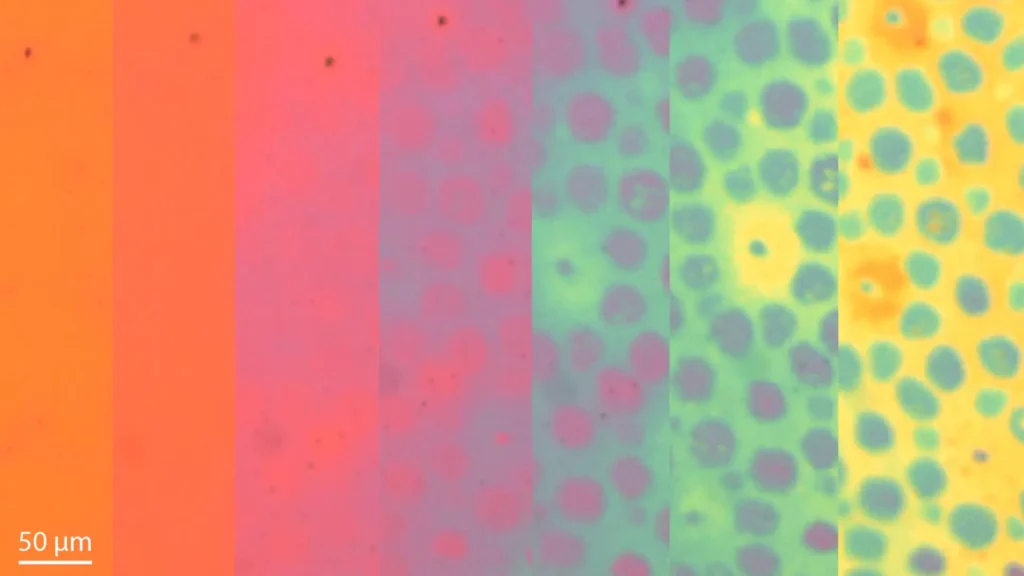
The same ingenious approach can be leveraged to generate complex and vibrant color patterns. This is achieved by strategically placing thin metal layers on both sides of the polymer film, thereby creating structures known as Fabry-Pérot resonators. These resonators are sophisticated optical devices that work by selecting and transmitting specific wavelengths of light while reflecting others, much like a prism. As the polymer film expands or contracts in response to hydration or dehydration, the distance between these metallic layers changes, altering the resonant wavelength and consequently displaying different colors. With a finely tuned balance of water and solvent, a seemingly plain surface can be made to transform into a dazzling array of dynamic, vibrant patterns, offering a new palette for optical design.
Mark Brongersma, also a professor of materials science and engineering and a senior author on the paper, highlighted the immense potential. "By dynamically controlling the thickness and topography of a polymer film, you can realize a very large variety of beautiful colors and textures," he explained. "The introduction of soft materials that can expand, contract, and alter their shape opens up an entirely new toolbox in the world of optics to manipulate how things look."
The Vision for Real-Time Adaptive Camouflage
One of the most immediate and impactful applications envisioned for this novel material is in the realm of advanced camouflage. The researchers have demonstrated that when multiple layers of these polymer films are combined, they can independently adjust both color and texture. This multi-layered approach allows the material to mimic its surroundings in a manner strikingly similar to a living octopus. While the current iteration still requires some manual tuning of water and solvent levels to match a specific background, the potential for autonomous adaptation is clear.
The long-term vision for this technology includes automating the entire process. The team aims to integrate sophisticated computer vision systems and artificial intelligence (AI) to achieve real-time, autonomous camouflage. This would involve embedding sensors that can analyze the immediate environment, feeding that data to an AI system that then intelligently adjusts the material’s color and texture to achieve seamless blending. "We want to be able to control this with neural networks – basically an AI-based system – that could compare the skin and its background, then automatically modulate it to match in real time, without human intervention," Doshi elaborated. Such a system could revolutionize military stealth technologies, improve search and rescue operations by making equipment less visible in challenging terrains, or even enhance wildlife photography by allowing researchers to blend more effectively into natural habitats.
Beyond Concealment: Diverse Horizons for a Revolutionary Material
While the headline application remains camouflage, the potential uses for this dynamically reconfigurable material extend far beyond mere concealment. The fine control it offers over surface texture could have profound implications for robotics, particularly in areas requiring adaptable grip. By altering the surface friction, small robots could be engineered to either firmly grip surfaces for climbing and manipulation or to slide across them with minimal resistance, offering unprecedented versatility in movement. This could be particularly beneficial for soft robotics, which often struggle with precise interaction with varied surfaces.
At the nanoscale, changes in surface structure have a documented influence on how biological cells behave. This opens up exciting possibilities in bioengineering, where such materials could be used to direct cell growth, create responsive biomedical implants, or develop advanced platforms for drug delivery and tissue engineering. The ability to dynamically present different topographical cues to cells could lead to breakthroughs in regenerative medicine and diagnostics.
The interdisciplinary nature of this innovation is further highlighted by the team’s collaboration with artists. Exploring the creative uses for a material that can dynamically change its appearance offers new avenues for interactive art installations, responsive architectural elements, and dynamic fashion. The interplay of science and art in this context underscores the broad appeal and transformative potential of the research.
"Small changes in the properties of soft materials over micron distances are finally possible, which will open up all sorts of possibilities," Melosh reiterated, emphasizing the foundational nature of their work. "I think there are a lot of exciting things coming up." Experts in the field of materials science have lauded the achievement, with some suggesting that the combination of softness, swellability, and nanoscale patterning places this material in a league of its own, far surpassing the capabilities of existing technologies in adaptive optics and biomimicry. The ability to integrate such complex functionalities into a flexible, easily actuated material represents a significant paradigm shift.
Collaborative Excellence: The Team Behind the Innovation
This groundbreaking research is the product of extensive collaboration and expertise across multiple disciplines at Stanford University. Mark Brongersma holds appointments as a professor, by courtesy, of applied physics; he is also a valued member of Stanford Bio-X, the Wu Tsai Human Performance Alliance, and the Wu Tsai Neurosciences Institute, in addition to being an affiliate of the Precourt Institute for Energy. Nicholas Melosh is similarly a member of Stanford Bio-X and the Wu Tsai Neurosciences Institute, an affiliate of the Precourt Institute for Energy, and a faculty fellow of Sarafan ChEM-H.
The comprehensive list of additional Stanford co-authors who contributed to this significant research includes Alberto Salleo, the Hong She and Vivian W. M. Lim Professor and professor of photon science; Associate Professor Polly Fordyce; postdoctoral researchers Nicholas A. Güsken and Gerwin Dijk; Jennifer E. Ortiz-Cárdenas, director of the Stanford Microfluidics Foundry; and graduate students Johan Carlström, Peter Suzuki, and Bohan Li.
The extensive and complex nature of this research was made possible through crucial financial backing from a diverse range of institutions. Key funding sources include a Stanford Graduate Fellowship, a Meta PhD Fellowship, support from the Wu Tsai Human Performance Alliance at Stanford University and the Joe and Clara Tsai Foundation, the German National Academy of Sciences Leopoldina, the Department of Energy, the Air Force Office of Sponsored Research, and the National Science Foundation. This broad base of support underscores the recognized potential and interdisciplinary importance of the work. The successful development of this material is a testament to the power of collaborative science and serendipitous discovery, promising a future where our engineered world can dynamically adapt to its surroundings with unprecedented elegance and efficiency.