Octopuses and cuttlefish are renowned for their extraordinary ability to blend seamlessly into their surroundings, a natural feat achieved by rapidly altering both the color and texture of their skin. This remarkable biological camouflage has long captivated scientists, inspiring efforts to replicate such dynamic capabilities in man-made materials. Now, researchers at Stanford University have reported a significant breakthrough, describing a novel flexible material that can swiftly change its surface patterns and colors, forming features smaller than a human hair. The findings, published in the prestigious journal Nature, mark a major advance in biomimetic materials science, opening doors to a new generation of adaptive technologies.
The innovation addresses a long-standing challenge in materials engineering: creating synthetic surfaces that can dynamically modify their physical topography and optical properties at the microscopic level. Siddharth Doshi, a doctoral student in materials science and engineering at Stanford and the first author on the groundbreaking paper, emphasized the critical role of texture in human perception and interaction with objects. "Textures are crucial to the way we experience objects, both in how they look and how they feel," Doshi stated. "These animals can physically change their bodies at close to the micron scale, and now we can dynamically control the topography of a material – and the visual properties linked to it – at this same scale." This unprecedented level of control over both visual and tactile characteristics positions the material for a diverse array of applications, from enhanced camouflage systems for military and robotic deployment to flexible, color-changing displays for wearable devices. Furthermore, it promises to unlock new frontiers in nanophotonics, a specialized field dedicated to manipulating light at exceptionally small scales for applications spanning electronics, secure encryption, and advanced biological sensing.
Nicholas Melosh, a professor of materials science and engineering and a senior author on the paper, underscored the unique nature of their creation. "There’s just no other system that can be this soft and swellable, and that you can pattern at the nanoscale," Melosh commented, hinting at the vast potential. "You can imagine all kinds of different applications."
The Biological Inspiration: Masters of Disguise
The quest to mimic cephalopod camouflage is rooted in a deep admiration for these marine invertebrates’ unparalleled adaptive abilities. Octopuses, cuttlefish, and squid possess highly specialized skin cells called chromatophores, which contain sacs of pigment. Tiny muscles surrounding these sacs allow the animals to expand or contract them almost instantaneously, revealing or concealing the pigment and thus changing their skin color. Beyond color, iridophores and leucophores contribute to iridescent and reflective properties, respectively. Crucially, these animals can also rapidly alter the texture of their skin, creating intricate three-dimensional papillae and projections that allow them to blend seamlessly with rocky seabeds or coral formations. This dual capability—dynamic control over both color and texture—is what has made cephalopod camouflage so difficult to replicate synthetically.
For decades, researchers have explored various approaches to create adaptive materials, often focusing on color change using electrochromic, thermochromic, or photochromic principles. However, achieving rapid, localized, and reversible topographical changes simultaneously with color shifts, particularly at the micron scale, has remained an elusive goal. Previous attempts often involved complex multi-layered structures, rigid components, or slow response times, limiting their practicality for real-world applications where fluidity and speed are paramount. The Stanford team’s innovation directly addresses these limitations, offering a material that is both soft and capable of dynamic, high-resolution texture and color modulation.
The Mechanism Unveiled: How the Material Creates Dynamic Patterns
The core of Stanford’s breakthrough lies in a clever combination of established manufacturing techniques and novel material science. To produce these rapidly shifting textures, the team integrated electron-beam lithography, a precision technique widely utilized in semiconductor manufacturing for patterning micro- and nano-scale features, with a specially engineered water-responsive polymer film.
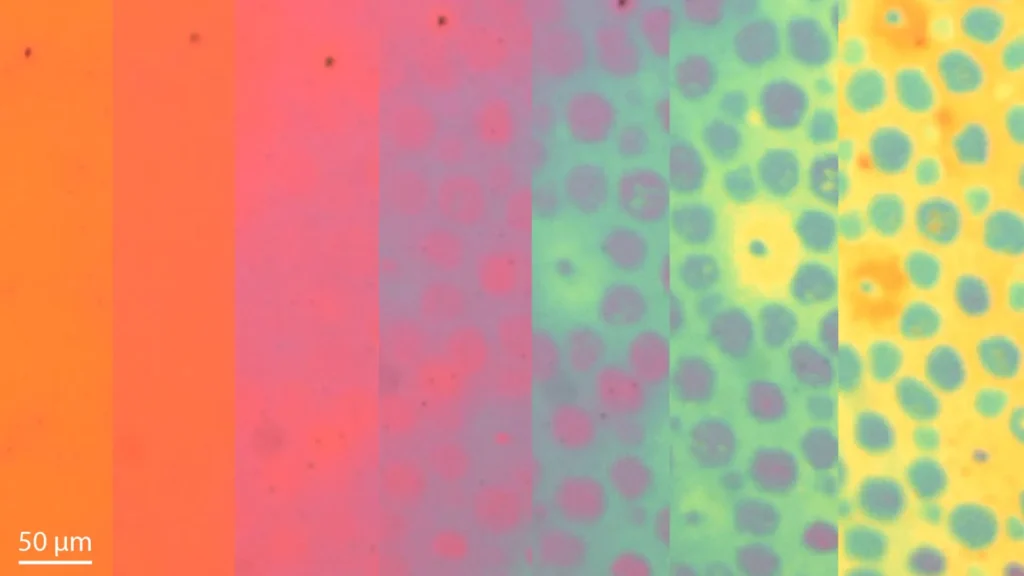
The process begins by exposing specific regions of the polymer film to a focused beam of electrons. This exposure subtly alters the chemical structure of these regions, making them either more or less absorbent to water. The critical step occurs when the material is subsequently exposed to water. The regions that absorbed more water swell differently than the less absorbent areas, resulting in the formation of intricate, three-dimensional patterns on the film’s surface. Importantly, these patterns are only visible when the film is hydrated, disappearing as the material dries. This allows for dynamic control, switching between a flat, featureless state and a textured, patterned state.
The genesis of this key insight was, as often happens in scientific discovery, serendipitous. Siddharth Doshi recounted how, in an earlier experiment, he used a scanning electron microscope to examine nanostructures on a polymer film. Rather than discarding the samples after initial examination, he chose to reuse them in subsequent tests. It was during these later experiments that Doshi observed an unexpected phenomenon: the areas previously exposed to the electron beam behaved distinctly when hydrated, displaying unique and dynamic colors. "We realized that we could use these electron beams to control topography at very fine scales," Doshi explained, acknowledging the role of chance in the discovery. "It was definitely serendipitous." This unexpected observation laid the groundwork for the controlled patterning and dynamic textural changes that now define the new material.
From Flat Surfaces to Dynamic 3D Structures and Colors
The precision offered by this electron-beam patterning technique allows for truly remarkable detail. To illustrate the material’s capabilities, the researchers demonstrated the creation of a miniature, three-dimensional relief map of Yosemite’s iconic El Capitan. When the polymer film is dry, its surface remains perfectly flat and featureless. However, upon the controlled introduction of water, the intricate topography of El Capitan gracefully rises from the film, transforming a two-dimensional surface into a complex three-dimensional shape. This ability to reversibly switch between flat and detailed 3D structures represents a significant leap in responsive materials.
Beyond topographical changes, the team also achieved dynamic control over the material’s optical properties. By meticulously adjusting the degree to which the polymer film swells, researchers can precisely manipulate how it reflects light. This enables the material to switch between a glossy, reflective finish and a matte, diffuse appearance, producing visual effects that surpass the capabilities of current static screens. The entire process is fully reversible: adding an alcohol-like solvent quickly removes the absorbed water, causing the material to return to its original flat, unpatterned state.
The same underlying approach can also generate complex color patterns. To achieve this, the researchers incorporated thin metal layers on both sides of the polymer film, creating structures known as Fabry-Pérot resonators. These optical devices are designed to select and transmit specific wavelengths of light while reflecting others. As the polymer film expands or contracts due to water absorption or solvent exposure, the distance between the metal layers changes, consequently altering the wavelengths of light that are transmitted or reflected. This allows the material to display different colors dynamically. With precise control over the balance of water and solvent, a seemingly plain surface can be transformed into a vibrant array of dynamic patterns and hues.
Mark Brongersma, a professor of materials science and engineering and another senior author on the paper, highlighted the profound implications for optics. "By dynamically controlling the thickness and topography of a polymer film, you can realize a very large variety of beautiful colors and textures," Brongersma noted. "The introduction of soft materials that can expand, contract, and alter their shape opens up an entirely new toolbox in the world of optics to manipulate how things look."
Implications and Future Trajectories: Beyond Visual Deception
The potential applications of this dynamic material extend far beyond simple camouflage, although that remains a significant immediate goal. The ability to precisely control both surface texture and color at the microscopic level unlocks a vast array of possibilities across multiple fields.
Advanced Camouflage Systems:
The most direct application is in advanced camouflage. When multiple layers of these responsive films are combined, researchers can independently adjust both color and texture, allowing the material to blend into its surroundings in a manner strikingly similar to an octopus. While the current iteration requires some manual tuning of water and solvent levels to match a background, the team envisions a future where this process is fully automated. The goal is to integrate computer vision and artificial intelligence (AI) systems that can analyze the surrounding environment in real-time and automatically modulate the material’s properties for seamless adaptation. "We want to be able to control this with neural networks – basically an AI-based system – that could compare the skin and its background, then automatically modulate it to match in real time, without human intervention," Doshi articulated, outlining a future where robots and even human personnel could wear clothing that instantaneously adapts to its environment. This could revolutionize military stealth, search and rescue operations, and environmental monitoring.
Flexible Displays and Wearable Technology:
The material’s ability to create dynamic patterns and shift colors on a flexible substrate makes it ideal for next-generation displays. Imagine wearable devices that can change their aesthetic in an instant, or screens that can display tactile information in addition to visual content. Unlike traditional electronic displays that rely on pixels emitting light, this material changes color and texture through structural modifications, potentially offering higher contrast, wider viewing angles, and perhaps even lower power consumption for certain applications. This could lead to truly adaptive user interfaces and immersive augmented reality experiences.
Nanophotonics and Adaptive Optics:
For nanophotonics, the field focused on controlling light at very small scales, this material represents a transformative tool. The dynamic manipulation of surface topography and film thickness offers unprecedented control over light-matter interactions. This could lead to advancements in optical computing, highly efficient sensors, new encryption methods, and adaptive optical components that can dynamically correct for aberrations or focus light with extreme precision. The "new toolbox" described by Professor Brongersma signifies a paradigm shift in how engineers can design and interact with light at the nanoscale.
Robotics and Haptics:
The fine control over surface texture also has profound implications for robotics. Small robots equipped with this material could dynamically regulate friction, allowing them to either grip surfaces securely for climbing or manipulation, or conversely, slide across them with minimal resistance. This capability could enhance the versatility and mobility of microrobots, enabling them to navigate complex terrains or perform delicate tasks that require variable surface interaction. In haptics, the material could create dynamic tactile interfaces, allowing users to "feel" digital information or experience realistic textures in virtual environments.
Bioengineering and Medical Applications:
At the nanoscale, changes in surface structure and texture can significantly influence how cells behave, opening up intriguing possibilities in bioengineering. The material could be used to create dynamic cell culture substrates that guide cell growth, differentiation, or migration by presenting changing topographical cues. This might accelerate research in regenerative medicine, tissue engineering, and drug discovery. For instance, a dynamic surface could mimic the mechanical environment within the body, providing more physiologically relevant conditions for cell studies.
Art and Design:
Beyond its scientific and technological applications, the material also holds immense creative potential. The research team is already collaborating with artists to explore novel artistic expressions. Imagine architectural facades that dynamically change their texture and color with the time of day, or artworks that evolve and interact with their viewers through subtle, programmed surface transformations. This blend of science and art could lead to entirely new forms of interactive and responsive design.
Research Team and Support
The interdisciplinary nature of this groundbreaking research is reflected in the diverse expertise of the Stanford team. Professor Mark Brongersma holds appointments as a professor, by courtesy, of applied physics; is a member of Stanford Bio-X, the Wu Tsai Human Performance Alliance, and the Wu Tsai Neurosciences Institute; and is an affiliate of the Precourt Institute for Energy. Professor Nicholas Melosh is a member of Stanford Bio-X and the Wu Tsai Neurosciences Institute; an affiliate of the Precourt Institute for Energy; and a faculty fellow of Sarafan ChEM-H.
Additional Stanford co-authors who contributed to this significant research include Alberto Salleo, the Hong She and Vivian W. M. Lim Professor and professor of photon science; Associate Professor Polly Fordyce; postdoctoral researchers Nicholas A. Güsken and Gerwin Dijk; Stanford Microfluidics Foundry director Jennifer E. Ortiz-Cárdenas; and graduate students Johan Carlström, Peter Suzuki, and Bohan Li. The collaborative environment and broad expertise of this team were instrumental in bringing this complex material to fruition.
This extensive and innovative work received substantial financial backing from a consortium of prestigious institutions and fellowships, underscoring the perceived importance and potential impact of the research. Funding was provided by a Stanford Graduate Fellowship, a Meta PhD Fellowship, the Wu Tsai Human Performance Alliance at Stanford University and the Joe and Clara Tsai Foundation, the German National Academy of Sciences Leopoldina, the Department of Energy, the Air Force Office of Sponsored Research, and the National Science Foundation. This broad support highlights the cross-sectoral interest in advancing materials science and engineering for a wide range of future applications.
In conclusion, the Stanford team’s development of a flexible, responsive material capable of dynamic, micron-scale pattern and color shifts represents a monumental step forward in biomimetic materials. By successfully replicating key aspects of cephalopod camouflage, they have not only deepened our understanding of natural adaptation but also engineered a versatile platform with transformative potential across advanced camouflage, flexible displays, nanophotonics, robotics, bioengineering, and artistic expression. The journey from serendipitous observation to a sophisticated, controllable material underscores the power of interdisciplinary research and the enduring inspiration drawn from the natural world. The "exciting things coming up," as Professor Melosh anticipates, are poised to redefine what is possible in the realm of adaptive materials.