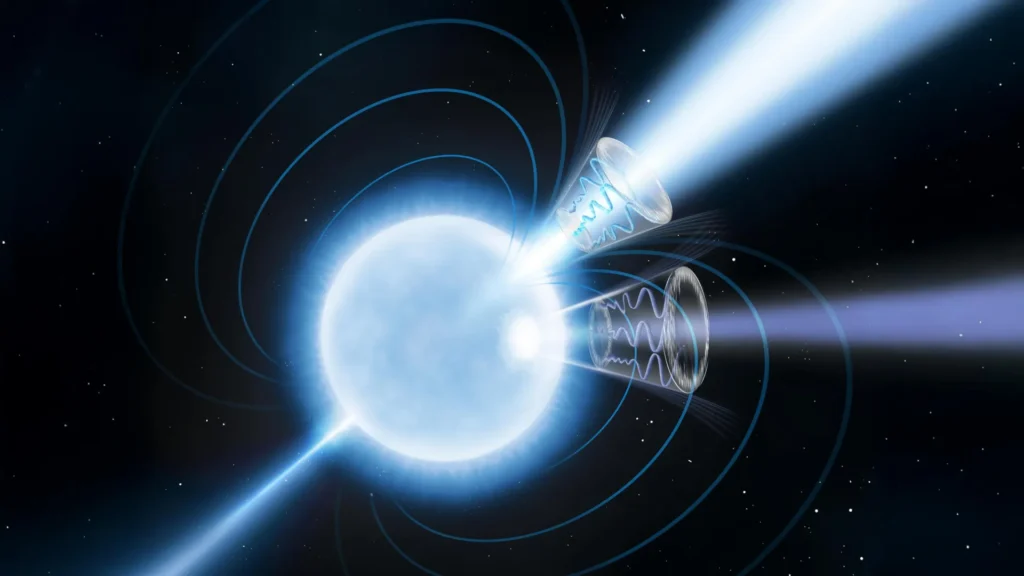
Nearly 90 years ago, the pioneering physicist Werner Heisenberg formulated a prediction that would profoundly challenge our understanding of what constitutes "empty" space. He posited the existence of a strange quantum effect known as vacuum birefringence, suggesting that even a perfect vacuum is not truly void, but rather a dynamic sea of "virtual particles" that spontaneously appear and disappear. This quantum foam, according to Heisenberg’s insight, could alter the way light behaves when subjected to sufficiently powerful magnetic fields. Despite significant advancements in nuclear physics since the 1930s and decades of work with sophisticated particle accelerators, scientists have struggled to conclusively confirm this elusive effect. Now, a groundbreaking study leveraging observations of one of the most extreme objects in the Universe—a magnetar—may finally provide the long-sought evidence, potentially opening new frontiers in quantum physics.
The Enduring Mystery of the Quantum Vacuum
Heisenberg’s prediction emerged from the nascent field of Quantum Electrodynamics (QED), a theoretical framework developed in the mid-20th century that describes how light and matter interact. QED is renowned as one of the most successful scientific theories ever conceived, accurately predicting phenomena from the precise energy levels of atoms to the magnetic moment of electrons. Central to QED is the concept of a quantum vacuum, which is fundamentally different from the classical notion of an empty void. Instead, it is theorized to be a bustling, energetic environment where pairs of "virtual" particles and antiparticles—such as electrons and positrons—constantly pop into existence and annihilate each other in timescales so brief they defy direct observation. These virtual particles borrow energy from the vacuum itself, existing only transiently before returning to it, in accordance with Heisenberg’s uncertainty principle.
The phenomenon of vacuum birefringence arises when this quantum vacuum is exposed to an extraordinarily strong electromagnetic field. Under such conditions, the fleeting virtual particles, normally appearing in random orientations, can become temporarily aligned with the direction of the external magnetic field. This alignment effectively changes the optical properties of the vacuum, making it behave like a birefringent material. In birefringent materials, light waves traveling through them split into two components that travel at different speeds and are polarized in different directions. For the quantum vacuum, this means light passing through a region of intense magnetism would experience a change in its polarization, a tell-tale signature of vacuum birefringence (VB).
The challenge in confirming VB has always been the sheer magnitude of the magnetic field required. Earth’s magnetic field is a mere fraction of a Gauss (approximately 0.5 Gauss at the surface). Even the most powerful electromagnets in terrestrial laboratories can only generate fields up to tens of Tesla, or around 100,000 Gauss, for brief periods. Theory predicts that to detect vacuum birefringence, magnetic fields over 100 million times stronger than anything achievable on Earth are necessary. Such conditions exist only in the most extreme cosmic environments, rendering Earth-bound experiments largely impractical for this particular quest.
Magnetars: Nature’s Ultimate Quantum Laboratories
Fortunately, the cosmos offers natural solutions to these seemingly insurmountable experimental hurdles in the form of magnetars. These are a rare and exotic subclass of neutron stars, which themselves are the collapsed remnants of massive stars that have undergone supernova explosions. Neutron stars are already extraordinary objects, packing the mass of our sun into a sphere only about 20 kilometers in diameter, making them incredibly dense—a teaspoon of neutron star material would weigh billions of tons.
What sets magnetars apart, however, are their unfathomably powerful magnetic fields. While typical neutron stars possess magnetic fields up to 10^12 Gauss, magnetars boast fields that can reach staggering strengths of 10^14 to 10^15 Gauss (10 to 1,000 trillion Gauss). These are the strongest known magnetic fields in the Universe, generated by a process known as a "dynamo mechanism" involving the convection and differential rotation of the star’s super-dense, conductive interior. The immense energy stored within these fields is so vast that their decay powers spectacular high-energy emissions, including X-rays and gamma-ray bursts.
For physicists seeking to test Heisenberg’s prediction, magnetars represent the ultimate "cosmic laboratories." As Dr. Marcus Lower, an Australian Research Council DECRA Fellow at the Center for Astrophysics and Supercomputing (CAS) at Swinburne University of Technology, eloquently put it: "Detecting vacuum birefringence requires a magnetic field that is over 100 million times stronger than any we’ve ever made on Earth. Thankfully, nature has provided us with magnetars, which are the perfect cosmic laboratories to go looking for this effect." Their unparalleled magnetic field strengths create precisely the conditions where the quantum vacuum’s birefringent properties should become evident.
A Cosmic Test: The Study of 1E 1547.0-5408
The recent breakthrough comes from an international collaboration of scientists, led by Rachael E. Stewart, a Graduate Student of Physics at George Washington University. The research involved a consortium of prestigious institutions, including the Center for Space Sciences and Technology, the South African Radio Astronomy Observatory (SARAO), the Los Alamos National Laboratory, NASA’s Marshall Space Flight Center, the Center for Research and Exploration in Space Science & Technology (CRESST), and the Astrophysics Science Division at NASA’s Goddard Space Flight Center, alongside universities from around the world. Their findings, which represent a major step towards confirming vacuum birefringence, were recently published in the esteemed scientific journal Nature.
The team focused their observations on a specific magnetar designated 1E 1547.0-5408 (often abbreviated as 1E1547). To achieve a comprehensive understanding of the magnetar’s emissions and the surrounding magnetic environment, the researchers employed a multi-wavelength observational strategy, combining data from several cutting-edge astronomical facilities.
Radio observations were spearheaded by Dr. Lower, utilizing CSIRO’s Murriyang, also known as the Parkes radio telescope, located in Australia. This iconic 64-meter dish, famous for its role in tracking the Apollo 11 mission, collected highly sensitive radio data from 1E1547. The resulting colossal datasets were then meticulously analyzed using Swinburne University’s Ngarrgu Tindebeek supercomputer, which is capable of processing vast amounts of astrophysical information to extract subtle signals.
Crucially, these radio observations were complemented by measurements from two of NASA’s premier X-ray telescopes. The Imaging X-ray Polarimetry Explorer (IXPE) was a key instrument, specifically designed to measure the polarization of X-rays from cosmic sources. Polarization refers to the orientation of the electric field oscillations within an electromagnetic wave. For vacuum birefringence, a change in X-ray polarization would be a direct signature. The NICER (Neutron star Interior Composition Explorer) X-ray telescope, mounted aboard the International Space Station, provided additional X-ray timing and spectral data, allowing researchers to accurately characterize the magnetar’s high-energy output.
As the team monitored 1E1547’s radio emissions, they diligently tracked the orientation of the waves’ oscillations—their "polarization state"—as the magnetar rotated. These observations, combined with the X-ray data, revealed several critical characteristics of 1E1547 that made it an ideal candidate for detecting vacuum birefringence. The measurements showed that the magnetar’s magnetic axis and its rotational axis are almost perfectly aligned. Furthermore, the object is observed from a nearly pole-on perspective relative to Earth. These two features together are particularly favorable because they allow for a clear, unobstructed view of light passing through the strongest and most uniform parts of the magnetar’s magnetic field, maximizing the potential to detect any polarization changes caused by VB.
Unveiling the Quantum Signature: Key Findings
The analysis of the X-rays emanating from the magnetar, as detected by IXPE, yielded compelling results: they exhibited an extremely high degree of polarization. More significantly, researchers found that the direction of this polarization remained consistently aligned with 1E1547’s magnetic field, mirroring the behavior observed in its radio waves. Both of these observations—the high X-ray polarization and its alignment with the magnetic field—are considered strong indicators that vacuum birefringence may indeed be occurring in the extreme environment around the magnetar.
Dr. Lower elaborated on the physical interpretation of these findings: "Because of the magnetic field’s strength, Heisenberg’s virtual particles become aligned with the direction the field is pointing. By carefully tracking the direction the radio waves and X-rays oscillate as the magnetar rotates, the team found that the alignment of 1E1547’s magnetic and rotational poles was ideal for detecting vacuum birefringence." The consistent alignment suggests that the quantum vacuum itself is being modified by the magnetar’s colossal magnetic field, influencing the passage of light in precisely the manner predicted by Heisenberg’s theory.
The Road to Confirmation: Next Steps and Scientific Consensus
While these results are highly encouraging and represent the most compelling evidence to date, the scientific community emphasizes that additional observations and more advanced computer simulations are still needed to definitively confirm the detection of vacuum birefringence. The scientific process demands rigorous scrutiny to rule out alternative explanations. Other physical processes, such as the behavior of highly magnetized plasma in the magnetar’s magnetosphere, could potentially produce similar polarization effects. Therefore, distinguishing the subtle quantum signature from more conventional astrophysical phenomena is paramount.
Future research will likely involve longer observation campaigns targeting 1E1547 and potentially other suitable magnetars. Multi-epoch observations, spanning different periods of magnetar activity, could help disentangle the various physical processes at play. Furthermore, the development of more sophisticated theoretical models and computational simulations will be critical. These advanced models can more accurately predict how light should behave under extreme magnetic fields, incorporating both QED effects and plasma dynamics, allowing researchers to make precise comparisons with observational data. Only through such comprehensive efforts can scientists be confident that the observed signals are indeed the elusive hallmark of vacuum birefringence. As Dr. Lower concluded, "With these future data on hand and our updated simulations, we may finally be able to complete the quest started by Heisenberg nearly 90 years ago."
Profound Implications for Fundamental Physics
If confirmed, the detection of vacuum birefringence would have profound implications for our understanding of fundamental physics. Primarily, it would provide a direct empirical validation of a core prediction of Quantum Electrodynamics (QED) in an extreme regime never before probed. QED is already a cornerstone of modern physics, and its successful prediction of such a subtle and exotic phenomenon would further solidify its status as an incredibly robust and accurate theory. It would demonstrate that the quantum vacuum, far from being inert, is an active participant in the universe’s grand workings, even in the most energetic and magnetized environments.
This discovery would also open up powerful new avenues for testing quantum physics under conditions that are simply impossible to reproduce in terrestrial laboratories. Magnetars, with their unparalleled magnetic fields, become natural laboratories where physicists can explore the interplay between matter, light, and the quantum vacuum at an intensity far beyond anything we can create on Earth. This could lead to a deeper understanding of how fundamental physical theories behave when pushed to their absolute limits.
Furthermore, a confirmed detection of VB could have implications for theoretical endeavors beyond QED, potentially offering insights into the broader landscape of quantum field theory and even speculative theories like quantum gravity or string theory, which aim to unify all fundamental forces. Understanding the properties of the vacuum itself is a crucial step in unraveling the universe’s deepest mysteries, from the nature of dark energy to the origins of spacetime.
The long arc of scientific inquiry, stretching from Heisenberg’s theoretical brilliance in the 1930s to the cutting-edge astronomical observations of today, underscores the relentless human pursuit of knowledge. The potential confirmation of vacuum birefringence stands as a testament to the power of theoretical prediction combined with technological innovation, offering a tantalizing glimpse into the hidden quantum fabric of our universe.






