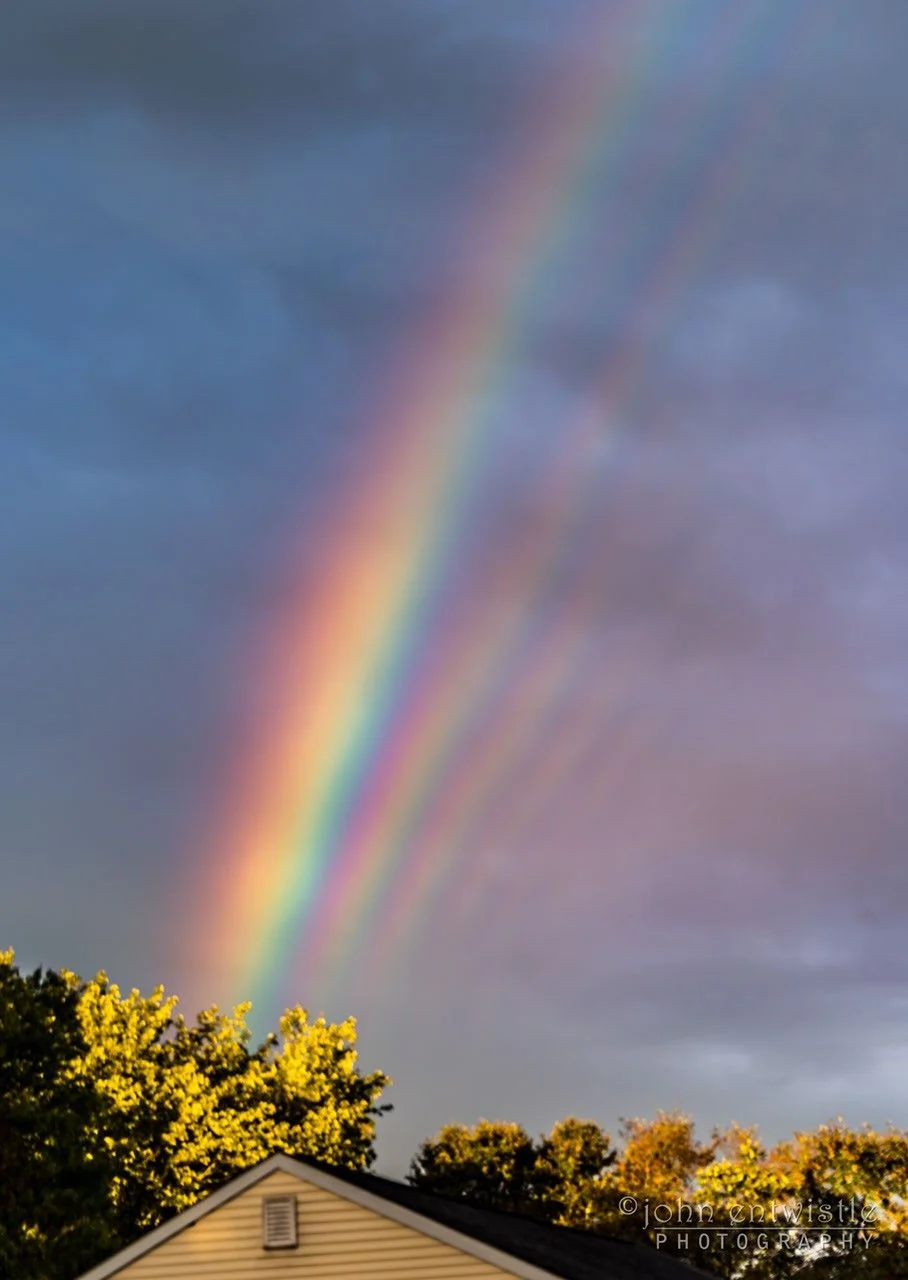
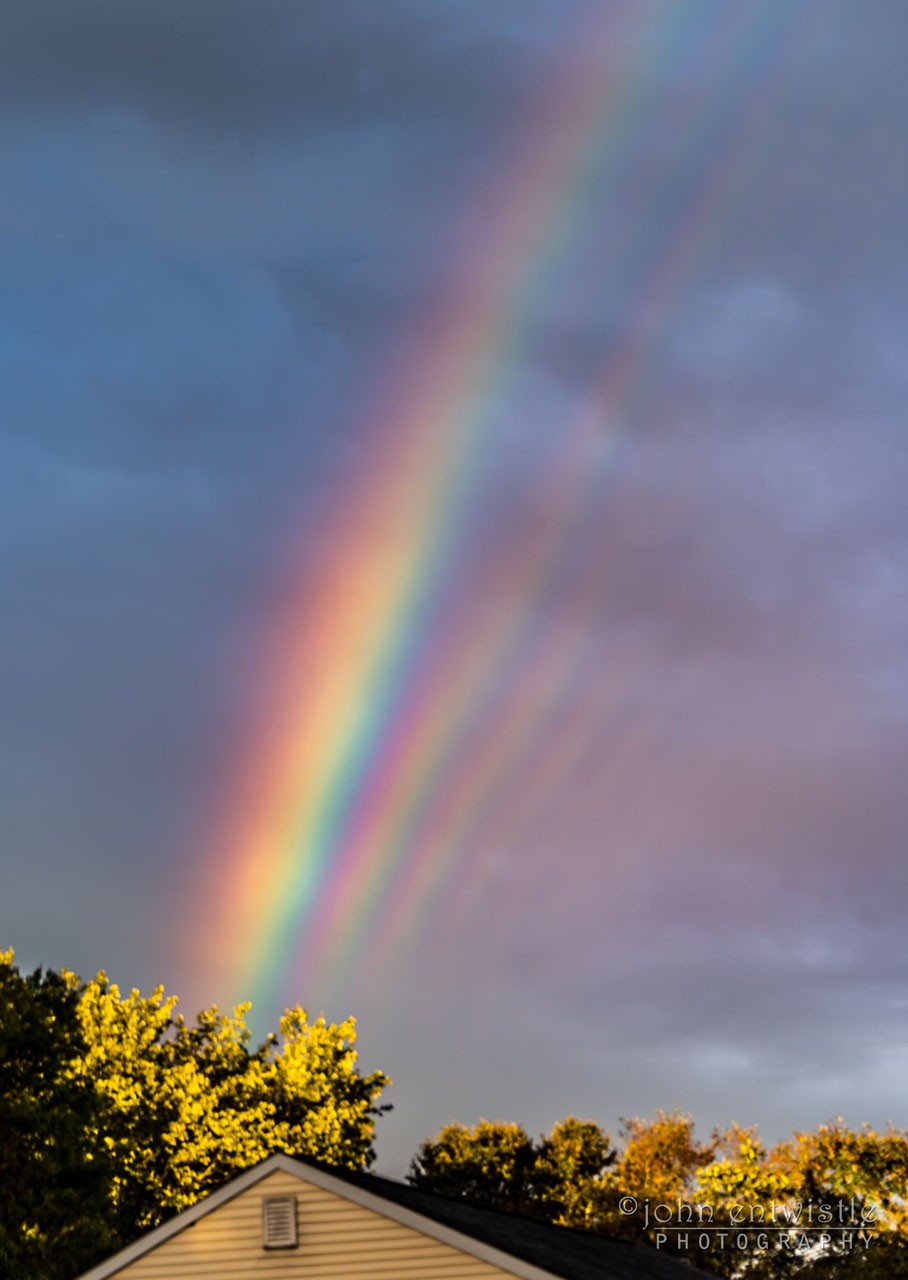
The skies over the Jersey Shore in New Jersey, USA, treated onlookers to a rare and spectacular atmospheric phenomenon on the day after the remnants of Hurricane Florence had passed through the region in 2018. Instead of the typical single arc of a rainbow, a vibrant "hall" of multiple, closely spaced rainbow bands, known as supernumerary rainbows, materialized in the sky. This captivating display, observed in the direction opposite to the sun, provided a stunning visual testament to the intricate physics of light and water.
The event, captured by a photographer and witnessed by their daughter, unfolded over approximately half an hour. During this period, the photographer documented at least five distinct supernumerary rainbows that appeared and faded with remarkable fluidity. The featured image, a single shot that immortalized this ephemeral spectacle, showcased the distinct, layered colors of these unusual arcs against a backdrop of a house under a cloudy sky.
The Science Behind the Spectacle
Supernumerary rainbows are a fascinating optical illusion that occurs under specific atmospheric conditions. Unlike the primary rainbow, which is formed by the single internal reflection of sunlight within raindrops, supernumerary rainbows arise from the interference of light waves after they have undergone multiple reflections and refractions within the water droplets.
For these secondary bows to appear, the water droplets responsible for the rainbow must be remarkably uniform in size, typically less than one millimeter in diameter. This uniformity is crucial because it leads to constructive and destructive interference of light waves of specific wavelengths. As sunlight, which is composed of a spectrum of colors, interacts with these uniformly sized droplets, different wavelengths of light are amplified or canceled out at slightly different angles. This process results in the appearance of additional, fainter bands of color just inside the primary rainbow.
The phenomenon of supernumerary rainbows is a direct consequence of light behaving as a wave. Their observation and scientific understanding in the early 19th century were considered significant evidence supporting the then-emerging wave theory of light, which challenged the prevailing corpuscular theory. The intricate patterns observed in supernumerary rainbows are a visual manifestation of wave interference, a principle analogous to the ripples that form on the surface of a pond when a stone is dropped into it. The precise spacing and intensity of these supernumerary bands are highly sensitive to the size distribution of the water droplets, making their appearance a delicate indicator of atmospheric conditions.
Context of the Event: Hurricane Florence’s Aftermath
Hurricane Florence, a powerful and destructive Category 4 hurricane, made landfall on the coast of North Carolina on September 14, 2018. The storm brought with it immense rainfall, devastating flooding, and strong winds that caused widespread damage across several southeastern states. While the most severe impacts were felt in North Carolina and South Carolina, the storm’s extensive rain bands and associated weather systems extended northward, affecting areas as far as New Jersey.
In the days following the hurricane’s passage, the weather patterns began to shift. As the storm system weakened and moved inland, clearer skies started to emerge in some regions. It was during this transitional period, when scattered clouds and intermittent sunshine prevailed, that the conditions became ripe for the formation of atmospheric optical phenomena like rainbows. The presence of lingering moisture in the atmosphere, combined with the emergence of sunlight from a specific angle, created the perfect environment for both primary and supernumerary rainbows to manifest.
The specific location, the Jersey Shore, is known for its coastal geography, which can influence atmospheric conditions. The proximity to the ocean often contributes to humidity and the presence of fine water droplets in the air, especially in the aftermath of significant weather events. This particular instance, occurring after the passage of a major hurricane, highlights how even in the wake of destructive weather, nature can offer moments of breathtaking beauty and scientific intrigue.
Timeline of Observation
While the precise date of the photograph’s capture is not explicitly stated in the provided information, it is understood to have occurred in 2018, shortly after Hurricane Florence had moved through the region. The observation itself was a relatively brief but dynamic event.
- Post-Hurricane Florence Period (2018): The remnants of Hurricane Florence had passed over the Jersey Shore.
- Emergence of Sunlight: The sun began to appear in one direction.
- Appearance of Rainbows: In the opposite direction, a "hall" of rainbows, including supernumerary bands, became visible.
- Dynamic Display: Over the course of approximately 30 minutes, the vibrant supernumerary rainbows fluctuated, fading in and out.
- Photographic Documentation: At least five supernumerary bands were captured in a single photograph during this period.
Supporting Data and Related Phenomena
The occurrence of supernumerary rainbows is not an isolated event but rather a specific manifestation of broader atmospheric optics. Understanding these phenomena often involves comparing them to other related visual displays:
- Primary Rainbow: The most common rainbow, characterized by a single arc of colors with red on the outer edge and violet on the inner edge. This is formed by a single internal reflection of sunlight within raindrops.
- Secondary Rainbow: A fainter, larger arc that appears above the primary rainbow, with its colors reversed (violet on the outer edge, red on the inner). It is formed by two internal reflections of sunlight within raindrops.
- Fogbows: Similar to rainbows, fogbows are formed by sunlight interacting with water droplets. However, they occur in fog, where the droplets are much smaller and more uniformly sized than raindrops. This leads to the interference effects that create supernumerary bows, but often with less distinct colors due to the very small droplet size. The article references a past APOD feature on "a hall of mountain fogbows," illustrating the similarity in the visual spectacle.
- Circumzenithal Arc (CZA) and Circumhorizontal Arc (CHA): These are other halo phenomena that involve ice crystals in the upper atmosphere, producing bright, colorful arcs. While visually striking, they are distinct from rainbows, which are formed by water droplets.
The scientific explanation of supernumerary rainbows relies heavily on the principles of wave interference. This phenomenon is analogous to:
- Wave Interference: The superposition of two or more waves, which can result in constructive interference (where wave amplitudes add up) or destructive interference (where wave amplitudes cancel out). This is the fundamental principle behind the formation of the extra bands.
- Diffraction: The bending of waves as they pass around obstacles or through narrow openings. While interference is the primary mechanism for supernumerary rainbows, diffraction also plays a role in the overall light scattering process within the droplets.
The characteristic colors of a rainbow, including the supernumerary bands, are a result of the dispersion of sunlight. White sunlight is composed of different wavelengths, each corresponding to a specific color. When light passes through a medium like water, it is refracted at an angle that depends on its wavelength. Violet light, with shorter wavelengths, is refracted more than red light, with longer wavelengths, leading to the separation of colors.
Broader Impact and Implications
The appearance of such a striking atmospheric phenomenon serves multiple purposes:
- Educational Outreach: The Astronomy Picture of the Day (APOD) program, which featured this image and explanation, plays a vital role in science communication. By presenting stunning astronomical and atmospheric imagery with clear explanations, APOD makes complex scientific concepts accessible to a wide audience. The featured image and its accompanying text likely inspired curiosity about meteorology, optics, and the physics of light among viewers.
- Scientific Understanding: The continued observation and documentation of phenomena like supernumerary rainbows contribute to our understanding of atmospheric physics. The precise conditions under which they form can provide valuable data for meteorologists and atmospheric scientists studying cloud droplet size distributions and light scattering.
- Appreciation of Natural Beauty: Beyond the scientific implications, such events offer moments of awe and wonder, reminding people of the beauty and complexity of the natural world. The photographer’s experience with their daughter highlights the potential for these natural displays to create memorable and educational moments for families.
- Technological Relevance: While not directly related to this specific event, the understanding of wave phenomena derived from studying rainbows has broad applications in various fields, including telecommunications, optics, and materials science. The historical significance of supernumerary rainbows as evidence for the wave nature of light underscores the fundamental importance of such observations in the progression of scientific thought.
Future Observations and Citizen Science
The APOD program itself encourages continued engagement with celestial and atmospheric phenomena. The "Your Sky Surprise" feature, which allows users to discover APOD images from their birthday, promotes a personalized connection to astronomy and space science. Similarly, the mention of "Tomorrow’s picture: open space" suggests a continuous stream of visually engaging content from the program.
The existence of supernumerary rainbows, while relatively rare in their full glory, is a reminder of the dynamic and often surprising nature of our atmosphere. For amateur astronomers and citizen scientists, such events underscore the value of careful observation and documentation. The availability of advanced digital cameras and widespread internet connectivity allows for the rapid sharing of such discoveries, contributing to a collective understanding and appreciation of the phenomena that occur above us. The image from the Jersey Shore, captured and shared through platforms like APOD, stands as a testament to the beauty that can emerge even in the aftermath of significant weather events, offering a moment of scientific marvel and natural splendor.