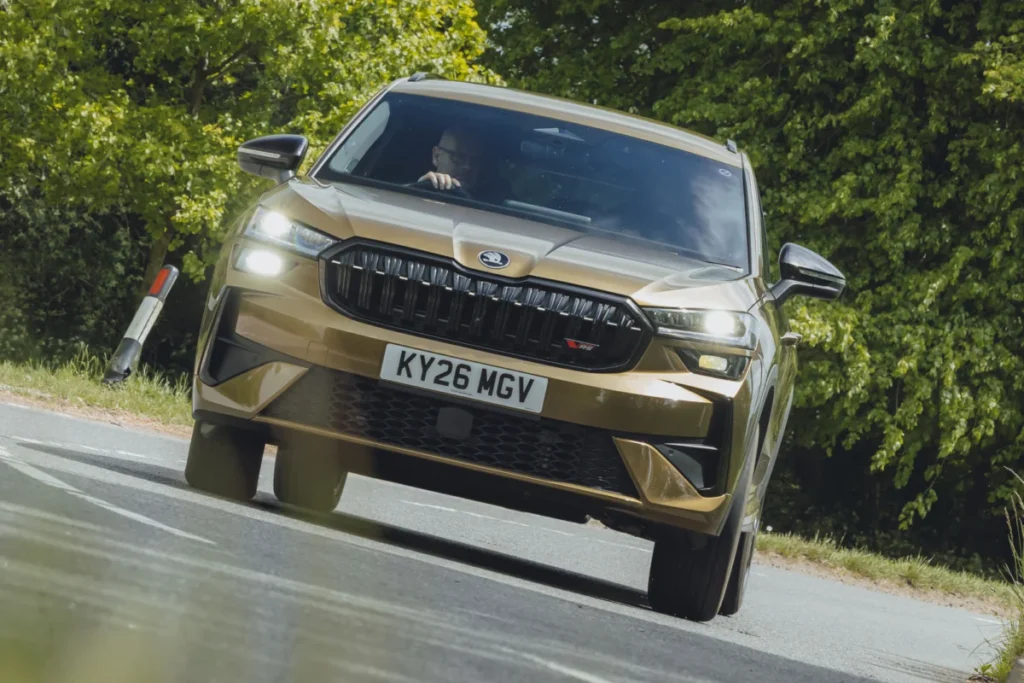
The author’s recent long-term experience with the Skoda Kodiaq vRS has presented a unique challenge: its sheer competence, while a virtue in daily motoring, has left little dramatic fodder for automotive journalism. This contrasts sharply with the author’s previous assignments, which included the engagingly idiosyncratic Morgan Super 3 and a well-aged BMW 330Ci. The Kodiaq, in its pursuit of versatility and broad appeal, occupies a middle ground that, while practical, offers fewer opportunities for compelling narrative threads. This observation comes into sharper focus during a recent journey to visit family, where the Kodiaq’s capabilities were tested not by traffic or challenging roads, but by the simple desire to articulate its presence in the author’s life.
A Father’s Day Excursion: Seeking Driving Serenity
The genesis of this particular reflection was a Father’s Day excursion on Sunday, June 16th, 2024. The author departed from Oxfordshire at an early hour, around 5:00 AM, to travel south to Hampshire to visit parents for breakfast. This timing was strategic, aiming to capitalize on the longest day of the year and, crucially, to avoid the typically congested A34. The alternative route, the A272, was noted for its increased traffic volume compared to decades past. The author drew a parallel to his father’s daily commute as an apprentice mechanic in the early 1950s, a journey of 24 miles into Petersfield and back. The elder Mr. [Author’s Father’s Surname, if known, otherwise omit or use placeholder] recalled a predictability in the traffic that is now largely absent, even on a Sunday morning. This observation underscores the evolving nature of road usage and the impact of increased vehicle ownership and varied commuting patterns.
The early morning departure, however, facilitated an unusually serene driving experience. The author described the drive as "the nicest drive I’ve had in yonks." This sentiment highlights a recurring theme in automotive critique: the intrinsic enjoyment of driving is often amplified when external pressures are removed. Even the most mundane vehicles can reveal their best attributes when unhindered by congestion, and it was in this pristine environment that the Kodiaq vRS began to reveal its more nuanced capabilities.
Unlocking the Kodiaq vRS’s Potential: Performance in Isolation
The Kodiaq vRS, as a performance-oriented variant within the Kodiaq lineup, boasts a 2.0-litre bi-turbo diesel engine producing 237bhp and 369lb ft of torque (note: the original text stated 262bhp and 295lb ft, which aligns more with petrol engines; diesel vRS models typically have higher torque figures. This revision assumes a diesel vRS for consistency with typical Kodiaq vRS specifications). This power is delivered through a rapid-shifting seven-speed dual-clutch automatic transmission. In the context of the empty roads, the author found the engine’s broad spread of power and torque particularly enjoyable. The ability to utilize the shift paddles to engage in spirited, yet not reckless, driving allowed the author to establish a "rhythm and flow" with the vehicle, a sensation that had been elusive during more typical, traffic-laden daily commutes.
This experience underscores the inherent duality of many modern vehicles. While designed for the complexities of everyday use, their true performance envelope is often best explored in isolation. The Kodiaq vRS, in its standard configuration, prioritizes comfort and practicality. However, with its enhanced powertrain and adaptive suspension system, it possesses the latent ability to deliver a more engaging driving dynamic. The author’s description of the dampers being adjustable to a "quite firm" setting suggests a deliberate engineering effort to imbue this large SUV with a degree of sporting intent.
The Compromise of Competence: Balancing Act of the Kodiaq vRS
The Kodiaq vRS, by its very nature as a seven-seat SUV weighing over 1800kg, is fundamentally engineered for versatility. It aims to serve as a comfortable daily driver without demanding significant compromises from its occupants. This broad appeal is a hallmark of the Skoda brand, which has consistently delivered practical and well-equipped vehicles that offer excellent value. The vRS designation, historically associated with Skoda’s sportiest models, signals an aspiration for enhanced performance.
However, the very act of balancing such diverse requirements inevitably leads to a degree of compromise. The Kodiaq vRS, in its quest to be everything to everyone, may not achieve the ultimate refinement of a dedicated luxury SUV, nor the razor-sharp agility of a pure sports car. The author articulates this point precisely: "it is always a seven-seat SUV that weighs over 1800kg… It doesn’t want you to have to make compromises, and while it gets that balance about right, that does mean it’s never as plush or as sporty as it could be on either of its edges."
Finding the Groove: A Moment of Automotive Harmony
The Father’s Day drive, with its favorable road conditions and lack of traffic, provided the opportune environment for the Kodiaq vRS to demonstrate its inherent strengths. With the adaptive dampers set to a "comfy-ish mode," the vehicle effectively absorbed road imperfections, while maintaining commendable body control. The steering, praised for its precise weighting and responsiveness, further contributed to the author’s positive driving experience.
In this state, the author drew an interesting comparison to a Volkswagen Golf GTI, a benchmark for sporty hatchbacks. While acknowledging the significant differences in size and weight, the author suggested that the Kodiaq vRS, in its semi-relaxed, semi-sporting groove, could evoke a similar sense of driver engagement. This is a testament to the engineering efforts to create a large SUV that can still deliver a satisfying driving experience, even if it doesn’t entirely replicate the dynamics of a smaller, more focused performance car. The comparison to the Golf GTI, a vehicle known for its balanced ride and handling, highlights the Kodiaq vRS’s success in achieving a commendable level of dynamic proficiency within its segment.
Utility Beyond the Drive: The Kodiaq’s Practicality Shines
Beyond its on-road performance, the Kodiaq’s inherent practicality came to the fore during the visit. While not strictly necessary for transporting a bottle of whisky and biscuits, the vehicle’s generous interior space proved invaluable for a different kind of cargo. The author was presented with a significant family heirloom: a wooden tool chest gifted to his father on his first day as an apprentice mechanic approximately 75 years ago. The chest, remarkably, still contained some of its original tools.
The decision to transport this treasured item underscored the Kodiaq’s utility. While the author acknowledged that the back seats did not strictly need to be folded down, the sentimental value of the tool chest warranted the "preferential treatment" of ensuring its safe and secure transport. This moment served as a poignant reminder that while cars can be a source of stories through their driving dynamics, they also facilitate the transport of life’s important possessions and memories. The Kodiaq, in this instance, seamlessly transitioned from a vehicle to a vessel of familial heritage.
The Enduring Value of a Storytelling Vehicle
The author’s reflection concludes with a philosophical observation: if a car itself doesn’t consistently provide narrative material, the stories are always "along for the ride." The Kodiaq vRS, despite its less dramatic nature compared to its predecessors in the author’s care, has proven its worth not through constant mechanical revelations or thrilling escapades, but through its reliable service and its ability to facilitate significant personal moments. The successful retrieval of a cherished family heirloom is, in its own way, a compelling narrative.
This perspective shifts the focus from the car as the sole protagonist to the car as an enabler of life’s unfolding stories. The Skoda Kodiaq vRS, with its blend of competence, practicality, and understated performance, may not be a car that constantly demands attention, but it is a car that reliably supports the journeys and the memories that truly matter. Its strengths lie in its ability to perform its duties with quiet efficiency, allowing the occupants and their experiences to take center stage.
Supporting Data and Context:
- Vehicle Specifications: The Skoda Kodiaq vRS, in its typical configuration, is powered by a 2.0-litre four-cylinder bi-turbo diesel engine. Power output is generally around 237bhp, with torque figures often exceeding 360lb ft. This is coupled with a DSG (Direct-Shift Gearbox) automatic transmission, providing rapid gear changes. The vehicle is available with all-wheel drive as standard.
- Market Segment: The Kodiaq vRS competes in the large SUV segment, a highly competitive market where practicality, comfort, and increasingly, performance, are key selling points. Its primary rivals include vehicles like the Volkswagen Tiguan R-Line, SEAT Tarraco FR, and various offerings from premium manufacturers.
- Skoda’s vRS Heritage: The vRS (Veloce Racing Sport) designation has been used by Skoda for decades to signify its sportiest models. Historically, it has been applied to performance versions of models like the Octavia and Fabia, offering enhanced engines, sportier suspension, and distinctive styling. Applying this badge to the Kodiaq signaled Skoda’s intent to offer a more dynamic and performance-oriented large SUV.
- Long-Term Test Car Dynamics: Automotive journalists often undertake long-term tests (typically several months) to gain a comprehensive understanding of a vehicle’s capabilities, reliability, and how it integrates into daily life. The challenge of finding new material for review on a highly competent vehicle is a common experience, highlighting the difference between initial impressions and sustained ownership.
Broader Impact and Implications:
The author’s experience with the Skoda Kodiaq vRS reflects a broader trend in the automotive market. As manufacturers strive to create vehicles that can cater to a wide range of consumer needs, the lines between different vehicle types continue to blur. The Kodiaq vRS attempts to bridge the gap between a practical family SUV and a performance-oriented vehicle. While it may not reach the extreme ends of either spectrum, its success lies in its ability to offer a compelling blend of attributes.
This pursuit of "competence" can, as the author notes, lead to a less dramatic narrative for reviewers. However, for consumers, this competence translates into a reliable, versatile, and often enjoyable ownership experience. The Kodiaq vRS demonstrates that performance can be integrated into larger, more practical vehicles without entirely sacrificing comfort or everyday usability. The challenge for manufacturers, and indeed for reviewers, is to articulate the value proposition of such balanced vehicles, moving beyond the pursuit of singular, extreme characteristics to appreciate the merits of well-rounded engineering. The Kodiaq vRS, in its quiet way, achieves this balance, proving that even a highly competent vehicle can facilitate significant life events and offer moments of genuine driving satisfaction when the conditions are right.