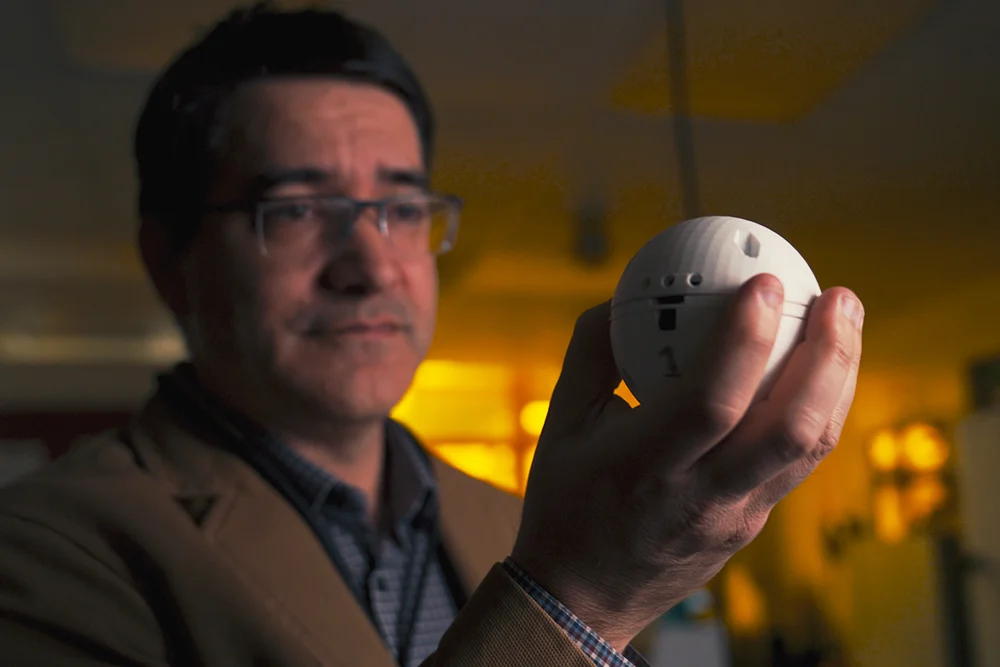
Researchers at MIT Lincoln Laboratory have unveiled a groundbreaking innovation poised to significantly enhance the safety of military personnel, first responders, and law enforcement in environments contaminated by dangerous airborne substances. The newly developed device, aptly named the Tactical Optical Spherical Sensor for Interrogating Threats, or TOSSIT, is a compact, baseball-sized sensor capable of remotely detecting hazardous vapors and aerosols. This advancement promises to fill a critical gap in current threat detection capabilities, offering a low-cost and highly deployable solution for a range of chemical hazards, from sophisticated chemical warfare agents to accidental industrial releases and dangerous particulate matter.
Revolutionary Detection Technology
TOSSIT’s operational principle is elegantly straightforward yet remarkably effective. The sensor is designed for immediate deployment in potentially hazardous zones, whether by being physically tossed, dropped from a drone, or launched via other means. Upon reaching its target area, TOSSIT actively samples the surrounding air. Its core detection mechanism relies on an internal camera that monitors a removable dye card. This specialized card undergoes a distinct color change when exposed to specific chemicals, acting as a visual indicator of their presence. This colorimetric approach allows for rapid and reliable identification of a spectrum of threats, including nerve agents, blister agents, and volatile organic compounds commonly associated with industrial accidents. Crucially, TOSSIT can also detect airborne particulate matter, such as fentanyl dust, which poses a significant and growing threat in both law enforcement and public health contexts.
The alerts generated by TOSSIT are designed for immediate action. Upon detecting a confirmed threat, the device can transmit notifications to users via a dedicated mobile application or trigger audible alarms integrated directly into the sensor itself. This dual alert system ensures that personnel are informed of immediate dangers in real-time, allowing for swift and appropriate protective measures to be taken. The development represents a significant leap forward in portable, immediate threat detection, moving beyond the limitations of more complex or stationary sensing equipment.
Addressing an Unmet Need in Threat Assessment
The impetus behind TOSSIT’s development stems from a recognized deficiency in the existing arsenal of chemical detection tools. Many current systems are either too cumbersome, too expensive for widespread deployment, or lack the sensitivity to detect the full range of airborne threats, particularly solid aerosolized particles. Richard Kingsborough, the principal investigator on the TOSSIT project at MIT Lincoln Laboratory, highlighted this critical gap in a recent statement. "TOSSIT fills an unmet need, providing a low-cost sensing option for vapors and solid aerosol threats — think toxic dust particles — that would otherwise not be detectable by small deployed sensor systems," Kingsborough explained. This statement underscores the device’s potential to empower individuals and teams with the ability to assess risks in situations where conventional methods fall short.
The implications of TOSSIT extend beyond military applications. First responders, such as firefighters and hazardous materials teams, frequently encounter unknown chemical substances during emergencies. The ability to quickly and safely assess the airborne composition of a scene before full entry or extensive operations can dramatically reduce the risk of exposure and injury. Similarly, law enforcement agencies dealing with drug interdictions, particularly involving potent synthetic opioids like fentanyl, could benefit from TOSSIT’s ability to detect airborne traces, safeguarding officers from accidental inhalation.
A Chronology of Innovation and Deployment
The journey of TOSSIT from concept to deployment reflects a dedicated research and development effort. While the precise timeline of its initial conception and early development stages remains proprietary, the successful completion of extensive field testing signifies a mature and reliable technology. The announcement of its transfer to the U.S. military indicates that TOSSIT has successfully navigated rigorous validation processes, meeting the stringent performance and reliability requirements of defense applications. This transfer is a testament to the efficacy and readiness of the technology for operational use.
The development process likely involved iterative design, prototyping, and rigorous testing under various environmental conditions. This would have included simulations of chemical agent releases, exposure to diverse atmospheric conditions, and assessments of the sensor’s durability and operational range. The use of removable dye cards suggests a modular design, potentially allowing for the customization of sensors to detect specific classes of chemicals based on anticipated threats, further enhancing its versatility.
Supporting Data and Technical Specifications
While detailed technical specifications are typically not disclosed in initial public announcements, the "baseball-sized" descriptor provides a tangible sense of TOSSIT’s portability and ease of deployment. This compact form factor is crucial for its intended use, allowing for rapid dispersal and minimal logistical burden. The reliance on an internal camera and dye card indicates a visual-spectroscopic detection method, which is generally cost-effective and can be highly sensitive depending on the specific dyes employed.
The capacity to alert via a mobile app suggests the integration of wireless communication capabilities, likely utilizing Bluetooth or similar short-range protocols for immediate data transfer. The inclusion of an onboard alarm further enhances its standalone functionality, ensuring operation even in environments with limited connectivity. The "low-cost" attribute, as emphasized by the principal investigator, is a critical factor for widespread adoption. This suggests that TOSSIT is designed to be an accessible and expendable tool, enabling the deployment of multiple sensors to create a network of detection points rather than relying on a single, high-cost device. This cost-effectiveness is paramount for equipping large numbers of personnel and covering expansive areas.
Official Responses and the Path Forward
The transfer of TOSSIT technology to the U.S. military represents a significant endorsement from a key stakeholder. This move signals confidence in the device’s capabilities and its potential to bolster national security. While specific military branches or units that will be adopting TOSSIT have not been publicly detailed, its applicability spans across various combat and security operations where chemical threats are a concern. This includes scenarios such as reconnaissance missions, perimeter security, and post-incident assessment.
The implications of this deployment are far-reaching. For service members operating in potentially contaminated zones, TOSSIT offers an unprecedented level of real-time situational awareness. This proactive detection capability can inform immediate tactical decisions, such as the need for enhanced personal protective equipment, evacuation orders, or the establishment of safe perimeters. The ability to rapidly identify the presence and type of chemical threat can significantly reduce the time to mitigation and medical response, thereby minimizing casualties and long-term health consequences.
Broader Impact and Future Implications
The success of TOSSIT has the potential to ripple beyond its immediate military and first responder applications. The underlying technology could be adapted for a variety of civilian uses. For instance, environmental monitoring agencies could utilize TOSSIT to detect hazardous emissions from industrial sites or identify the source of chemical spills. In public health, it could play a role in monitoring air quality for specific pollutants or detecting the presence of dangerous substances in public spaces.
Furthermore, the development of TOSSIT highlights a broader trend in the miniaturization and democratization of advanced sensing technologies. As these tools become more accessible and affordable, they empower a wider range of individuals and organizations to address safety and security challenges. The emphasis on a "low-cost" solution is particularly important, as it suggests a pathway towards equipping even smaller agencies or teams with cutting-edge detection capabilities.
The collaborative effort between MIT Lincoln Laboratory and the U.S. military underscores the vital role of public-private partnerships in advancing national defense and public safety. Innovations like TOSSIT are the product of sustained investment in research and development, coupled with a clear understanding of the operational needs of those on the front lines. As the world continues to face evolving threats, from state-sponsored chemical weapons to the clandestine production of dangerous substances, technologies that offer rapid, reliable, and accessible detection will be indispensable. TOSSIT represents a significant stride in this ongoing effort, promising to make the world a safer place by providing an early warning against invisible dangers.