In a significant leap forward for STEM education, Backyard Brains has unveiled SpikerBot, an innovative robot designed to democratize learning in both robotics and neuroscience by introducing a revolutionary programming paradigm rooted in biological principles. Departing from traditional coding languages and complex logic, SpikerBot empowers users to imbue their robotic creations with lifelike behaviors using an intuitive interface built entirely on virtual neurons and synapses, offering an unprecedented hands-on approach to understanding how brains, both biological and artificial, function. This groundbreaking system aims to bridge a critical gap in neuroscience education while making the exciting world of robotics more accessible than ever before.
The Genesis of a New Educational Paradigm
Backyard Brains, a company renowned for its commitment to making neuroscience accessible to all, has consistently pushed the boundaries of educational technology. Founded on the principle that understanding the brain shouldn’t be confined to advanced university labs, their previous innovations, such as the SpikerBox, allowed students to record electrical activity from living neurons using simple, affordable equipment. This track record of demystifying complex biological processes laid the groundwork for SpikerBot, which extends their mission into the realm of artificial intelligence and robotics.
The development of SpikerBot was driven by a fundamental observation: while students often learn about individual neurons in elementary school, the curriculum rarely progresses to explain how millions of these units work in concert to produce complex behaviors until college-level neuroscience courses. This leaves a vast, unexplored territory in between, hindering a deeper, more intuitive understanding of the brain. As Co-Founder & CEO Greg Gage and Designer Alex Hatch highlighted in their discussions about the new bot, this educational chasm is akin to teaching the basic function of a transistor and then expecting students to immediately grasp Python programming without any intermediate knowledge of electronics or circuit design. SpikerBot is engineered to fill this void, fostering "neuroscience literacy" from an early age.

A Brain on Wheels: Inspired by Biological Simplicity
The core philosophy underpinning SpikerBot is elegantly simple, yet profoundly powerful, drawing direct inspiration from Valentino Braitenberg’s seminal 1984 book, Vehicles: Experiments in Synthetic Psychology. Braitenberg’s work demonstrated how remarkably complex, almost lifelike behaviors—such as fear, love, or aggression—could emerge from rudimentary vehicles equipped with simple sensors and direct connections to motors. These "vehicles" responded to environmental stimuli in straightforward, predefined ways, yet their collective actions appeared intentional and intelligent. SpikerBot embraces this concept, allowing users to design neural circuits where sensors directly influence actuators, bypassing the need for abstract computational logic.
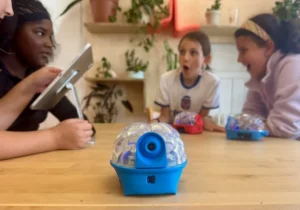
Instead of writing lines of if-then statements or grappling with intricate algorithms, SpikerBot’s app presents a visual canvas where users drag and connect virtual neurons and axons. This graphical programming environment transforms the daunting task of coding into an engaging, experimental process of circuit design. As the creators emphasize, "there’s no code, no LLMs, just neurons, synapses, and behavior emerging from a circuit a kid designed." This intuitive approach significantly lowers the barrier to entry for aspiring roboticists and neuroscientists, making the learning experience less about syntax and more about the fundamental principles of neural networks.
Programming with Neurons: An Intuitive Interface
The SpikerBot programming interface is a testament to thoughtful design and extensive refinement. Described as being "less like traditional programming with pages of code to scroll through and more like moving cables on a patch synthesizer," the app provides an immediate, holistic view of the neural circuit being constructed. Every component, from sensory inputs (like light or sound detection) to motor outputs (controlling movement or activating lights), is represented as a node in a visual network. Users can connect these nodes with "axons," adjusting the strength and type (excitatory or inhibitory) of synaptic connections, much like a neuroscientist might hypothesize about neural pathways.

One of the most compelling features of SpikerBot’s programming environment is its instantaneous feedback. There is no compilation time, no waiting for code to upload. As soon as a user modifies a connection or changes a neuron’s property, the SpikerBot physically reacts, demonstrating the immediate consequences of the neural circuit alteration. This real-time interaction transforms learning into a dynamic process of experimentation and discovery, mirroring the rapid feedback loops inherent in biological systems. This immediacy not only enhances engagement but also accelerates the learning curve, allowing for rapid iteration and a deeper understanding of cause and effect in neural pathways.
This neuromorphic programming approach leads to fascinating inversions in complexity. Behaviors that are notoriously difficult to program with traditional methods for beginners—such as a robot gracefully following a person or chasing an object—become surprisingly simple with just a few neurons. A creature that hunts objects can be constructed with as few as two neurons. Conversely, tasks that are trivial in conventional programming, like making a robot count in binary, become an intricate challenge requiring a complex web of neural connections. This contrast vividly illustrates the different strengths of biological and silicon-based computation, providing a unique perspective on intelligence.
Hardware and Interaction: A Sensory Experience
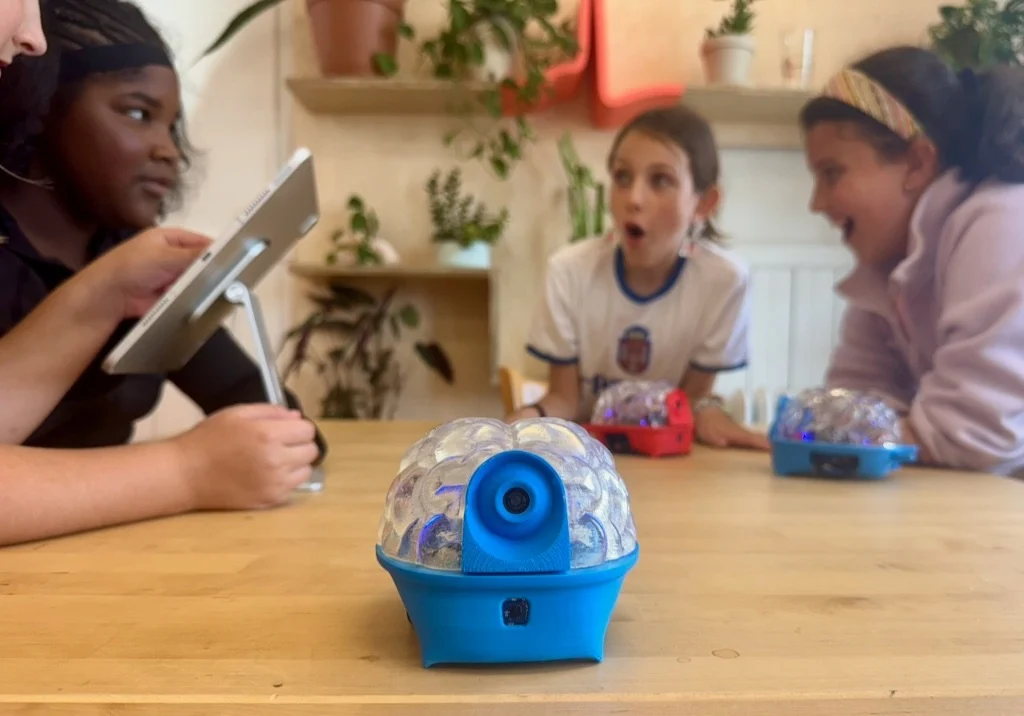
The SpikerBot itself is a thoughtfully designed piece of hardware, embodying the "brain on wheels" concept both functionally and aesthetically. Its chassis is distinctly brain-shaped, echoing Backyard Brains’ corporate logo and reinforcing its educational mission. This compact robot is equipped with a rich array of sensors, allowing it to perceive its environment in a manner analogous to living organisms. A camera provides visual input, a microphone registers sounds, and a distance sensor enables it to detect proximity to objects. These sensory inputs are the raw data that feed into the user-designed neural networks.
Beyond perception, SpikerBot also communicates and acts through a variety of outputs. Its integrated lights are designed to glow and fade with a natural, "bioluminescent cell"-like quality, adding to the organic feel of its responses. The sound effects are described as "charming and quirky," carefully crafted to enhance the robot’s personality and reactions rather than just providing generic mechanical noises. Furthermore, connection points on the chassis support 3D-printed attachments, enabling owners to customize their bot’s appearance and extend its functionality, fostering creativity and personal expression.

A key aspect of SpikerBot’s appeal lies in its ability to interact with existing Backyard Brains peripherals. Specifically, it supports their Spiker:bit board, which means users can connect the SpikerBot to their own muscle signals. This capability opens up a fascinating avenue for learning about bio-control, allowing individuals to program their robot’s movements and behaviors using electrical impulses from their own bodies, forging a direct, embodied connection to neuroscience. Imagine controlling a robot’s "thoughts" with your arm muscles—a powerful demonstration of the nervous system at work.
Bridging the Neuroscience Gap: More Than Just a Toy
The educational value of SpikerBot extends far beyond basic robotics. By immersing users in neural circuit design, it organically introduces fundamental neuroscience principles. Students can experiment with concepts like recurrent pairs, where neurons form feedback loops, and lateral inhibition, a mechanism critical for sensory processing (e.g., edge detection). They can also explore how simple circuits can give rise to emergent properties, such as working memory, by observing how the robot "remembers" recent stimuli. The curriculum embedded within the SpikerBot experience, developed with input from both child educators and professional neuroscientists, ensures that the play is grounded in rigorous scientific understanding.
The implications of fostering this "neuroscience literacy" are profound. With roughly one in five people experiencing a neurological condition—ranging from ADHD and autism to Parkinson’s and Alzheimer’s—a foundational understanding of how brain patterns work can significantly enhance public understanding and empathy. By providing a shared language and tangible models of basic neural functions, SpikerBot can help demystify these conditions, reducing stigma and promoting informed discussions about brain health and function. It empowers individuals to grasp the building blocks of the brain, making complex topics more approachable and relatable.
A Commitment to Longevity and Accessibility

Backyard Brains has also demonstrated a forward-thinking approach to the long-term sustainability and accessibility of SpikerBot. The accompanying app, the heart of its programming interface, is entirely free and does not require cloud-based authentication, ensuring that users retain full control and access to their creations without ongoing subscriptions or internet dependency. This commitment to open access aligns with their mission to democratize science education.
Furthermore, the hardware design reflects a philosophy of durability and repairability. The robot operates on easily swappable AA batteries, a deliberate choice over non-replaceable lithium-ion cells that inevitably degrade over time. To support this, Backyard Brains offers its own custom, high-performance NiMH AA batteries, providing a rechargeable and environmentally conscious power solution. This design decision enhances the product’s longevity and reduces electronic waste, reinforcing responsible consumer practices.
Crowdfunding Success and Future Horizons
SpikerBot was launched through a Kickstarter campaign, which concludes on June 14. This crowdfunding model allowed early adopters to secure the robot at a discounted price of $219, significantly below its eventual retail price of $299. Backyard Brains’ history of successfully delivering on past crowdfunding projects instills confidence in their ability to bring SpikerBot to fruition, assuring backers of their proven track record.
The enthusiasm surrounding SpikerBot underscores a growing appetite for innovative educational tools that make complex scientific concepts tangible and engaging. The project represents more than just a new robot; it signifies a potential paradigm shift in how we teach and learn about artificial intelligence, robotics, and the most complex organ known—the human brain. As Alex Hatch aptly noted, a significant portion of SpikerBot’s capabilities and behaviors remains undiscovered, waiting for users worldwide to "build anything yet" and unlock its full potential. This open-ended invitation to explore and innovate promises a future where a new generation, equipped with a deeper understanding of neural networks, will drive the next wave of scientific and technological breakthroughs.