The cosmic tapestry, once a vibrant nursery of nascent stars, is now demonstrably quieter. Over the past 4.5 billion years, the universe’s rate of stellar formation has plummeted to less than half its former intensity. Intriguingly, however, the abundance of one of the most critical ingredients for this stellar genesis – neutral atomic hydrogen – has remained surprisingly stable. This profound discovery, spearheaded by an international consortium of scientists led by researchers from the Chinese Academy of Sciences (CAS) and leveraging the capabilities of the Dark Energy Spectroscopic Instrument (DESI) project, challenges long-held assumptions about galactic evolution and the very mechanisms that light up the cosmos.
The groundbreaking findings, published on September 1st in the prestigious journal Nature Astronomy, stem from meticulously precise measurements of cosmic neutral atomic hydrogen (HI) taken across a significant span of the universe’s history, utilizing the formidable power of China’s Five hundred meter Aperture Spherical radio Telescope (FAST). The research team’s analysis reveals a stark dichotomy: while the universe’s star-making machinery has significantly wound down, the vast reservoirs of HI gas within galaxies, crucial for fueling this process, have diminished only marginally. This mismatch presents a compelling puzzle for astrophysicists, shifting the focus from a simple depletion of raw materials to a more complex understanding of how gas is processed and converted into stars.
The Fading Glow of Stellar Nurseries: A Cosmic Trend
Understanding why the universe’s star formation activity has declined with age is a central tenet of research into galaxy formation and evolution. The most intuitive explanation has long been that galaxies have gradually exhausted the readily available cold gas necessary to ignite new stars. This "cosmic consumption" model suggests a direct correlation: as star formation dwindles, so too should the supply of its primary feedstock. However, observational data has consistently presented a less straightforward picture, with a notable disconnect between the precipitous drop in star formation rates and a similarly dramatic depletion of available gas.
Neutral atomic hydrogen (HI) occupies a pivotal position in this cosmic equation. It acts as a vital intermediary, a reservoir of cold gas within galaxies that bridges the gap between the diffuse gas pervading the universe and the dense molecular clouds where stars are ultimately born. Astronomers primarily detect HI through its exceedingly faint 21-centimeter radio emission line. This spectral signature, however, is notoriously difficult to isolate from the cacophony of cosmic background noise, especially when observing distant galaxies.
Pioneering Observations: FAST and DESI Unite for Unprecedented Reach
For decades, astronomers grappled with a significant observational hurdle. While extremely sensitive radio telescopes could detect the faint HI signals, they were often limited to observing very small regions of the sky. Conversely, surveys that covered vast swathes of the cosmos generally lacked the sensitivity required to pick up these subtle radio whispers from the early universe. This fundamental limitation made it challenging to establish a reliable census of the universe’s total HI mass across the intermediate cosmic epochs, often referred to as the low- to intermediate-redshift universe.
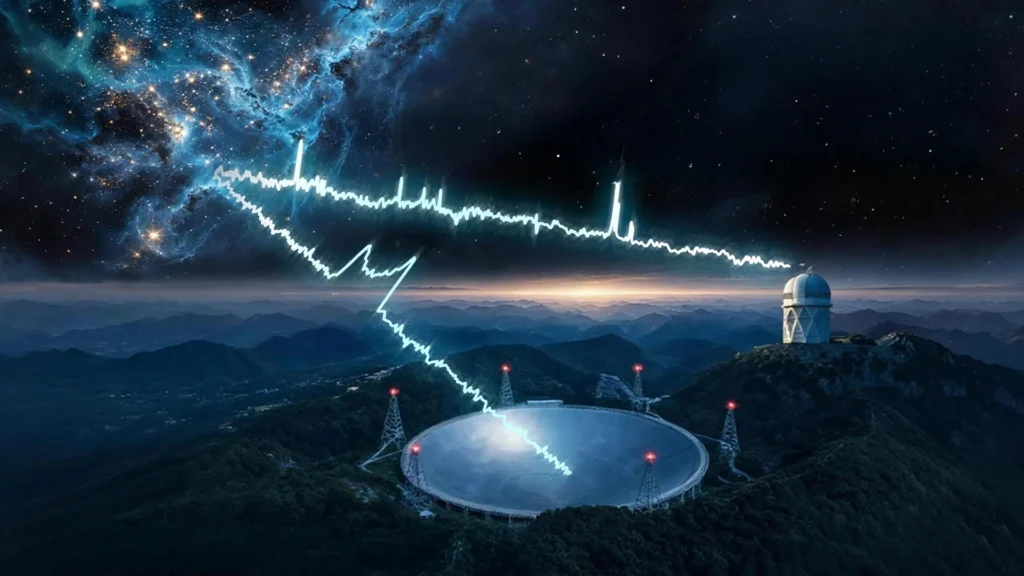
The new research ingeniously circumvents these limitations by synergistically combining the unparalleled radio sensitivity of FAST with the colossal optical spectroscopic dataset provided by DESI. This collaborative effort allowed the team to meticulously examine approximately 2.5 million galaxies, spanning nearly a third of the entire observable sky. This unprecedented sample size is crucial for statistical robustness and for capturing the subtle variations across different cosmic environments.
The core of their methodology lies in a sophisticated technique known as HI spectral stacking. This process involves carefully aligning and aggregating the faint radio signals from individual galaxies, which would otherwise be undetectable on their own. By leveraging precise redshift measurements for each galaxy – which indicate their distance and therefore their position in cosmic time – the weak HI signals are coherently stacked. This aggregation effectively amplifies the signal above the pervasive background noise, allowing the average HI signature to emerge with remarkable clarity. This innovative approach has enabled scientists to chart the evolution of cosmic neutral hydrogen with a precision and on a scale never before achieved, providing a robust new benchmark for understanding galactic gas reservoirs.
A Stark Disparity: Star Formation’s Decline Outpaces Hydrogen Loss
The results of this ambitious survey have unveiled a striking disparity between the evolutionary trajectories of star formation and the universe’s neutral hydrogen reserves. The data indicates that approximately 4.5 billion years ago, the cosmic star formation rate was about 2.5 times higher than it is today. Over the same temporal span, however, the density of neutral atomic hydrogen was only approximately 1.4 times greater than its current level.
This quantitative comparison highlights a critical insight: star formation has decelerated at a significantly faster pace than the depletion of the universe’s HI reservoir. The implication is profound: the simple exhaustion of neutral hydrogen cannot, by itself, account for the dramatic decline in the birth of new stars. This observation compels a re-evaluation of the prevailing models and suggests that other factors are playing a more dominant role in regulating star formation.
The Shifting Cosmic Mystery: From "How Much?" to "How?"
The findings of the FAST and DESI collaboration effectively reframe the central question in galactic evolution. Instead of pondering "whether the gas is depleting," the focus now shifts to "why it is increasingly difficult to form stars despite abundant neutral hydrogen reserves." This transition signifies a move from a supply-and-demand narrative to a more nuanced understanding of the complex processes that govern star birth.
It is essential to understand that stars do not form directly from the bulk of neutral atomic hydrogen. Their genesis is primarily confined to much denser environments: molecular gas clouds. Neutral atomic hydrogen serves as a crucial intermediary, a stepping stone in the cosmic baryon cycle, connecting the diffuse gas present throughout the universe to the molecular hydrogen that can ultimately condense and ignite into stars.
The researchers propose that the most significant changes impacting star formation in the more recent cosmic epochs may not be related to the overall quantity of HI, but rather to how this gas is processed and transported within galaxies. As the inflow of gas from the vast cosmic web diminishes, and as gas densities within galaxies decrease, the efficiency with which neutral hydrogen is converted into molecular hydrogen might be declining. Under this hypothesis, the overall HI reservoir can remain relatively stable, while the supply of the denser molecular gas, the direct precursor to star formation, gradually dwindles. This scenario offers a compelling explanation for the observed divergence between HI abundance and star formation rates.
Implications for Understanding Galactic Evolution and the Universe’s Future
The implications of this research extend far beyond simply quantifying hydrogen content in the universe. These findings provide a vital new clue in unraveling the mystery of why the universe’s once prolific star-forming engines have been steadily slowing down. This slowdown has profound consequences for the long-term evolution of galaxies, the chemical enrichment of the cosmos, and ultimately, the conditions for life itself.
The successful integration of observations from FAST and DESI marks a significant advancement in our ability to study the cosmic gas cycle during the universe’s later stages. This new observational benchmark will be instrumental in understanding the protracted decline in star formation and the broader processes that sculpt galaxies over cosmic timescales. By precisely mapping the distribution and evolution of neutral hydrogen and its relationship with star formation, scientists can refine their models of galaxy evolution, providing a clearer picture of how the universe transitioned from a period of intense stellar birth to its current, more quiescent state.
This interdisciplinary endeavor, involving lead scientists from the National Astronomical Observatories of China, the Shanghai Astronomical Observatory of CAS, and Shanghai Jiao Tong University, alongside researchers contributing to DESI, underscores the power of international scientific collaboration. The diverse contributions from research institutions across Asia, North America, and Europe highlight the global nature of modern astrophysics and the immense scientific potential unlocked when highly sensitive radio observations are fused with extensive optical spectroscopic surveys. This synergy allows for a more comprehensive and nuanced understanding of the complex interplay of forces that govern the universe’s ongoing evolution. As astronomers continue to probe the depths of space and time, discoveries like these illuminate the intricate and dynamic nature of our cosmos, reminding us that even the most fundamental processes are subject to profound and ongoing change.