In 1985, a seemingly modest advertisement in the prestigious pages of Scientific American offered a glimpse into the future of material science and product design. The Innovative Design Fund, seeking groundbreaking concepts, extended an offer of up to $10,000 to support inventive prototypes across categories like clothing, home decor, and textiles. It was within this call for ingenuity that William Freeman PhD ’92, then an electrical engineer at Polaroid and now a distinguished professor at MIT, encountered an opportunity that would spark an idea dormant for nearly four decades. Freeman’s proposal was not for a mere garment fastener, but for a revolutionary concept: a three-sided zipper designed to imbue objects with tunable stiffness, transforming them from pliable to rigid with a simple manipulation.
Freeman envisioned a zipper mechanism that diverged from the conventional linear function. Instead of closing seams on flat surfaces, his triangular design was conceived as a dynamic switch. Imagine a purse that could compress for effortless packing, or a tent that could autonomously erect itself. This innovative zipper would function by interlocking three distinct belts, each equipped with narrow, triangular "teeth." A specialized slider, designed to encompass the entire triangular structure, would then be drawn along its length. This action would bring the three sides into alignment, effectively straightening them into a rigid, triangular tube, thereby locking the object into a firm state. Conversely, retracting the slider would allow the structure to revert to its softer, more malleable form.
While Freeman’s pioneering blueprint, meticulously detailed and a testament to his engineering acumen, was ultimately not selected for funding by the Innovative Design Fund, its potential was not entirely dismissed. He proceeded to patent his prototype, a tangible manifestation of his forward-thinking design, and stored it away in his garage, a testament to his belief in its future utility. This act of preservation would prove prescient, as the seeds of his innovation lay dormant, awaiting the technological advancements necessary for its full realization.
The Revival: MIT CSAIL Brings the Y-Zipper into the 21st Century
Fast forward nearly forty years, and the pursuit of objects with "tunable stiffness" has become a significant area of research within advanced engineering and robotics. Prior attempts to achieve this dynamic material property often fell short, requiring cumbersome manual assembly or lacking the crucial reversibility that makes a system truly adaptable. Recognizing the inherent potential in Freeman’s long-shelved concept, researchers at the MIT Computer Science and Artificial Intelligence Laboratory (CSAIL) embarked on a mission to revive and refine his three-sided zipper. The result of this ambitious undertaking is the "Y-zipper," a sophisticated system that integrates an automated design tool with an adaptable fastener, breathing new life into Freeman’s original vision.
The CSAIL team’s approach involved developing a powerful software program that empowers users to design and customize their own three-sided zippers. This digital blueprint is then brought to life through the precision of 3D printing, utilizing durable plastics. The Y-zipper, as it is now known, is not merely a fastener; it is a transformative component capable of being attached to or seamlessly embedded within a wide array of applications. From the practicalities of camping equipment and the critical demands of medical gear to the intricate movements of robotics and the expressive forms of art installations, the Y-zipper promises to revolutionize how objects are assembled, deployed, and interacted with.
Redefining Assembly: From Flat Closures to Morphological Transitions
Jiaji Li, an MIT postdoc and a leading researcher at CSAIL, who is a principal author on the open-access paper detailing this project, highlighted the fundamental difference between traditional zippers and Freeman’s original concept. "A regular zipper is great for closing up flat objects, like a jacket," Li explained. "But Freeman ideated something more dynamic. Using current fabrication technology, his mechanism can transform more complex items." This transformation is not merely about opening and closing; it is about fundamentally altering the physical form and structural integrity of an object.
The key innovation lies in the Y-zipper’s ability to facilitate rapid transitions between flexible and rigid states. "We’ve developed a process that builds objects you can rapidly shift from flexible to rigid, and you can be confident they’ll work in the real world," Li stated, underscoring the practical applicability of their advancements. This level of predictability and reliability in dynamic assembly has been a long-sought goal in engineering.
Customizable Form and Function: The Power of User-Defined Design
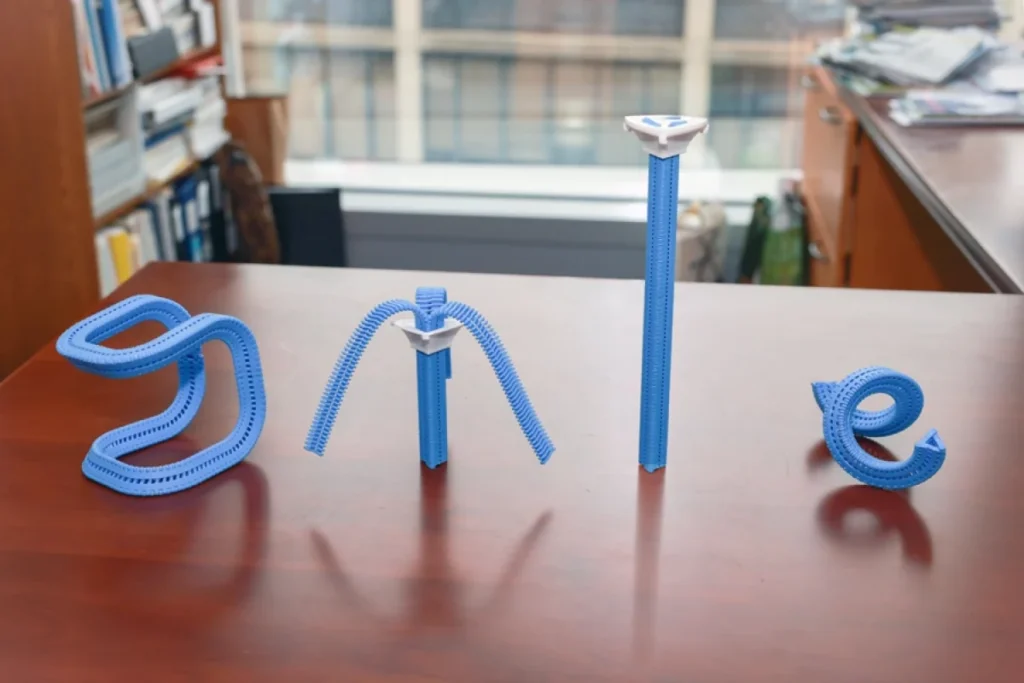
The user interface developed by CSAIL is central to the Y-zipper’s versatility. Through the software, individuals can meticulously customize the aesthetic and functional characteristics of their zippers. This includes defining the precise length of each of the three zipper strips, as well as dictating the direction and angle at which they will bend when engaged. This granular control allows for tailored designs that can adapt to specific structural requirements.
Furthermore, users can select from four fundamental "motion primitives" that govern the zipper’s appearance when fully zipped: straight, bent (forming an arch), coiled (resembling a spring), or twisted (mimicking a screw thread). This allows for a remarkable degree of shape-shifting capability. When unzipped, a Y-zipper might unfurl like a creature with multiple, flexible appendages. Upon activation, it transforms into a more compact and rigid structure, such as a rod or a column.
This adaptability has profound implications for practical applications. Consider the process of pitching a tent. Traditionally, this can be a time-consuming and sometimes challenging endeavor, especially for a single person. While manual tent assembly can take upwards of six minutes, the integration of a Y-zipper could dramatically reduce this to a mere minute and twenty seconds. By attaching each arm of the Y-zipper to the sides of a tent canopy, and then engaging the zipper, the structure could effectively "pop" into place, erecting the tent with unprecedented speed and ease.
Medical and Robotic Applications: Enhancing Human Health and Autonomous Systems
Beyond recreational uses, the seamless transition offered by the Y-zipper holds significant promise for the development of more flexible and adaptable wearables, particularly in medical contexts. The research team demonstrated this potential by wrapping a Y-zipper around a wrist cast. This innovative application allows a patient to loosen the cast for comfort during the day and then zip it up securely at night to prevent further injury. This ability to adjust rigidity based on specific needs transforms a typically static medical device into a dynamic tool that enhances patient comfort and therapeutic efficacy.
The system’s capacity to enable rapid, push-button actuation also opens doors for advancements in robotics. By attaching a motor to a fabricated Y-zipper, the zipping process can be automated, leading to the creation of more sophisticated and adaptive robotic systems. For instance, a robotic quadruped could dynamically adjust the length of its legs. By tightening (zipping up) its limbs, it could assume taller stances for traversing uneven terrain, and by loosening (unzipping), it could lower its center of gravity for stability or to navigate confined spaces. Such rapid, on-the-fly adjustments could be crucial for robots exploring challenging environments like canyons or forests, where terrain variability is a constant obstacle.
The potential extends to dynamic art installations as well. The CSAIL researchers successfully created a long, winding floral sculpture that "bloomed" to life through the controlled actuation of a static motor driving a Y-zipper. This demonstrates the artistic and expressive capabilities of the technology, allowing for kinetic sculptures that can transform and evolve.
Mastering the Material: Durability and Performance Under Stress
While the creative and functional potential of the Y-zipper was evident, a critical question remained: its durability. Could these 3D-printed fasteners withstand the rigors of daily use and repeated manipulation? To address this, the CSAIL team conducted a series of rigorous stress tests, pushing the Y-zippers to their limits.
Their investigation began with an evaluation of two commonly used 3D printing plastics: polylactic acid (PLA) and thermoplastic polyurethane (TPU). Using a specialized machine designed to bend the Y-zippers, they assessed the materials’ strength and flexibility. Their findings indicated that PLA, while less flexible, could withstand heavier loads, whereas TPU offered greater pliability, suggesting that material selection would be crucial depending on the intended application.
Further testing involved subjecting the Y-zippers to continuous opening and closing cycles using an actuator. The objective was to determine the lifespan of the fasteners before failure. Astonishingly, some Y-zippers endured approximately 18,000 cycles of zipping and unzipping before breaking. This remarkable resilience, as revealed by subsequent 3D simulations, is attributed to the Y-zipper’s inherent elastic structure, which effectively distributes stress across the entire mechanism, preventing localized failure points.
Future Horizons: From Space Exploration to Disaster Relief
Despite the impressive durability demonstrated, the researchers are already looking towards further enhancements. Li envisions the development of even stronger three-sided zippers, potentially utilizing metallic components for applications demanding extreme robustness. The current 3D printing platform also presents limitations in scaling up the zippers for larger projects, a hurdle they aim to overcome in future iterations.
The potential applications for Y-zippers extend far beyond current demonstrations. Li speculates about their utility in space exploration, where the multi-tentacled nature of unzipped Y-zippers could be incorporated into spacecraft for grasping rock samples from asteroids or planetary surfaces. Furthermore, their ability to facilitate rapid assembly makes them ideal for humanitarian efforts. In the aftermath of natural disasters or during rescue operations, Y-zippers could be embedded into structures that allow relief workers to quickly erect shelters or deploy medical tents, providing critical aid much faster.
Expert Validation: Bridging Softness and Rigidity
The significance of the Y-zipper’s contribution has been recognized by peers in the field. Guanyun Wang, an assistant professor at Zhejiang University who was not involved in the research, offered a compelling endorsement. "Reimagining an everyday zipper to tackle 3D morphological transitions is a brilliant approach to dynamic assembly," Wang stated. "More importantly, it effectively bridges the gap between soft and rigid states, offering a highly scalable and innovative fabrication approach that will greatly benefit the future design of embodied intelligence." This sentiment highlights the Y-zipper’s role in advancing fields that require the integration of physical objects with intelligent systems.
The research paper detailing this groundbreaking work was co-authored by Jiaji Li and William Freeman, alongside Tianjin University PhD student Xiang Chang. The MIT CSAIL team contributing to this project includes PhD student Maxine Perroni-Scharf, undergraduate Dingning Cao, recent visiting researchers Mingming Li (Zhejiang University), Jeremy Mrzyglocki (Technical University of Munich), and Takumi Yamamoto (Keio University), and MIT Associate Professor Stefanie Mueller, a CSAIL principal investigator and senior author. The research received support from various institutions, including a postdoctoral research fellowship from Zhejiang University and the MIT-GIST Program.
The culmination of this extensive research was presented at the ACM’s annual Computer-Human Interaction (CHI) conference on Human Factors in Computing Systems in April, marking a significant milestone in the journey of an idea that began with a small advertisement in 1985 and has now blossomed into a transformative technology with the potential to reshape our interaction with the physical world. The Y-zipper stands as a powerful testament to the enduring value of innovation and the remarkable progress that can be achieved when visionary concepts are revisited and empowered by cutting-edge technological advancements.