In 1985, a seemingly modest advertisement in the esteemed pages of Scientific American offered a glimpse into a future where everyday objects could possess dynamic functionality. The Innovative Design Fund, with a forward-thinking grant of up to $10,000, sought ingenious prototypes in clothing, home decor, and textiles. It was this call for innovation that captured the attention of William Freeman, then an electrical engineer at Polaroid and a graduate of MIT, who would go on to become a distinguished professor at the Massachusetts Institute of Technology. Freeman, driven by a vision of transformative design, submitted a radical concept: a three-sided zipper. Unlike its ubiquitous two-sided counterpart designed to fasten flat materials, Freeman’s invention was envisioned as a versatile switch, capable of transitioning objects like chairs, tents, and purses between soft, pliable states and rigid, stable forms, thereby revolutionizing their portability and ease of assembly.
Freeman’s initial blueprint, though innovative, bore a striking resemblance to a conventional zipper, with a crucial triangular modification. The core of his design involved three belts, each meticulously attached to a series of narrow wooden "teeth." A specially designed slider, engineered to encircle this three-sided mechanism, could be moved along its length. When engaged, this slider would draw the three strips together, aligning them into a triangular tube, effectively locking the object into a rigid configuration. While this pioneering proposal was ultimately not funded by the Innovative Design Fund, Freeman, recognizing the inherent potential of his creation, pursued a patent for his prototype. The meticulously crafted device was then carefully stored away in his garage, a testament to his belief that its utility would eventually be realized.
A Dormant Idea Reawakened: The Genesis of the Y-Zipper
Fast forward nearly four decades, and the innovative spirit that sparked Freeman’s initial concept has found fertile ground within the hallowed halls of the MIT Computer Science and Artificial Intelligence Laboratory (CSAIL). Researchers at CSAIL, driven by a persistent challenge in creating objects with "tunable stiffness" – the ability to dynamically alter an object’s rigidity – have unearthed Freeman’s forgotten patent. Prior attempts to achieve this feat often fell short, either by requiring laborious manual assembly or by offering irreversible transformations. The CSAIL team, however, envisioned a more elegant and accessible solution, leading to the development of an advanced automated design tool and an adaptable fastener they have christened the "Y-zipper."
This sophisticated software program empowers users to intricately customize three-sided zippers. Once designed, these personalized fasteners are brought to life through the precision of 3D printing, utilizing advanced plastics. The potential applications for these versatile devices are remarkably broad, spanning critical sectors such as camping equipment, where rapid deployment of shelters could be paramount; medical gear, offering enhanced patient comfort and support; robotics, enabling adaptable locomotion and manipulation; and even artistic installations, allowing for dynamic and interactive structures.
Jiaji Li, an MIT postdoc and CSAIL researcher, who also serves as a lead author on the open-access paper detailing this groundbreaking project, elaborated on the transformative nature of Freeman’s original idea. "A regular zipper is great for closing up flat objects, like a jacket, but Freeman ideated something more dynamic," Li explained. "Using current fabrication technology, his mechanism can transform more complex items. We’ve developed a process that builds objects you can rapidly shift from flexible to rigid, and you can be confident they’ll work in the real world." This sentiment underscores the core achievement: bridging the gap between conceptual brilliance and practical, real-world application.
The Mechanics of Transformation: Customization and Functionality
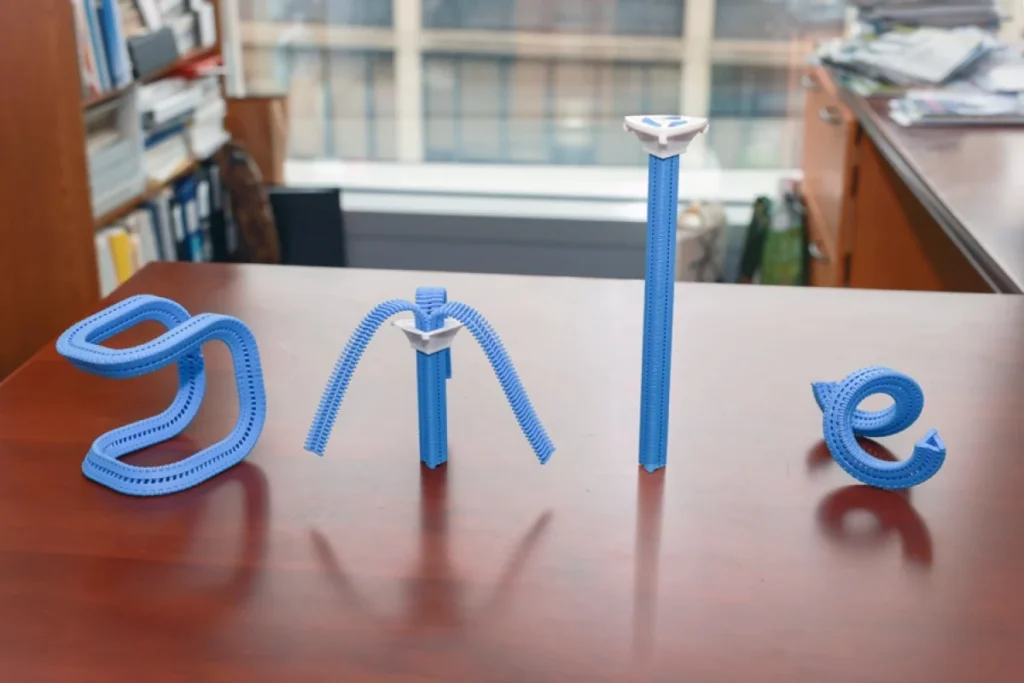
The user-centric design of the Y-zipper is a significant aspect of its innovation. Through CSAIL’s intuitive software, individuals can meticulously tailor the visual appearance of the fasteners when they are in their zipped, rigid state. This customization extends to defining the length of each of the three strips, as well as precisely controlling the direction and angle at which they will bend. Furthermore, users can select from four distinct "motion primitives" that dictate the zipper’s appearance when engaged: straight, bent (forming an arch-like structure), coiled (resembling a spring), or twisted (mimicking the appearance of a screw).
The resulting Y-zipper exhibits a remarkable "shape-shifting" capability in real-world scenarios. In its unzipped state, it can unfurl to resemble a creature with three sprawling appendages, akin to a squid’s tentacles. Upon zipping, it contracts into a more compact and rigid form, such as a rod. This inherent flexibility holds immense practical value, particularly in situations demanding efficiency and ease of use. Consider the seemingly simple act of pitching a tent. While typically a multi-step process that can take upwards of six minutes, the Y-zipper offers a dramatic acceleration, reducing the time to a mere one minute and twenty seconds. The application is straightforward: each arm of the Y-zipper is attached to a side of the tent, providing structural support from the apex, allowing the zipper to elegantly deploy the canopy into its erected position.
Beyond recreational applications, this seamless transition between states holds significant promise for the development of more adaptable wearable technologies, especially within the medical field. The research team demonstrated this potential by wrapping a Y-zipper around a wrist cast. This innovation allows a patient to loosen the cast during the day for increased comfort and then tighten it at night to prevent further injury. This adaptability transforms a typically rigid medical device into a more personalized and responsive aid, adjusting to the user’s evolving needs and promoting enhanced recovery.
The Y-zipper system also unlocks new avenues for creating devices that exhibit dynamic movement at the mere push of a button. By integrating a motor post-fabrication, the zipping process can be automated, facilitating the construction of sophisticated mechanisms like adaptive robotic quadrupeds. Such robots could possess the remarkable ability to alter the size of their limbs, extending them into taller configurations for traversing challenging terrain or retracting them for stability at lower altitudes. This capacity for rapid adjustment could prove invaluable for robots tasked with exploring complex environments such as canyons or dense forests. Furthermore, actuated Y-zippers can be employed in the creation of dynamic art installations. The CSAIL team showcased this potential by fabricating a long, winding floral sculpture that "bloomed" to life through the controlled zipping and unzipping of a static motor-driven device.
Material Science and Durability: Withstanding the Test of Time
While the creative and functional potential of the Y-zipper was readily apparent to Li and his colleagues, a critical question loomed: its durability. Could these novel fasteners withstand the rigors of daily use and repeated transformations? To address this, the CSAIL team embarked on a series of rigorous stress tests, meticulously evaluating the resilience of their creations.
The initial phase involved assessing the mechanical properties of two commonly utilized 3D printing plastics: polylactic acid (PLA) and thermoplastic polyurethane (TPU). Through controlled experiments using a specialized machine designed to bend the Y-zippers, researchers discovered that PLA offered superior load-bearing capacity, making it suitable for applications requiring greater strength. Conversely, TPU demonstrated greater flexibility, lending itself to designs where pliability was paramount.
In a subsequent experiment, the CSAIL researchers subjected the Y-zippers to a continuous cycle of opening and closing, driven by an actuator, to determine their lifespan before failure. The results were impressive: after enduring approximately 18,000 cycles of zipping and unzipping, the fasteners eventually succumbed. In-depth 3D simulations revealed the underlying reason for this remarkable durability: the inherent elastic structure of the Y-zipper, which effectively distributes stress across its entire form, preventing localized failure points.
Despite these promising findings, Li expressed an ambition for even greater resilience, envisioning future iterations of the three-sided zipper constructed from stronger materials, such as metal. He also noted the potential for scaling up the size of these zippers for larger-scale projects, a capability currently limited by the constraints of their existing 3D printing platform.
Future Frontiers: Expanding the Horizon of Applications
Li further speculated on the untapped potential of the Y-zipper system, highlighting its applicability in extreme environments like space exploration. He posited that Y-zipper tentacles could be integrated into spacecraft, enabling them to precisely grasp and collect nearby rock samples. Similarly, the zippers could be embedded within structures designed for rapid deployment, offering invaluable assistance to relief workers tasked with quickly establishing shelters or medical tents in the aftermath of natural disasters or during emergency rescue operations.
The significance of this innovation has not gone unnoticed by the broader scientific community. Guanyun Wang, an assistant professor at Zhejiang University who was not involved in the research, offered high praise for the project. "Reimagining an everyday zipper to tackle 3D morphological transitions is a brilliant approach to dynamic assembly," Wang stated. "More importantly, it effectively bridges the gap between soft and rigid states, offering a highly scalable and innovative fabrication approach that will greatly benefit the future design of embodied intelligence." This endorsement underscores the Y-zipper’s potential to revolutionize how we design and interact with the physical world, particularly in the burgeoning field of robotics and intelligent systems.
The research paper detailing this transformative work was co-authored by Jiaji Li and William Freeman. They collaborated with Xiang Chang, a PhD student from Tianjin University, and a distinguished team of MIT CSAIL colleagues. This included PhD student Maxine Perroni-Scharf, undergraduate Dingning Cao, and recent visiting researchers Mingming Li from Zhejiang University, Jeremy Mrzyglocki from the Technical University of Munich, and Takumi Yamamoto from Keio University. Stefanie Mueller, an MIT Associate Professor and CSAIL principal investigator, served as the senior author on the project. The research received crucial support from a postdoctoral research fellowship from Zhejiang University and the MIT-GIST Program.
The groundbreaking findings of this research were formally presented at the ACM’s esteemed Computer-Human Interaction (CHI) conference on Human Factors in Computing Systems, held in April, marking a significant milestone in the dissemination and recognition of this remarkable technological advancement. The journey of the Y-zipper, from a visionary concept conceived in 1985 to a tangible, functional technology in 2023, exemplifies the enduring power of innovation and the profound impact that persistent research and development can have on shaping our future.