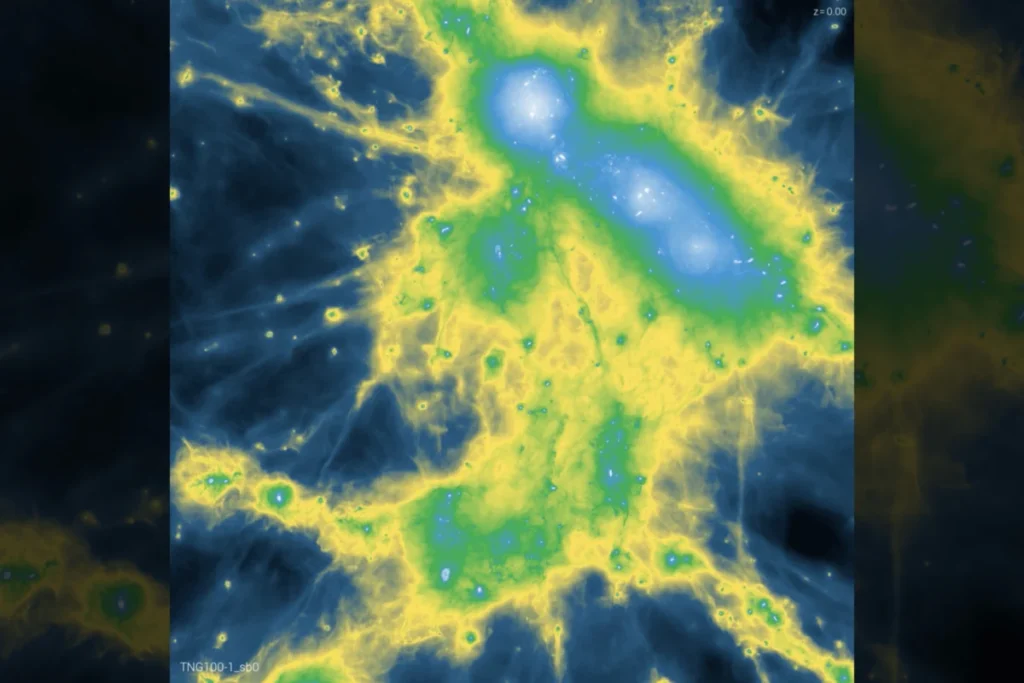
For decades, the cosmic ledger has failed to balance. While astronomers and physicists have developed a sophisticated understanding of the early universe’s composition, a significant portion of the "ordinary" matter that should exist in the modern cosmos has remained stubbornly invisible. This discrepancy, known as the "missing baryon problem," has long suggested that the vast majority of the atoms that make up stars, planets, and human beings are not where we expected them to be. However, a groundbreaking study led by researchers at the Massachusetts Institute of Technology (MIT) and the CHIME/FRB Collaboration has finally tracked down this elusive matter, revealing that it hides in gargantuan, diffuse clouds far beyond the visible boundaries of galaxies.
The research, published today in the journal Physical Review Letters, utilizes the high-precision detection of Fast Radio Bursts (FRBs)—millisecond-long pulses of intense radio waves from deep space—to map the distribution of matter across the intergalactic void. By analyzing how these signals "smear" as they travel through space and cross-referencing that data with the locations of millions of galaxies, the team has provided the most definitive evidence to date of where the universe’s missing ordinary matter resides.
The Missing Baryon Problem: A Cosmic Discrepancy
To understand the significance of this discovery, one must look back to the origins of the universe. Shortly after the Big Bang, the universe was a hot, dense plasma. Through observations of the Cosmic Microwave Background (CMB)—the afterglow of the Big Bang—and calculations based on Big Bang Nucleosynthesis (BBN), physicists have established a precise "budget" for the universe’s matter content. Approximately 83 percent of all matter is "dark matter," an invisible substance that interacts only through gravity. The remaining 17 percent is "baryonic matter," the ordinary matter composed of protons and neutrons that forms everything we can see and touch.
However, when astronomers tally up all the baryonic matter visible in the modern universe—counting every star in every galaxy and all the observable interstellar gas—the numbers do not add up. This visible matter accounts for only about 10 percent of the expected baryons. For nearly thirty years, the scientific community has asked: where is the other 90 percent?
Theoretical models suggested that this missing matter was not gone, but simply too diffuse to see. It was hypothesized to exist in the "Intergalactic Medium" (IGM), the vast spaces between galaxies, at densities as low as a single proton per cubic meter. At such low concentrations, this gas does not emit enough light to be detected by traditional telescopes, leaving it effectively invisible to conventional astronomy.
Fast Radio Bursts: The Universe’s Measuring Tape
The breakthrough came from an unlikely source: Fast Radio Bursts. First discovered in 2007, FRBs are among the most energetic and mysterious phenomena in the cosmos. They release as much energy in a fraction of a second as the Sun does in several days. Because they originate in distant galaxies billions of light-years away, their signals must travel through the vast expanses of the intergalactic medium to reach Earth.
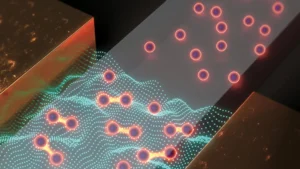
As an FRB signal travels, it encounters free electrons associated with the missing baryonic matter. This interaction causes a phenomenon known as dispersion. High-frequency radio waves travel slightly faster through a plasma than low-frequency waves. By the time the burst reaches a telescope on Earth, the signal has been "smeared" or stretched out in time, with the "blue" (high-frequency) components arriving before the "red" (low-frequency) components.
"What makes FRBs good to probe missing matter is that they have a special property," explains Haochen Wang, a graduate student at MIT’s Kavli Institute for Astrophysics and Space Research and a co-author of the study. "The more missing matter that the signal passes through, the more smeared the signal becomes. We can measure that smearing very precisely."
A Multi-Observatory Statistical Masterpiece
The MIT-led team did not rely on a single burst to solve the mystery. Instead, they employed a massive statistical approach, cross-correlating two of the most significant datasets in modern astronomy.
The first dataset came from the Canadian Hydrogen Intensity Mapping Experiment (CHIME), a revolutionary radio telescope located in British Columbia. Unlike traditional dish telescopes, CHIME is a stationary array of four massive cylindrical reflectors that "scan" the entire northern sky as the Earth rotates. This design has allowed the CHIME/FRB Collaboration to detect thousands of bursts, providing a large enough sample size for deep statistical analysis. For this study, the researchers analyzed 2,870 FRB signals.
The second dataset was provided by the Dark Energy Spectroscopic Instrument (DESI), located at the Kitt Peak National Observatory in Arizona. DESI is designed to measure the effect of dark energy on the expansion of the universe by mapping the 3D positions of tens of millions of galaxies. By utilizing DESI’s map of over 6 million galaxies, the MIT researchers could determine exactly where the FRB signals were passing through galactic environments versus empty space.
By overlapping the "smear" data from CHIME with the galaxy "maps" from DESI, the team could isolate how much of the signal degradation was caused by matter within galaxies compared to the matter surrounding them.
Findings: The Scale of Galactic Fountains
The results of the analysis were startling. The team found that the missing matter is indeed clustered around galaxies and galaxy groups, but it is far more spread out than previously assumed.
While a typical galaxy might be a few hundred thousand light-years across, the researchers found that the surrounding clouds of missing matter extend out to approximately 4 million light-years. This distance is significantly larger than what most cosmological simulations had predicted.
"We find that, overall, where there are more galaxies, there tends to be more missing matter around them," says Wang. "They’re more like fountains, and really push out gas to very large distances."
This "fountain" effect points to highly energetic processes occurring within galaxies. Supermassive black holes at the centers of galaxies often produce powerful jets of energy, and the collective explosions of supernovae (dying stars) create "galactic winds." The study suggests that these processes are much more violent and efficient at ejecting matter into the intergalactic void than scientists had estimated.
Kiyoshi Masui, associate professor of physics at MIT and a co-author of the study, notes the implications: "These measurements indicate that star activity, and activity from black holes, is stronger and much more violent than predicted. We’re finding missing matter that is pushed out to larger scales."
Chronology of the Discovery and Broader Context
The search for missing baryons has been a multi-decade journey:
- 1990s: Theoretical physicists first identify the "Missing Baryon Problem" after comparing Big Bang nucleosynthesis models with observed galactic matter.
- 2007: The first Fast Radio Burst (the "Lorimer Burst") is discovered in archival data, though its utility as a cosmological probe is not yet fully realized.
- 2018: CHIME begins full operations, drastically increasing the rate of FRB detections from a handful per year to hundreds.
- 2020: Early studies begin using single, localized FRBs to "weigh" the universe, confirming that the missing matter likely resides in the IGM.
- 2024: The MIT-led team publishes their findings in Physical Review Letters, using a massive sample size to map the specific shape and extent of this matter for the first time.
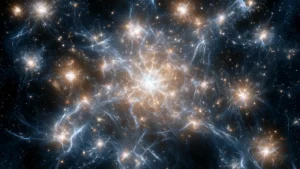
This discovery does more than just solve a cosmic accounting error; it provides a new "thermometer" for understanding galaxy evolution. If matter is being flung 4 million light-years away, it means the energy feedback loops within galaxies—the interplay between star formation, black hole growth, and gas expulsion—are the primary architects of the large-scale structure of the universe.
Future Implications and Scientific Impact
The success of this method marks a turning point in observational cosmology. Historically, the space between galaxies was considered a "dark" territory, nearly impossible to study because it contained so little light-emitting material. With the emergence of FRB science, the intergalactic medium is becoming a transparent laboratory.
The scientific community has reacted with enthusiasm to the findings. The ability to "see" the shape of the missing matter allows theorists to refine their simulations of how the universe grew from a smooth plasma into the "cosmic web" of filaments and voids we see today. If current models were underestimating the power of galactic feedback, this data will force a recalibration of how we understand the lifecycle of galaxies.
Furthermore, as CHIME and other next-generation radio telescopes—such as the upcoming CHORD (Canadian Hydrogen Observatory and Radio-transient Detector) and the Square Kilometre Array (SKA)—come online, the precision of these measurements will only increase.
"We got it to work for the first time, and will get it to work even more precisely as data gets better," Masui says.
In the near future, researchers hope to use this technique to distinguish between different types of galactic feedback. For instance, they may be able to determine whether the "fountains" of gas are primarily driven by the radiation pressure of newborn stars or the magnetic-hydrodynamic jets of supermassive black holes.
By solving the mystery of the missing matter, MIT and the CHIME/FRB Collaboration have not only accounted for the universe’s lost atoms but have also opened a new window into the violent, energetic processes that shape the cosmos on its grandest scales. The "missing" 90 percent of our world is no longer lost; it is simply part of a vast, invisible atmosphere that connects every galaxy in the universe.