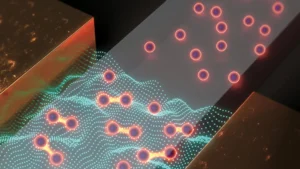
The core of this transformative research lies in the application of an electric field to a specialized ceramic material, which was observed to profoundly alter the behavior of phonons—the microscopic atomic vibrations responsible for carrying heat through solid matter. The scientists discovered that when the atoms within the ceramic vibrate in alignment with the direction of the applied electric field, referred to as the poling direction, these heat-carrying phonons exhibit a dramatically extended persistence. Conversely, vibrations moving perpendicular to the electric field are significantly attenuated. This directional control yields a remarkable outcome: heat travels almost three times more efficiently along the poling direction of the electric field than it does in other orientations, demonstrating a previously unachievable level of anisotropic thermal conduction.
Puspa Upreti, a postdoctoral research associate at ORNL and a key contributor to the study, underscored the profound implications of this newfound control. "Being able to control both how fast and in what manner heat flows could lead to devices that manage thermal energy far more efficiently than current technologies allow," Upreti stated, emphasizing the potential for a paradigm shift in device design and energy optimization. This breakthrough is particularly significant given the ever-increasing demand for more efficient thermal solutions in a world grappling with escalating energy consumption and the persistent challenge of waste heat.
The Pressing Need for Advanced Thermal Management
The ability to efficiently manage and direct heat is not merely an academic pursuit; it is a critical engineering challenge underpinning a vast array of modern and future technologies. From the microscopic scale of integrated circuits in smartphones and data centers to macroscopic industrial processes, uncontrolled heat is a relentless adversary. In electronics, excess heat can degrade performance, reduce lifespan, and even lead to catastrophic failure. As electronic components become smaller, denser, and more powerful—a trend exemplified by Moore’s Law—the thermal power density continues to escalate, pushing the limits of traditional cooling methods like fans and heat sinks.
Beyond electronics, efficient thermal management is crucial for:
- Solid-state electronic cooling systems: Devices with no moving parts, relying on thermoelectric effects or other material properties, which could revolutionize cooling in quiet, compact environments.
- Thermoelectric devices: Systems that convert waste heat directly into electricity, offering a promising avenue for energy harvesting and improving overall energy efficiency in various applications, from automotive to industrial.
- Chip-based electronics: The performance and reliability of microprocessors, GPUs, and memory chips are directly limited by their operating temperatures. Better heat removal can enable higher clock speeds and greater computational power.
- Cogeneration systems: Industrial processes often generate vast amounts of waste heat. Capturing and reusing this heat can significantly improve energy efficiency and reduce environmental impact.
The theoretical underpinning of energy efficiency in heat engines is famously illustrated by the Carnot cycle, an idealized model that meticulously defines the maximum possible efficiency by carefully orchestrating the movement of heat between hot and cold reservoirs. The present research offers a tangible step towards realizing such idealized thermal control in practical materials, by fundamentally altering how heat-carrying phonons navigate the material lattice.
In the context of the new study, the applied electric field acts as a sophisticated conductor, effectively reducing the internal obstacles and scattering events that typically impede phonon movement. This allows the heat-carrying vibrations to propagate much farther through the material with less dissipation, akin to easing severe congestion on a busy multi-lane highway, thereby enabling a significantly more efficient and directed flow of thermal energy.
Unraveling Atomic Motions with Neutrons
To truly grasp the intricate atomic-level phenomena driving this unprecedented thermal control, the research team leveraged the advanced capabilities of the Spallation Neutron Source (SNS) at ORNL, a world-leading DOE Office of Science user facility. SNS provides intense pulsed beams of neutrons, which are uniquely suited for probing the atomic structure and dynamics of materials. Unlike X-rays, which interact with electron clouds, neutrons interact with the nuclei of atoms, allowing for a clearer picture of atomic positions and, crucially, how those atoms move and vibrate.
Utilizing state-of-the-art inelastic neutron scattering techniques, the researchers were able to directly observe both the static arrangement of atoms within the crystal lattice and, more importantly, their dynamic motions. This allowed them to precisely characterize the phonons – their energy, momentum, and lifespan. This methodology builds upon the foundational work recognized by the Nobel Prize in Physics, awarded to Clifford Shull and Bertram Brockhouse in 1994 for their pioneering development of neutron scattering techniques for condensed matter research. Their work established neutron scattering as an indispensable tool for understanding the fundamental properties of materials.
The detailed measurements performed at SNS revealed two critical effects of the applied electric field: it not only increased the velocity at which the phonons propagated but also, and perhaps more significantly, substantially extended their lifetimes before they scattered. These extended phonon lifetimes are the primary mechanism behind the material’s dramatically enhanced ability to conduct heat along the poling direction. Michael Manley, an ORNL senior researcher who led the inelastic neutron scattering experiments alongside ORNL senior R&D staff member Raphaël Hermann, highlighted the magnitude of this achievement. "Earlier work on bulk ferroelectric materials achieved modest improvements in thermal conductivity of 5 percent to 10 percent. In stark contrast, these new measurements reveal an enhancement close to 300 percent – mainly because the phonons are able to travel much longer before they stop," Manley explained, underscoring the revolutionary nature of the current findings.
The Remarkable Properties of Relaxor-Based Ferroelectrics
The specific class of materials central to this discovery are known as relaxor-based ferroelectrics. Ferroelectric materials are characterized by their spontaneous electric polarization, which can be reversed by an external electric field. Relaxor ferroelectrics are a special subclass known for their diffuse phase transitions and the presence of dynamic polar nanoregions (PNRs) – tiny, fluctuating regions with local electric polarization, even above their average Curie temperature. When these materials are exposed to an external electric field, these myriad tiny electric charges within the material become aligned, or "poled," in a specific direction.
This alignment of the internal electric dipoles has a profound impact on the material’s lattice dynamics. The ordered electric dipoles create a more uniform potential energy landscape for the atomic vibrations, thereby reducing the probability of phonon scattering. In essence, the electric field "smoothes out" the atomic environment, allowing the heat-carrying phonons to propagate with less impedance, much like a wave traveling across a calm, unobstructed surface versus a turbulent, choppy one. This reduction in scattering events is the direct cause of the extended phonon lifetimes and the resultant highly efficient, directional thermal transport observed.
The single crystals of relaxor-based ferroelectrics used in these groundbreaking experiments were meticulously grown and then precisely exposed to the electric field (the "poling" process) by Raffi Sahul at Amphenol Corporation. This collaboration with an industrial partner like Amphenol, a global leader in interconnect products, sensors, and antennas, was crucial. It ensured the availability of high-quality, engineered materials necessary for the fundamental research and highlights the bridge between cutting-edge scientific discovery and practical material preparation, hinting at potential pathways for future industrial scaling and application development. The resulting poled materials consistently demonstrated highly controllable and anisotropic heat transport properties, validating the experimental approach.
A Threefold Increase: Surprising Even the Researchers
The interdisciplinary team meticulously combined the thermal conductivity measurements with the detailed insights gleaned from the neutron scattering data. This comprehensive approach allowed them to establish a direct and unequivocal link between the dramatic increase in heat flow and the observed changes in the atomic vibrations within the crystal lattice.
The design and execution of the crucial thermal conductivity experiments were overseen by the late Professor Joseph Heremans of The Ohio State University, a distinguished figure in the field of thermoelectrics. His profound expertise and guidance were instrumental in this phase of the research, as he mentored doctoral candidate Delaram Rashadfar through the complex analysis of the experimental data.
Rashadfar reflected on the unexpected magnitude of their findings: "While earlier work led us to expect only a modest effect, observing a threefold difference turned out to be a significant result." She further paid tribute to Professor Heremans’ scientific philosophy, stating, "Professor Heremans always stressed the importance of trusting the data first and letting the theory follow." This commitment to empirical evidence proved vital in accepting and interpreting such a surprisingly large enhancement in thermal conductivity, challenging pre-conceived notions based on previous research. The scientific community often expects incremental improvements, and a 300% enhancement is a rare and exhilarating outcome, demanding rigorous validation and a re-evaluation of theoretical models.
Broader Implications and Future Horizons
This revolutionary discovery holds immense potential to reshape thermal management strategies across numerous sectors. The ability to actively tune and direct heat flow in solids opens doors to designing "smart" thermal materials that can adapt to varying operational demands.
In Electronics and Computing: The rapid miniaturization and increasing power density of electronic devices, from advanced microprocessors to quantum computing components, create unprecedented thermal challenges. This new method could lead to:
- Highly efficient microcoolers: Integrated directly into chips, enabling higher clock speeds and extended device lifespans.
- Localized thermal management: Directing heat away from critical "hot spots" within a circuit, preventing performance bottlenecks and improving reliability.
- Solid-state refrigeration: Developing compact, silent, and vibration-free cooling systems for specialized applications, replacing less efficient or bulky conventional methods.
In Energy Conversion and Harvesting: The implications for energy technologies are equally profound:
- Enhanced thermoelectric generators: By optimizing heat flow across the junctions of thermoelectric materials, the efficiency of converting waste heat into usable electricity could be substantially improved, leading to more effective energy harvesting from industrial processes, automotive exhaust, and even body heat.
- Advanced thermal barrier coatings: Materials that can selectively block or transmit heat could lead to more efficient insulation in engines, turbines, and industrial furnaces, saving vast amounts of energy.
- Smart energy systems: Materials that dynamically adjust their thermal properties based on external stimuli could enable intelligent energy management in buildings and power grids.
Beyond Current Applications: This fundamental understanding of phonon engineering could also pave the way for entirely new classes of materials and devices. It might influence the development of advanced sensors, actuators, and even contribute to fundamental research in fields like phononics—the study of heat and sound waves in materials, analogous to photonics for light. The global market for thermal management solutions is projected to grow significantly in the coming years, driven by the increasing demand from electronics, automotive, and industrial sectors. A technology capable of such dramatic improvements in heat transfer efficiency could capture a substantial share of this market, fostering innovation and creating new economic opportunities.
Looking ahead, the research team envisions exploring the scalability of this effect, investigating other relaxor-based ferroelectrics and related materials to optimize the magnitude and tunability of the thermal anisotropy. Further theoretical modeling will also be critical to fully elucidate the complex interplay between electric fields, lattice distortions, and phonon scattering mechanisms. The long-term goal is to integrate these engineered materials into functional prototypes and ultimately into commercial products.
This research, supported by the DOE Basic Energy Sciences program and additional contributing partners, exemplifies the power of collaborative, interdisciplinary science facilitated by world-class national laboratory facilities. By challenging long-held assumptions and venturing into uncharted territories of material physics, scientists at ORNL, Ohio State, and Amphenol have not only made a significant scientific discovery but have also laid the groundwork for a future where thermal energy can be controlled with unprecedented precision, promising a new era of energy efficiency and technological advancement.