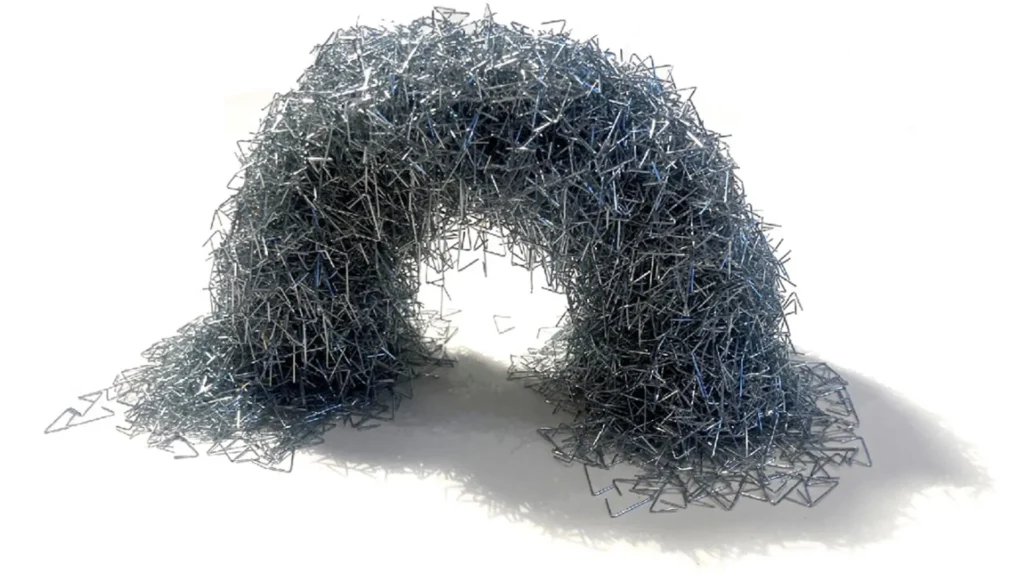
A tightly compressed bundle of office staples can behave in a surprising way. Even though it is made of many separate pieces, the tangled mass can be difficult to pull apart and can act almost like a single solid object. Yet that same bundle can quickly come undone. With the right vibration or movement, the staples can separate and return to a loose collection of individual pieces. This intriguing duality – the ability to transition rapidly between robust solidarity and individual fluidity – has captured the attention of researchers, sparking a new wave of innovation in material science. Scientists at the Paul M. Rady Department of Mechanical Engineering at CU Boulder are leveraging this everyday observation to inspire a novel generation of engineered materials, aiming to create systems that are not only strong and adaptable but also inherently recyclable.
A Quest for Adaptable Materials in a Sustainable Future
The pursuit of advanced materials has long been a cornerstone of technological progress, driving advancements from ancient tools to modern aerospace composites. However, contemporary material science faces increasingly complex challenges, particularly concerning sustainability and adaptability. Traditional construction materials, for instance, often offer immense strength but are difficult to disassemble and recycle, contributing significantly to landfill waste. Similarly, many high-performance materials are designed for specific, immutable properties, limiting their versatility in dynamic environments. The global construction industry alone generates billions of tons of waste annually, with concrete and demolition debris forming a substantial portion. The imperative for materials that can be easily repurposed or recycled without extensive energy input is therefore paramount.
It is against this backdrop that the research from CU Boulder emerges, offering a paradigm shift in how we conceive of material properties. By meticulously designing particles that interlock in a manner reminiscent of humble staples, Professor Francois Barthelat and his team at the Laboratory for Advanced Materials & Bioinspiration are charting a course towards materials that could redefine durability, flexibility, and environmental responsibility. "We’ve been playing around with the idea of building blocks and geometry for many years, but we started looking at interlocking, entangled particles only recently," stated Professor Barthelat, underscoring the evolutionary nature of their scientific inquiry. "We are excited about the combination of properties we can get out of these systems and we believe this technology has the potential to go in many directions." The foundational findings of this innovative research were recently detailed in the Journal of Applied Physics, marking a significant step in the development of reconfigurable granular materials.
Unpacking the Phenomenon of Entanglement
At the heart of this groundbreaking work lies the phenomenon of entanglement, a concept widely observed in nature but less commonly harnessed in engineered bulk materials. Entanglement occurs when discrete particles become intertwined, forming a complex network of physical connections that collectively resist separation. Nature abounds with examples of this principle at work, demonstrating its efficacy in conferring structural integrity and resilience. A bird’s nest, for instance, derives its remarkable strength and stability from a chaotic yet effective network of interwoven twigs, fibers, and mud. Similarly, the robust mechanical properties of bone are partly attributable to the intricate, entangled interaction between its hard mineral components (hydroxyapatite) and softer, fibrous protein matrices (collagen). Even the roots of plants, forming a dense, interlocking mesh in soil, contribute to stability and erosion resistance.
The CU Boulder team sought to systematically understand how these natural principles of entanglement could be translated and optimized for the creation of manufactured materials. Their investigations quickly converged on a critical variable: the morphology, or shape, of the individual particles themselves. "Let’s take sand as an example. Sand is smooth and convex-shaped, meaning it cannot interlock from grain to grain," explained PhD student Youhan Sohn, highlighting the fundamental limitation of typical granular materials. "However, we found that if we change the shape of a grain of sand, we can drastically affect its behavior and mechanical properties, including the particle’s ability to link with other particles." This insight paved the way for a targeted exploration of particle geometries designed specifically to maximize interlocking capabilities.
Computational Design and Experimental Validation: The Staple Emerges
To embark on this ambitious design challenge, the researchers employed advanced computational techniques, primarily Monte Carlo simulations. Monte Carlo methods are a broad class of computational algorithms that rely on repeated random sampling to obtain numerical results. In materials science, these simulations are invaluable for modeling the behavior of complex systems where analytical solutions are intractable. By simulating millions of interactions between particles of varying shapes, the team could efficiently explore a vast design space, predicting how different geometries would influence entanglement and overall mechanical properties without the need for extensive physical prototyping in the initial stages. This computational horsepower allowed them to identify promising particle architectures that theoretically maximized the degree of entanglement.
Following the identification of these computationally promising designs, the research transitioned from the digital realm to physical experimentation. The team conducted a series of "pickup tests" to validate their simulations and observe how the particles behaved under real-world conditions. These tests involved creating aggregates of the specially shaped particles and then attempting to lift them, quantifying the material’s cohesion and resistance to separation. The results from these empirical trials were striking and confirmed the predictive power of their simulations. A particular particle design, characterized by a "two-legged" structure remarkably resembling a common office staple, consistently produced the highest degree of entanglement among all the shapes tested. This simple, yet profound, geometric characteristic proved to be the key.
Unprecedented Synergy: Strength, Toughness, and Reversibility
The staple-like particle not only delivered superior entanglement but also exhibited several unexpected and highly desirable mechanical properties. One of the most significant findings was its ability to combine high tensile strength with remarkable toughness – a pairing that is notoriously difficult to achieve simultaneously in conventional materials. Tensile strength refers to a material’s ability to withstand forces that pull it apart, while toughness describes its capacity to absorb energy and deform plastically before fracturing. Often, materials excel in one but fall short in the other; for example, ceramics are strong but brittle, while some plastics are tough but yield easily. "Our entangled granular material using the staple-like particle demonstrates both high strength and toughness at the same time," affirmed PhD student Saeed Pezeshki, highlighting a breakthrough with wide-ranging implications for material design. This synergistic combination suggests that structures built from these particles could withstand significant loads and deformations without catastrophic failure.
Beyond this impressive mechanical synergy, the staple-like particles displayed another truly novel characteristic: their dynamic reversibility. This engineered material could rapidly coalesce into a robust, solid-like structure and, just as quickly, separate back into a loose collection of individual pieces. The key to this controlled transformation lay in the application of specific vibration patterns. The researchers discovered that gentle, low-frequency vibrations encouraged the particles to settle into their most entangled configurations, thereby strengthening the overall material. Conversely, higher-frequency or more vigorous vibrations could cause the intricate network to unravel, effectively dissolving the structure. This ability to modulate material properties on demand, moving between solid-like and fluid-like states, positions these entangled particles in a unique category of reconfigurable matter. "It’s a strange material because it’s obviously not a liquid. However, it’s also not quite solid. This opens new and intriguing engineering possibilities," Professor Barthelat mused, reflecting on the exotic nature of their creation. "Handling a bundle of these entangled particles feels very remote and exotic."
Transformative Potential: From Construction to Robotics
The implications of this research extend across multiple sectors, offering compelling solutions to long-standing engineering challenges and opening entirely new avenues for technological innovation. One of the most immediate and impactful applications envisioned by the researchers is in the field of sustainable construction. The ability to create materials that are strong enough for structural applications but can be easily disassembled and reused or fully recycled could revolutionize the building industry. Imagine bridges, buildings, or temporary structures constructed from these entangled materials, designed not for demolition but for deconstruction. At the end of their service life, rather than being reduced to costly and environmentally burdening waste, the constituent particles could simply be vibrated apart, collected, and re-entangled into new structures, embodying the principles of a truly circular economy. This could dramatically reduce the ecological footprint of construction and infrastructure development, which currently accounts for a substantial portion of global resource consumption and waste generation.
Beyond static structures, the dynamic properties of these entangled particles hold immense promise for the rapidly evolving field of robotics. The concept of swarm robotics, where numerous small, simple robots cooperate to achieve complex tasks, could be profoundly enhanced by materials that can reconfigure on demand. "I was talking with other students who believe this technology can be used in swarm robotics — where small robots can entangle, do a task and then disentangle when they are done," PhD student Pezeshki shared. This vision hints at a future where robots are not rigid, monolithic entities but rather adaptable, fluid systems capable of morphing their physical form to suit varying environmental demands. Professor Barthelat vividly likened this potential to the iconic T-1000 from Terminator 2, a fictional liquid metal automaton capable of shape-shifting. "Yes, kind of like that liquid metal T-1000 in Terminator 2 who can change shape to slide under a door and then transform back to a human’s size on the other side," he added. While acknowledging the significant challenges of scalability and cost, particularly for such advanced applications, the imaginative parallel underscores the transformative potential this technology embodies for programmable matter.
Further applications could include temporary supports for manufacturing, reconfigurable tooling, smart packaging that can adapt to product changes, and even deployable structures for disaster relief or space exploration. The ability to precisely control the rigidity and fluidity of a material at will presents a versatile platform for engineering solutions across a spectrum of industries.
Charting the Next Frontiers: Enhanced Entanglement and Beyond
Recognizing the foundational significance of their staple-like particle, the CU Boulder team is not resting on its laurels but is already advancing into the next stage of their research. Their current experiments are focused on exploring even more complex particle geometries, specifically designs that incorporate additional protruding "legs" or features. The researchers draw an analogy to the spiky burrs commonly found in nature, which cling stubbornly to clothing and animal fur. These multi-legged designs are hypothesized to create even stronger entanglement effects, further enhancing the material’s strength and toughness.
This iterative approach to material design, moving from simple, effective geometries to increasingly complex ones, is characteristic of cutting-edge materials science. Each added feature in the particle’s design represents a new variable that can be tuned to optimize specific properties, potentially unlocking entirely new capabilities. The exploration of these burr-like particles could lead to materials with unprecedented interlocking strength, or perhaps even finer control over the disentanglement process. The ultimate goal is to move towards a future where materials are not static objects with fixed properties but dynamic entities that can respond, adapt, and reconfigure in response to environmental cues or programmatic commands, pushing the boundaries of what engineered matter can achieve.
While significant challenges remain – including scaling up production of these precisely shaped particles, developing efficient and precise vibration control systems for large structures, and ensuring long-term material stability and fatigue resistance – the foundational research from CU Boulder provides a compelling blueprint. It illuminates a path towards a future where the materials that underpin our infrastructure and technology are not just strong and durable, but also inherently smart, adaptable, and environmentally responsible, echoing nature’s own elegant solutions to structural design.