Three years after successfully testing an ultra-miniaturized imaging technology in the harsh environment of medium Earth orbit aboard the European Space Agency’s (ESA) shoebox-sized TRISAT-R CubeSat, the technology has undergone further stringent validation. Developed by the University of Maribor in Slovenia, this remarkably small camera, approximately the size of the edge of a 20-cent coin, has now been subjected to intense radiation testing at CERN’s CHARM facility. The objective is to comprehensively assess its resilience and potential for critical spacecraft functions, particularly attitude and orbit determination, in the face of extreme space radiation.
The TRISAT programme, a testament to European innovation in miniaturized space technology, has consistently pushed the boundaries of what is possible with CubeSats. TRISAT-R, launched into medium Earth orbit, demonstrated the feasibility of capturing images of Earth with a camera that defied conventional size constraints. This achievement alone was significant, but the real challenge lay in its ability to withstand the relentless barrage of high-energy particles prevalent in this orbital region. These particles, moving at extremely high velocities, pose a constant threat to sensitive electronic components, including image sensors, potentially leading to data corruption or permanent damage.
The recent testing at CERN’s CHARM (CERN High-energy Accelerator for Research on Materials) facility, a state-of-the-art facility designed for simulating space radiation environments, represents a crucial next step in validating this groundbreaking imaging technology. This intensive radiation campaign was facilitated by the RADNEXT project, a European initiative focused on enabling access to cutting-edge radiation testing infrastructure for research and development.
Decoding the Cosmic Barrage: TRISAT-R’s Encounter with Radiation
The miniature camera from the TRISAT team was exposed to a highly accelerated radiation environment designed to replicate the conditions encountered in space. This included a mixed-field particle environment, encompassing a broad spectrum of particles and energies that are relevant to various space applications. Specifically, the camera faced conditions analogous to those created by radiation trapped within Earth’s magnetic field, as well as particles emitted during energetic solar events, such as solar flares and coronal mass ejections.
"Our tiny imaging system spent more than 108 hours in the CHARM chamber, exposed to a mixed-field radiation environment containing high-energy particles, including hadrons such as protons, neutrons and pions," explained Iztok Kramberger, the principal investigator of the TRISAT programme at the University of Maribor. Hadrons are subatomic particles composed of quarks, and their presence in space radiation poses a significant challenge due to their penetrating power and potential to interact deeply with electronic materials.
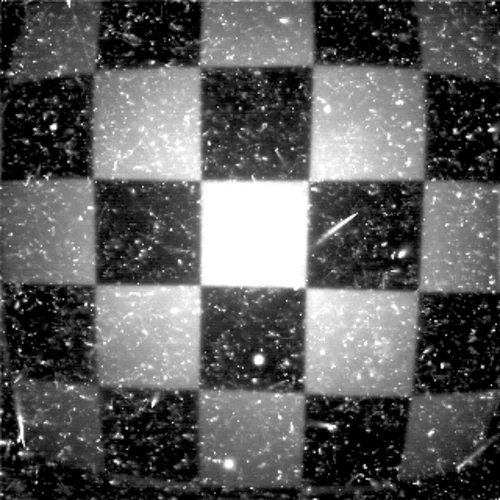
The experimental setup involved pointing the camera at a 13 cm wide chequerboard, which served as a crucial reference pattern. Over the course of the 108-hour exposure, the camera, operating at a rapid rate of 10 frames per second, acquired an astonishing volume of data: over 4 million images. From this vast dataset, more than 160,000 images were selected for meticulous analysis. The primary focus of this analysis is to study radiation-induced pixel activation and the subsequent recovery of the image sensor following interactions with these energetic particles.
Visualizing the Impact: Radiation-Induced Artefacts
The resulting images from the CHARM testing reveal a stark visual representation of the challenges posed by space radiation. The black-and-white chequerboard background is heavily speckled with countless bright dots and streaks. These are not part of the intended visual; they are known as "radiation-induced artefacts." Each individual dot or streak signifies the moment an energetic particle traversed the image sensor. This phenomenon vividly illustrates the inherent difficulties that imaging systems encounter when operating in the unforgiving radiation-rich environments of space.
These artefacts can manifest in various ways, from single-pixel errors to more complex patterns that can degrade image quality and potentially lead to misinterpretations of critical data. Understanding the nature and frequency of these artefacts is paramount for developing robust systems that can compensate for their effects.
Collaboration and Resilience: Safeguarding the Technology
A key aspect of this advanced testing was the collaborative effort involved. The TRISAT team joined forces with SkyLabs, a Slovenian company specializing in space technology. SkyLabs played a crucial role by implementing sophisticated protection mechanisms into the camera system. These safeguards are designed to ensure that the intense radiation encountered during testing, and in actual space missions, does not cause permanent damage or loss of functionality to the delicate imaging components.
"For this test we have joined forces with SkyLabs, who implemented protection mechanisms into the camera system to make sure the intense radiation doesn’t cause any permanent damage or loss of functionality," Kramberger elaborated. This partnership highlights the integrated approach to space system development, where expertise in sensor technology is combined with robust engineering for radiation hardening and fault tolerance.
Unlocking Future Capabilities: Implications for Spacecraft Operations
The analysis of the extensive dataset acquired during the CHARM campaign is expected to yield invaluable insights. Researchers are meticulously investigating several key aspects:
- Frequency and Spatial Distribution: Determining how often and where these radiation-induced artefacts occur across the sensor.
- Pixel Impact: Quantifying the number of pixels affected by each particle interaction.
- Recovery Dynamics: Understanding the precise mechanisms and timing of how affected pixels recover their normal function, if at all.
- Distinguishing Effects: Developing methods to differentiate between transient, recoverable effects and permanent radiation-induced damage.
The ultimate goal of this comprehensive analysis is to inform the development of more sophisticated image processing algorithms. These algorithms will be designed to effectively mitigate or correct for radiation-induced artefacts, thereby enhancing the reliability of image data. Furthermore, the insights gained will be instrumental in advancing next-generation attitude and orbit determination technologies. Accurate knowledge of a spacecraft’s orientation and position is fundamental to its mission success, and advanced imaging systems are increasingly being explored for these critical functions.
A Timeline of Innovation and Validation
The journey of this miniaturized imaging technology can be traced through several key milestones:
- Early Development (Pre-2020): Conceptualization and initial design of an ultra-miniaturized imaging system within the framework of the University of Maribor’s research initiatives, likely supported by national or institutional funding.
- ESA General Support Technology Programme (GSTP) Involvement: The project gains traction and support through ESA’s GSTP, a program dedicated to fostering the development of innovative technologies with strong market potential for space applications. This likely occurred in the years leading up to the TRISAT-R mission.
- TRISAT-R Mission (Circa 2020/2021): Development and launch of the shoebox-sized TRISAT-R CubeSat by the University of Maribor. The satellite successfully tests the miniaturized imaging technology in the medium Earth orbit environment, capturing images of Earth and demonstrating its operational capability under space conditions. This mission served as a critical proof-of-concept.
- Collaboration with SkyLabs: Development of enhanced radiation protection mechanisms for the imaging system, likely integrated into the TRISAT-R technology or a subsequent iteration, in partnership with SkyLabs.
- RADNEXT Project Facilitation: The RADNEXT project provides access to advanced radiation testing facilities.
- CERN CHARM Testing (Recent): The TRISAT imaging system undergoes an intensive 108-hour radiation campaign at CERN’s CHARM facility, simulating extreme space radiation environments. This is the latest and most comprehensive validation phase.
- Data Analysis and Future Development (Ongoing): Meticulous analysis of the vast dataset from CERN testing, leading to the refinement of image processing algorithms and the development of next-generation attitude and orbit determination technologies.
Broader Impact and the Future of Miniaturized Space Systems
The success of the TRISAT programme and its recent radiation testing at CERN has significant implications for the future of space exploration and utilization. Miniaturized imaging systems, like the one developed by the University of Maribor, offer several compelling advantages:
- Reduced Cost: Smaller components and satellites generally translate to lower manufacturing and launch costs, making space missions more accessible.
- Increased Mission Flexibility: CubeSats and other small satellites can be deployed in constellations, enabling distributed sensing and rapid data acquisition.
- Enhanced Capabilities for Small Satellites: The ability to incorporate high-performance imaging sensors into small platforms opens up new possibilities for scientific research, Earth observation, and in-orbit servicing.
- Robustness for Harsh Environments: By understanding and mitigating the effects of radiation, these miniaturized systems can be deployed in a wider range of orbital regimes and for longer mission durations.
The findings from this research will not only benefit ESA and its member states but also contribute to the broader international efforts to develop more resilient and cost-effective space technologies. As the demand for space-based data and services continues to grow, innovations like the TRISAT imaging system are poised to play a pivotal role in shaping the future of our engagement with space. The rigorous validation at CERN is a critical step towards realizing the full potential of this technology, paving the way for its integration into a new generation of spacecraft designed to operate reliably in the most challenging cosmic conditions. The bright dots and streaks captured during the testing are not merely artefacts; they are visual indicators of progress, demonstrating the ongoing dedication to pushing the boundaries of technological resilience in the pursuit of scientific discovery and practical applications in space.