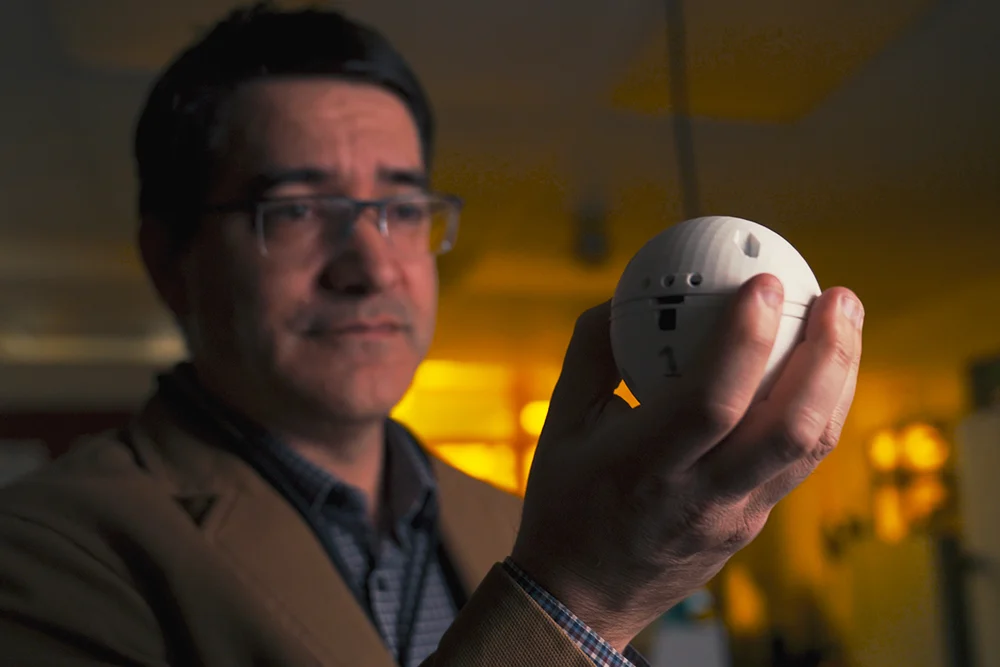
Researchers at MIT Lincoln Laboratory have unveiled a groundbreaking advancement in chemical threat detection with the development of the Tactical Optical Spherical Sensor for Interrogating Threats, or TOSSIT. This innovative, baseball-sized device is engineered to provide early and remote warnings to military service members, first responders, and law enforcement personnel about the presence of hazardous vapors and aerosols, a critical capability in an increasingly complex threat landscape. The technology, poised for transfer to the U.S. military following extensive field testing, represents a significant leap forward in personal and tactical safety.
The Science Behind TOSSIT: A Multi-Layered Approach to Detection
The TOSSIT device functions through a sophisticated yet remarkably accessible mechanism. Users can deploy TOSSIT into areas of concern through various means, including simple tossing, drone deployment, or even launching it from a distance. Once in position, the sensor actively samples the surrounding air. Its core detection capability lies in its interaction with a removable dye card. This card undergoes a visible color change when exposed to specific chemicals. An internal camera within TOSSIT then captures and analyzes these color transformations. This visual data is processed, and if a predefined hazardous chemical signature is detected, the device issues an alert. These alerts can be communicated through a dedicated mobile application or directly via alarms integrated into the sensor itself, ensuring immediate situational awareness for operators.
The types of chemical threats TOSSIT is designed to identify are broad and critically important. These include sophisticated chemical warfare agents such as nerve agents and blister agents, which pose severe risks to human health and operational readiness. Beyond military applications, the sensor is also being developed to address threats arising from industrial chemical accidents, where leaks or spills can release toxic substances into the environment, endangering civilian populations and emergency crews. Furthermore, TOSSIT is engineered to detect dangerous aerosols, such as the fine particulate matter associated with substances like fentanyl, a potent opioid that presents significant health risks even at minimal exposure levels.
Addressing an Unmet Need: The Significance of TOSSIT
The development of TOSSIT stems from a recognized gap in existing detection capabilities, particularly for certain types of airborne threats. "TOSSIT fills an unmet need, providing a low-cost sensing option for vapors and solid aerosol threats — think toxic dust particles — that would otherwise not be detectable by small deployed sensor systems," stated Richard Kingsborough, the principal investigator for the project at MIT Lincoln Laboratory. This statement underscores the device’s unique value proposition. Traditional chemical detection systems can be bulky, expensive, or require direct proximity to the threat, limiting their utility in rapidly evolving or high-risk scenarios. TOSSIT’s design as a disposable or easily replaceable, low-cost unit mitigates these limitations, allowing for widespread deployment and reducing the risk to personnel. The emphasis on detecting "toxic dust particles" is particularly noteworthy, as such aerosols can remain airborne for extended periods and pose a stealthy but deadly threat.
The strategic advantage of TOSSIT lies in its ability to provide remote sensing. This means that personnel can gain crucial intelligence about an area’s chemical safety without physically entering a potentially contaminated zone. This capability is invaluable in situations such as reconnaissance missions, initial sweep operations, or when responding to suspected chemical incidents. The speed at which TOSSIT can provide an alert also contributes to its tactical significance, enabling faster decision-making and more effective mitigation strategies.
From Concept to Deployment: A Timeline of Development
The journey of TOSSIT from a conceptual idea to a field-tested technology involves several key stages, reflecting the rigorous development process at MIT Lincoln Laboratory. While specific dates for initial research and prototyping are not detailed in the provided information, the culmination of this effort is marked by extensive field testing. These tests are crucial for validating the sensor’s performance under real-world conditions, which can involve diverse environmental factors, varying concentrations of threats, and different deployment scenarios.
The successful completion of these field trials signifies a critical milestone, demonstrating TOSSIT’s reliability and effectiveness. Following this validation, the technology is now undergoing a formal transfer process to the U.S. military. This transition typically involves further refinement, potential integration into existing military systems, and scaling up production to meet defense needs. The timeline for full operational deployment would depend on the specifics of this transfer, including manufacturing capacity and procurement cycles. However, the current stage suggests that TOSSIT is nearing a point where it can be issued to service members.
Supporting Data and Technical Specifications (Inferred and Contextualized)
While precise technical specifications for TOSSIT are not publicly detailed, the description provides insights into its operational parameters. The "baseball-sized" dimension suggests a compact and portable form factor, weighing likely a few hundred grams, making it easy to carry and deploy. The "removable dye card" implies a modular design, allowing for rapid replacement after use or for adapting the sensor to detect different classes of chemicals by swapping out specific dye formulations. The use of an "internal camera" for color analysis points to a reliance on visual spectroscopy principles, a well-established method for chemical identification.
The "low-cost" nature of the sensor, as highlighted by Richard Kingsborough, is a crucial differentiator. While the exact cost per unit is not provided, the implication is that TOSSIT is significantly more affordable than many advanced chemical detection systems, enabling mass deployment. This affordability is likely achieved through the use of common materials and manufacturing processes, alongside the deliberate choice of a simpler, yet effective, detection mechanism. The integration with an "app or alarms" suggests a wireless communication capability, likely utilizing Bluetooth or other short-range radio frequencies for communication with a user’s handheld device or a central command unit.
Broader Impact and Implications
The implications of TOSSIT extend beyond immediate military and first responder applications. Its development signals a broader trend towards democratizing advanced threat detection capabilities. As the technology matures and potentially becomes more widely available, it could find applications in civilian sectors such as industrial safety monitoring, environmental protection, and even public health surveillance.
For Military Service Members: TOSSIT offers enhanced force protection by providing an early warning system against chemical threats on the battlefield or in deployed zones. This can significantly reduce casualties and enable more confident execution of missions in environments where chemical agents might be employed or present due to industrial accidents. The ability to quickly assess an area’s safety before entering can be a mission-critical advantage.
For First Responders: In the event of hazardous material incidents, TOSSIT can provide immediate alerts about the presence of dangerous vapors and aerosols, such as during chemical spills, industrial accidents, or even in scenarios involving the illicit production of hazardous substances. This allows emergency personnel to take appropriate protective measures and to cordon off affected areas more effectively, thereby safeguarding both their own lives and the public.
For Law Enforcement: In domestic security contexts, TOSSIT could be deployed to assess potential threats at large public events, investigate suspicious packages, or during operations involving the seizure of illicit drug manufacturing sites where dangerous chemicals are present. The detection of substances like fentanyl dust is particularly relevant in this domain.
The successful deployment of TOSSIT could also spur further innovation in the field of portable chemical sensing. The principles behind its design, particularly the combination of simple visual indicators with automated analysis, could be adapted for detecting a wider range of substances or for developing even more sophisticated, miniaturized sensor networks. This advancement aligns with the growing demand for pervasive sensing technologies that can operate autonomously and provide continuous streams of critical data.
Future Outlook and Potential Enhancements
While TOSSIT represents a significant achievement, the field of chemical threat detection is constantly evolving. Future iterations of the TOSSIT device could potentially incorporate additional functionalities. These might include:
- Expanded Chemical Library: Enhancing the dye card technology or integrating multiple sensing modalities to detect a broader spectrum of chemical agents and industrial toxins.
- Quantitative Analysis: Moving beyond simple detection to provide an estimation of the concentration of detected substances, offering a more nuanced understanding of the threat level.
- Self-Destruct Mechanisms: For highly sensitive applications, incorporating a self-destruct feature to prevent captured devices from falling into enemy hands.
- Networked Capabilities: Developing a more robust mesh network capability, allowing multiple TOSSIT units to share data and create a comprehensive, real-time map of chemical hazards across a wide area.
- Artificial Intelligence Integration: Employing AI algorithms for more sophisticated pattern recognition of chemical signatures, potentially identifying novel or complex threats that might not be covered by standard dye cards.
The development of TOSSIT by MIT Lincoln Laboratory underscores the critical role of advanced research and development in addressing contemporary security and safety challenges. By providing a low-cost, effective, and remotely deployable solution for detecting hazardous vapors and aerosols, TOSSIT promises to significantly enhance the safety and operational effectiveness of those on the front lines of defense and emergency response. The transfer of this technology to the U.S. military marks a pivotal moment, signaling its readiness to move from the laboratory to practical application, where it can undoubtedly save lives and mitigate risks in an increasingly unpredictable world.