In an era defined by rapid technological advancements and increasing demands for product customization, manufacturers face the complex challenge of producing a wide variety of product types with short cycle times on a single, fully automated line. This formidable task was precisely the one presented to TEAM Automation Berlin, a German systems integrator renowned for its expertise in bespoke industrial automation. The company was approached by SKF, the world’s largest manufacturer of bearings, with a specific mandate: to design and construct a custom machine capable of automating the assembly of its diverse range of lubricant distributors. This strategic initiative aimed to revolutionize SKF’s manufacturing process, enhancing efficiency, precision, and adaptability in a highly competitive global market.
The Evolving Landscape of Bearing Lubrication and SKF’s Operational Imperative
For over 120 years, SKF bearings have been synonymous with reducing friction in machinery across countless industries, from automotive and aerospace to heavy industrial applications. Central to the longevity and optimal performance of these bearings are lubricant distributors and metering units, components that meticulously ensure a consistent supply of oil, preventing wear and premature failure. While the fundamental process of lubrication remains constant, the lubricant distributors themselves exhibit significant technical variation. These differences are dictated by the specific requirements of the final product, leading to a vast and ever-growing number of product variants.
Managing this extensive array of lubricant distributor configurations had become an increasingly complex operational hurdle for SKF. A significant portion of these variants are assembled in relatively small batches, often just a few hundred units at a time. This "high-mix, low-volume" (HMLV) manufacturing scenario traditionally poses considerable challenges for automation. Manual assembly, while offering flexibility, is prone to inconsistencies, higher labor costs, and slower throughput. Conversely, traditional fixed automation lines, designed for mass production of a single product, struggle with the frequent changeovers required for diverse variants, leading to substantial downtime and reduced overall equipment effectiveness (OEE).

For TEAM Automation, a company with two decades of experience in designing and building custom automation systems, the prospect of automating such a high-mix assembly process initially appeared daunting. Compounding the complexity were SKF’s stringent requirements for a short cycle time – a non-negotiable factor for maintaining production efficiency – and exceptionally high product quality standards, reflecting SKF’s commitment to precision engineering. The integrator’s mission was clear: to deliver a solution that could reconcile the seemingly contradictory demands of mass production efficiency with unparalleled flexibility for customized output.
TEAM Automation’s Vision: A Modular and Flexible Assembly Paradigm
Undeterred by the challenge, TEAM Automation embarked on the ambitious project, leveraging its deep understanding of industrial automation principles and innovative engineering solutions. The company’s core philosophy centers on creating systems that are not only robust and efficient but also inherently adaptable to evolving manufacturing needs. The resulting assembly line built for SKF stands as a testament to this philosophy, seamlessly blending the benefits of fully automated mass production with the agility to assemble a multitude of different products without the need for time-consuming and costly changeovers. This capability has empowered SKF to maintain its competitive edge by enhancing both its operational flexibility and overall efficiency.
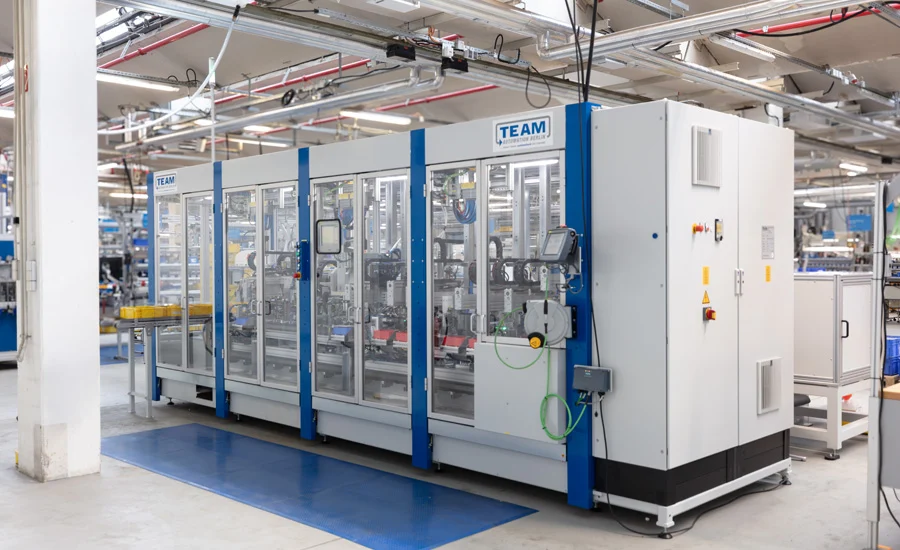
Andreas Nowak, CEO of TEAM Automation, elucidated the architectural brilliance behind the system: “Our system consists of a modular assembly line based on a longitudinal transfer system.” This modular approach is fundamental to its success. Unlike rigid, monolithic assembly lines, a modular system comprises distinct, self-contained workstations or modules, each responsible for a specific assembly task. These modules can be easily reconfigured, added, or removed, allowing the entire line to adapt quickly to new product variants or changes in production demands. The longitudinal transfer system, often employing a conveyor belt or shuttle system, provides the backbone for material flow, transporting workpiece carriers from one station to the next in a synchronized and precise manner.
The operational flow within the new line is meticulously choreographed. All necessary components – from various screws and seals to the intricate bodies of the lubricant distributors – are automatically fed into the line. Once introduced, they undergo a series of automated assembly steps, followed by rigorous inspection processes, and finally, packaging. The movements of all workpiece carriers are precisely synchronized within fixed cycles, ensuring a continuous and efficient production flow. Critically, each individual assembly step has been ingeniously designed with inherent flexibility, enabling it to accommodate the diverse technical specifications of different product variants.

The mathematical implications of this design are striking: the fully automated machine is theoretically capable of producing several thousand distinct variants of lubricant distributors. Furthermore, the system boasts an advanced capability to process up to two different variants in parallel. This concurrent processing, executed without interrupting the overall production flow, represents a significant leap in manufacturing efficiency, maximizing throughput and minimizing idle time. It underscores the system’s sophisticated control architecture and the precision of its component handling.
The Crucial Role of Precision Joining: Kistler Group’s Electromechanical Solution
A critical juncture in the assembly process, and indeed a highlight of the line’s advanced capabilities, involves the final sealing of the lubricant distributors. Depending on the specific variant, the distributors are either screwed shut or sealed by precisely pressing in a disc. These sealing discs themselves vary considerably in size, thickness, and even material composition, presenting a substantial challenge for a singular pressing operation. The requirement was clear: the press had to exhibit not only exceptional precision but also unparalleled flexibility to handle this wide array of disc types and their corresponding joining parameters.
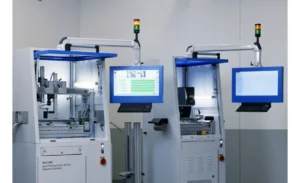
For this complex and high-stakes joining process, TEAM Automation strategically selected the Model NCFE electromechanical joining modules from Kistler Group. Kistler, a global leader in dynamic measurement technology, is renowned for its high-precision sensors, process monitoring systems, and electromechanical joining solutions. The choice of Kistler’s NCFE modules was not arbitrary; it was based on a proven track record and the specific advantages these systems offer over traditional pneumatic or hydraulic presses.
The joining process itself is a masterclass in synchronized automation. The system individually feeds the diverse sealing discs via a common feeder, meticulously positioning each one into the pressing station. This feeding operation must be precisely synchronized with the movement of the workpiece carrier, as the next disc is already being prepared for positioning even as the current joining process is underway. This dynamic and rapid sequencing is made possible by the inherent agility and control of the electromechanical press. The NCFE module swiftly moves into its designated position, executes the pressing operation with micro-level precision, and then rapidly retracts, all within an impressive cycle time of approximately 5 seconds. This speed, combined with accuracy, is pivotal for achieving the desired throughput.

Andreas Nowak reiterated the confidence in their choice: “We were already very familiar with Kistler’s joining technology from previous projects. We chose the NCFE joining module specifically for its cost-effectiveness in terms of reducing operating costs and scrap, its speed, and its durability.” This statement highlights the long-term economic and operational benefits derived from Kistler’s technology, including reduced energy consumption compared to pneumatic or hydraulic systems, minimized material waste due to high precision, and robust construction ensuring extended operational life.
Data-Driven Quality Assurance with maXYmos NC
The integrity and quality of the joining process are paramount, especially for components as critical as lubricant distributors. To ensure absolute precision and repeatability, the entire joining operation is meticulously governed by the press’s integrated force and displacement sensors, seamlessly interfaced with Kistler’s maXYmos NC process monitoring system. This advanced system plays a crucial role by analyzing each press-fitting operation in real-time, capturing and documenting the complete force-distance curves.
By utilizing predefined measurement windows and sophisticated algorithms, maXYmos NC precisely monitors the progression of the joining force against the displacement of the press ram. Any deviation from the acceptable curve – indicating potential material flaws, incorrect component placement, or an incomplete press-fit – is immediately detected, triggering an alarm and allowing for rejection of the faulty part. This capability not only ensures the joining process is precise and repeatable but also provides invaluable data for statistical process control (SPC) and continuous improvement initiatives.
Furthermore, a significant advantage of this integrated control system is its ability to automatically adapt the joining process parameters to the specific requirements of each variant. This is achieved without the need for manual intervention or mechanical adjustments, which would otherwise introduce downtime and potential for human error. The system intelligently recognizes the product variant being processed and applies the correct force, displacement, and speed profiles, guaranteeing optimal results across the entire product spectrum.

Strategic Partnership and Broader Industry Implications
The successful implementation of this sophisticated assembly line is not merely a technical triumph but also a testament to the power of collaborative engineering. Andreas Nowak emphasized the strength of their partnership: “We have found a reliable partner in Kistler, who understands our needs and responds quickly to unforeseen challenges. Our long-standing experience in joint projects, and the short decision-making processes have been instrumental for us to meet the demanding time frame and process requirements.” This highlights the critical role of strong vendor-integrator relationships, particularly in projects involving cutting-edge technology and ambitious timelines.
The SKF-TEAM Automation-Kistler collaboration exemplifies the ongoing transformation within the manufacturing sector, driven by the principles of Industry 4.0. This project showcases how advanced automation, intelligent systems, and data-driven quality control are becoming indispensable for companies striving for agility, efficiency, and superior product quality in an increasingly complex global marketplace. The ability to handle thousands of product variants on a single line, with rapid cycle times and uncompromising precision, provides SKF with a significant competitive advantage. It allows them to respond swiftly to market demands, offer greater product customization, optimize inventory management, and ultimately deliver higher value to their customers.
This successful deployment of a high-mix, low-volume automated assembly line for critical components like lubricant distributors demonstrates a pathway for other manufacturers facing similar challenges. It underscores the potential for systems integrators like TEAM Automation, equipped with the right technological partners like Kistler, to deliver innovative solutions that redefine the boundaries of manufacturing capability. The project serves as a compelling case study for the integration of flexible automation, advanced sensing, and intelligent process monitoring to achieve operational excellence in the demanding world of modern industrial production.
For more information on the advanced joining solutions employed in this project, details can be found at www.kistler.com. Further insights into custom automation systems and flexible manufacturing solutions can be explored at https://team-automation-berlin.de/index_en.html. The synergy between these specialized firms has not only delivered a state-of-the-art solution for SKF but also contributes significantly to the broader narrative of smart manufacturing and industrial innovation.