The intricate realm of electric motors, a cornerstone of modern industrial and technological advancement, is continuously evolving, driven by the relentless pursuit of enhanced efficiency, compactness, and performance. Within this vast universe, motors are often categorized by fundamental characteristics such as their power source (AC or DC), their construction methodologies, or, critically, by the properties of their magnetic circuits. While radial flux and axial flux machines have historically dominated the landscape, a distinctive third category, transverse flux motors (TFMs), is garnering significant attention for its unique magnetic characteristics and profound implications for high-performance applications, particularly in robotics and direct-drive systems.
Understanding the Foundational Motor Architectures: Radial and Axial Flux
To appreciate the innovation embodied by transverse flux motors, it is essential to first understand the more common magnetic circuit designs. The most prevalent motor type, by a significant margin, is the radial flux design. In these motors, the magnetic flux path is perpendicular to the axis of rotation. This configuration is archetypal, found in countless AC synchronous motors, induction motors, and DC motors, where a central rotor, housing the motor shaft, spins within a stationary stator. The magnetic field lines emanate radially from the rotor or stator, crossing the air gap perpendicularly to the rotational axis, creating the torque necessary for motion. Their widespread adoption stems from their relative simplicity in manufacturing, robust design, and well-understood performance characteristics, making them suitable for a broad spectrum of applications, from household appliances to heavy industrial machinery and a majority of electric vehicles (EVs). However, radial flux designs can face limitations in achieving extremely high torque densities in compact packages, often requiring complex gearboxes to multiply torque, which introduces inefficiencies, noise, and additional maintenance requirements.
In contrast, axial flux motors are engineered with a magnetic flux path that runs parallel to the axis of rotation. This design typically results in a flatter, thinner motor profile, often colloquially referred to as "pancake-style" motors. Instead of a cylindrical rotor rotating within a cylindrical stator, axial flux motors often feature disc-shaped rotors and stators arranged coaxially. This architecture offers advantages in applications where space constraints demand a compact, high-power-density solution along the axial dimension. Examples include certain electric vehicle drivetrains (particularly in-wheel or hub motors), drones, and specialized industrial machinery where a thin form factor is beneficial. While offering superior compactness in certain dimensions and potentially higher power density than radial designs for specific applications, axial flux motors can present their own manufacturing challenges and thermal management complexities due to their confined geometry.
The Emergence of Transverse Flux Motors: A Paradigm Shift in Magnetic Circuitry
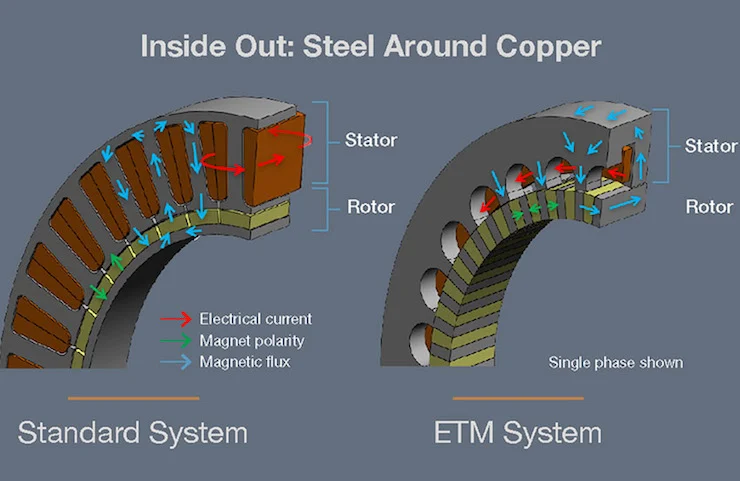
Transverse flux motors differentiate themselves fundamentally from both radial and axial flux designs through a magnetic flux path that flows transverse to the axis of rotation. This means the magnetic field lines cross the axis of rotation rather than being strictly parallel or perpendicular to it. In practice, this unique topology is achieved by constructing motors with a single winding for each phase, which is wound circumferentially around the stator, enveloping the axis of rotation. This innovative winding arrangement allows the magnetic flux to follow multiple, complex paths within the motor structure, including axially across the stator, along the circumference of the rotor, and radially through the air gap between them. This multi-directional flux path is key to their distinctive performance characteristics.
The profound advantage of this design lies in its ability to decouple the number of machine poles from the size of the electrical windings. In conventional motors, increasing the number of poles to enhance torque density often necessitates smaller windings, which can lead to higher electrical resistance, increased heat generation, and reduced efficiency. Transverse flux motors circumvent this trade-off. By allowing the magnetic circuit to be largely independent of the winding geometry, TFMs can incorporate a significantly higher number of poles without compromising the winding space or thermal management. This critical decoupling directly translates into two primary benefits: exceptionally high torque density and superior efficiency.
Unpacking the Advantages: High Torque Density and Efficiency
The high torque density of transverse flux motors is perhaps their most compelling attribute. Torque density refers to the amount of torque a motor can produce relative to its size and weight. For TFMs, this metric can be dramatically higher than that of conventional radial or axial flux motors. This characteristic is transformative for applications where space and weight are at a premium, such as advanced robotics, specialized industrial automation, and potentially future electric vehicle designs. A smaller, lighter motor capable of delivering the same or greater torque output allows for more compact designs, reduced overall system weight, and potentially lower material costs for the structural components supporting the motor.
Accompanying this high torque density is impressive operational efficiency. The efficient utilization of magnetic flux and the optimized winding configuration contribute to reduced energy losses. In direct-drive applications, where the motor directly drives the load without the interposition of gearboxes or other mechanical transmission elements, this efficiency is further amplified. Gearboxes, while essential in many traditional systems for torque multiplication, inherently introduce frictional losses, backlash, and maintenance requirements. By eliminating the need for such intermediaries, TFMs not only simplify the mechanical system but also significantly improve the overall system efficiency, translating into lower energy consumption and reduced operational costs over the motor’s lifespan. The ability to achieve high torque at low speeds directly, without gearing, also enhances precision and responsiveness, critical for sensitive control applications.
Challenges and Considerations: The Other Side of Innovation
Despite their significant advantages, transverse flux motors are not without their inherent complexities and drawbacks, which have historically limited their widespread commercial adoption. One commonly cited issue is the phenomenon of cogging torque and ripple torque. Cogging torque refers to the pulsating torque present even when the motor windings are not energized, caused by the interaction between the permanent magnets (if present) and the stator’s magnetic reluctance. Ripple torque, on the other hand, is the variation in torque output during normal operation, even with perfectly sinusoidal current excitation. Both cogging and ripple torque can lead to vibrations, acoustic noise, and reduced precision in motion control, requiring sophisticated control algorithms or mechanical design adjustments to mitigate.
Furthermore, the very nature of their unique magnetic circuit leads to a more complex mechanical design compared to conventional motors. The intricate flux paths and the necessity for specific material arrangements often make transverse flux motors more complicated and expensive to design and manufacture. Specialized manufacturing processes, precision assembly, and potentially novel materials may be required, contributing to higher unit costs. This complexity also extends to their dynamic behavior. Transverse flux motors often exhibit non-linear dynamics, which complicates the modeling and control of motor behavior. Engineers must develop advanced control strategies to accurately predict and manage their performance across various operating conditions.
Another technical disadvantage is their typically lower power factor. The power factor is a measure of how effectively electrical power is converted into useful work. A lower power factor indicates that a larger apparent power (measured in VA) is drawn from the supply for the same amount of real power (measured in Watts) delivered to the motor. This can necessitate larger electrical components (e.g., thicker cables, larger transformers, or power factor correction capacitors) in the overall electrical system, adding to system cost and complexity.
Timeline of Motor Development and TFM’s Recent Resurgence
The journey of electric motors spans nearly two centuries, beginning with Michael Faraday’s experiments in the 1820s, leading to the development of the first practical DC motors in the mid-19th century. AC motors, particularly induction motors, followed suit in the late 19th century, largely pioneered by Nikola Tesla and others, fundamentally transforming industrial capabilities. For much of the 20th century, radial flux designs dominated, continually refined for efficiency and power output. Axial flux motors began to see specialized applications from the mid-20th century, particularly where their compact form factor offered distinct advantages.
Transverse flux motor concepts, while perhaps less globally recognized, have roots in academic research and specialized applications stretching back several decades, with theoretical principles explored in the mid-to-late 20th century. However, the practical realization and commercial viability of TFMs have been significantly hampered by the complexities of their design, manufacturing, and control. The advent of advanced magnetic materials, sophisticated computational design tools (like Finite Element Analysis), and more powerful microcontrollers for complex motor control has, in recent years, paved the way for a resurgence of interest in TFMs. Companies and research institutions are now better equipped to tackle the design challenges and unlock the inherent potential of these machines.
This renewed focus has culminated in significant market introductions. Recently, ETM, a company specializing in advanced motor technology, has made notable strides in bringing transverse flux motors into the commercial sphere, particularly targeting the robotics market. ETM’s introduction signifies a crucial inflection point, demonstrating the maturation of TFM technology from theoretical concept to a viable, high-performance solution for demanding applications.
ETM’s Breakthrough in Robotics: A Case Study
ETM’s entry into the robotics market with its transverse flux motor technology marks a significant milestone. The company’s claims highlight the core advantages of TFMs, emphasizing the elimination of traditional trade-offs between efficiency and size. By effectively decoupling magnetic flux from electrical windings, ETM’s patented architecture purports to deliver up to 10 times greater torque density compared to conventional motors. This is a staggering figure that directly addresses some of the most pressing needs in modern robotics.
Robotics, particularly advanced industrial robots, collaborative robots (cobots), and mobile platforms, demands motors that are simultaneously powerful, precise, compact, and energy-efficient. Traditional robotic joints often rely on motors coupled with high-ratio gearboxes to achieve the necessary torque, which can introduce compliance, backlash, and reduce overall system stiffness and precision. ETM’s TFM technology promises to enable the torque density typically associated with high-ratio geared systems, but with the inherent efficiency and thermal reliability of low-ratio, direct-drive solutions. This direct-drive capability is revolutionary for robotics, as it simplifies mechanical designs, reduces the number of components, enhances positional accuracy, and improves dynamic response, leading to faster, more precise, and more robust robotic operations. For collaborative robots, the elimination of bulky gearboxes and the potential for lighter, more compact joints can improve safety and flexibility in human-robot interaction.
Broader Impact and Future Implications
The advancements in transverse flux motor technology, exemplified by companies like ETM, hold profound implications across various industries beyond robotics.
Electric Vehicles (EVs): While the automotive industry largely relies on advanced permanent magnet synchronous motors (PMSMs) and induction motors, TFMs could offer compelling advantages for specialized EV applications. Their high torque density and efficiency could lead to lighter, more compact powertrains, or potentially enable direct-drive wheel hub motors with superior performance, reducing unsprung weight and improving packaging. The ability to generate high torque at low speeds could also benefit heavy-duty electric trucks or construction vehicles, where immense starting torque is required.
Renewable Energy: Direct-drive generators for wind turbines are another promising application. By eliminating gearboxes, TFMs could reduce the weight, complexity, and maintenance requirements of wind turbine drivetrains, improving reliability and efficiency, especially in offshore environments where maintenance is challenging and costly.
Industrial Automation: High-precision industrial machinery, machine tools, and material handling systems could benefit from the direct-drive capabilities and enhanced precision offered by TFMs, leading to higher throughput, improved product quality, and reduced operational downtime.
Aerospace and Defense: In applications where weight reduction and reliability are paramount, such as aircraft actuators or specialized defense systems, the high power-to-weight ratio of TFMs could be a significant advantage.
Future Outlook and Research Directions:
The path to widespread adoption for transverse flux motors involves continued innovation to mitigate their existing drawbacks. Ongoing research is focused on:
- Advanced Materials: Developing new magnetic materials and composite structures to further enhance performance and simplify manufacturing.
- Design Optimization: Utilizing advanced computational fluid dynamics and electromagnetic simulation tools to refine motor geometries, minimize cogging and ripple torque, and improve thermal management.
- Control Strategies: Developing sophisticated sensorless control algorithms and adaptive control systems to manage the non-linear dynamics and ensure smooth, precise operation across all speeds and loads.
- Manufacturing Processes: Innovating automated manufacturing and assembly techniques to reduce production costs and improve scalability.
- Power Factor Correction: Integrating advanced power electronics to improve the power factor and overall system efficiency.
The potential of transverse flux motors to redefine performance benchmarks in demanding applications is undeniable. As research progresses and manufacturing techniques mature, the economic viability of TFMs will continue to improve, making them an increasingly attractive option for engineers and product developers seeking to push the boundaries of electric motor performance. Their ability to deliver unprecedented torque density and efficiency, particularly in direct-drive configurations, positions them as a key enabling technology for the next generation of intelligent machines and sustainable industrial solutions. The journey from academic curiosity to commercial reality for TFMs highlights the continuous innovation inherent in the field of electrical engineering, promising a future where motors are even more powerful, efficient, and seamlessly integrated into our technological landscape.