Physicists from the University of California, Santa Barbara (UCSB) have significantly advanced the search for microscopic black holes, pushing the boundaries of known physics at the Large Hadron Collider (LHC). Operating within the European Center for Nuclear Research (CERN), the researchers utilized the Compact Muon Solenoid (CMS) experiment to probe the existence of quantum black holes—hypothetical, short-lived structures that could provide the missing link between gravity and quantum mechanics. While the search did not yield a direct detection, the study established new "exclusion limits," effectively narrowing the search area for future experiments and refining our understanding of the fundamental structure of spacetime.
The investigation, led by postdoctoral researcher Tamas Vami and graduate researcher Danyi Zhang under the guidance of Professor Joe Incandela, represents a sophisticated attempt to solve the "hierarchy problem." This long-standing puzzle in physics questions why gravity is so much weaker than the other three fundamental forces: electromagnetism, the strong nuclear force, and the weak nuclear force. By analyzing data collected during the LHC’s second run between 2016 and 2018, the team sought evidence of extra spatial dimensions that might explain this gravitational discrepancy.
The Quest for Quantum Gravity and Extra Dimensions
The theoretical foundation for this search rests on the possibility that the universe contains more than the three spatial dimensions we experience. String theory, one of the leading candidates for a "Theory of Everything," suggests that up to ten or eleven dimensions may exist, most of which are "curled up" or compactified at scales too small to detect. If these extra dimensions exist, gravity might be much stronger at very short distances, with its strength "leaking" into these hidden realms.
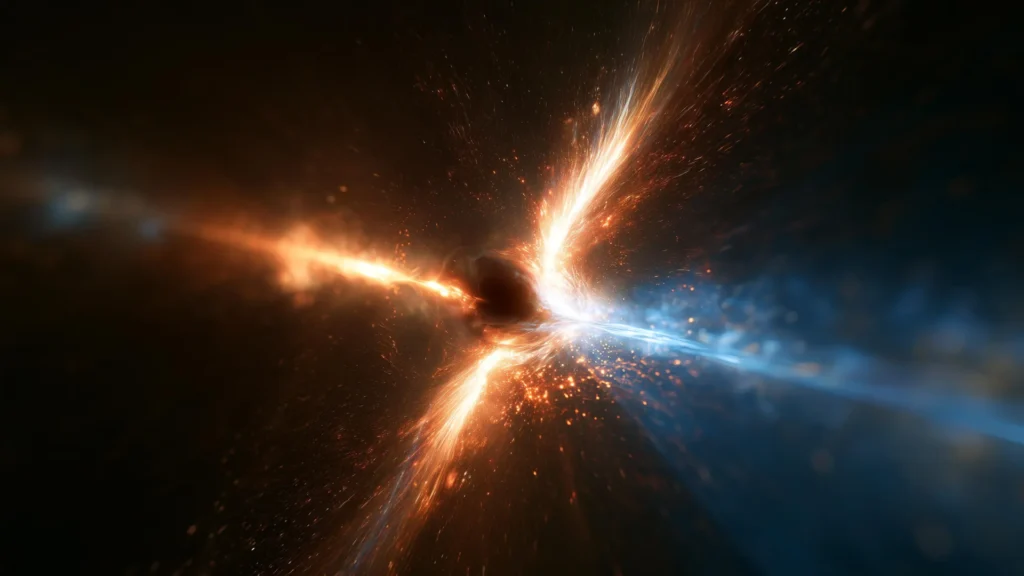
If gravity becomes significantly stronger at the energy scales reachable by the LHC, the collision of two protons could concentrate enough energy into a sufficiently small volume to cause spacetime to collapse into a microscopic black hole. Unlike the massive black holes formed by collapsing stars, which can persist for billions of years, these quantum black holes would be smaller than an atomic nucleus and would evaporate almost instantaneously through a process known as Hawking radiation.
"Had we found evidence, we could have begun to directly study quantum gravity," explained Tamas Vami. "It is a crucial step toward unifying all of the known fundamental forces, a goal that has eluded physicists since the time of Einstein."
Innovative Methodology: Machine Learning and Phase-Space Distance
To identify these rare and fleeting events among the trillions of proton collisions occurring within the LHC, the UCSB team employed a groundbreaking analytical technique. Traditionally, researchers looked for "sphericity"—a decay pattern where particles fly out in all directions from a central point, resembling a sphere. However, distinguishing a black hole signature from the "background noise" of standard particle interactions is notoriously difficult.
The researchers implemented a new method called "phase-space distance," developed by UCSB theorist Nathaniel Craig and his collaborators. This approach utilizes a Support Vector Machine (SVM), a type of supervised machine learning. In physics, "phase space" is a multidimensional map that tracks every possible state of a system, including the position and momentum of every particle produced in a collision.
By calculating the mathematical distance between different events in this phase space, the SVM assigns a score to each collision. Events with higher scores are more likely to represent "new physics" rather than standard interactions. This study marks the first time the phase-space distance method has been applied to LHC data. According to Danyi Zhang, the results demonstrated that this machine-learning approach significantly outperformed traditional sphericity variables in its ability to isolate potential signals.
Chronology of the Experiment and Safety Protocols
The data analyzed in this study was harvested during the LHC’s Run 2, a period of high-intensity operations that concluded in late 2018. During this time, the collider smashed protons together at an energy level of 13 Tera-electron volts (TeV). The CMS detector, a 14,000-ton instrument acting as a giant digital camera, recorded the trajectories and energies of the resulting debris.
Historically, the idea of creating black holes in a laboratory setting sparked public concern. When the LHC first began operations, some feared that a stable black hole might be created that could consume the Earth. However, the scientific community, including UCSB theorist Steven Giddings, provided extensive evidence to the contrary. Giddings noted that the Earth is constantly bombarded by ultra-high-energy cosmic rays from deep space, which strike the upper atmosphere with far more energy than the LHC can produce. The fact that the Earth and other celestial bodies have survived for billions of years proves that high-energy particle collisions do not produce stable, dangerous black holes.
The quantum black holes sought by Vami and Zhang are theoretical entities that obey the laws of quantum mechanics. Their near-instantaneous decay into a spray of ordinary particles ensures they pose no threat, while their brief existence offers a unique window into the Planck scale—the fundamental energy level where the effects of quantum gravity become dominant.
New Exclusion Limits and Scientific Impact
The analysis, recently published in the journal Progress in High Energy Physics (PHEP), concluded that no evidence of quantum black holes was found within the current energy reach of the LHC. However, in the realm of high-energy physics, a "null result" is not a failure; it is a vital piece of data.
The team established a new exclusion limit, determining that quantum black holes do not exist at energy scales up to approximately 12 TeV, given the parameters of the models tested. This finding also constrains theories involving extra dimensions. For instance, while string theory allows for many dimensions, these results suggest that within the specific parameters examined, certain configurations with more than two extra dimensions are increasingly unlikely at these energy levels.
"The result is an exclusion limit, which is a real, publishable statement," Zhang said. "It tells us: ‘If this thing existed with these properties, we would have seen it. We didn’t, so we can rule it out here.’ That is genuine knowledge about how the universe works."
By eliminating these possibilities, the researchers have narrowed the "hiding spots" for new particles and forces, allowing future experiments to focus their resources on higher energy levels or different theoretical models.
Addressing the Matter-Antimatter Asymmetry
In addition to the search for black holes, the UCSB researchers used the same dataset to hunt for "sphalerons." Sphalerons are not particles but rather unstable configurations of particle fields. Like black holes, they are expected to produce spherical decay signatures at high energies.
The existence of sphalerons is tied to another of the universe’s greatest mysteries: why there is more matter than antimatter. According to the Standard Model of particle physics, the Big Bang should have produced equal amounts of both, which would have led to total annihilation, leaving a universe filled only with light. Sphaleron processes are one theoretical mechanism that could have tipped the scales in favor of matter during the early moments of the universe.
As with the black hole search, the researchers found no evidence of sphalerons. However, this allowed them to set the first experimental limits on the frequency of sphaleron transitions, providing essential data for cosmologists trying to reconstruct the history of the early universe.
Future Outlook: The High-Luminosity LHC
The search for the fundamental secrets of gravity is far from over. The Large Hadron Collider is currently undergoing an ambitious set of upgrades to become the High-Luminosity LHC (HL-LHC). Once operational, the HL-LHC will produce collisions at a much higher rate—or "luminosity"—generating datasets many times larger than those currently available.
This massive increase in data will allow physicists to look for even rarer events that may have been missed during previous runs. Professor Joe Incandela noted that as the collider reaches higher energies and probes smaller distance scales, the chance of interacting with extra dimensions increases. The researchers are currently probing scales as small as $10^-20$ meters—a distance so minute that it is to an atom what an atom is to a human being.
The UCSB team’s work with the phase-space distance method has laid the groundwork for these future efforts. The success of their machine-learning approach suggests it will be a valuable tool for identifying other exotic phenomena, such as dark matter candidates or undiscovered symmetries of nature.
While the "Hierarchy Problem" and the mystery of quantum gravity remain unsolved, the rigorous work of the UCSB physics department ensures that the map of the unknown is becoming clearer. Every exclusion limit set and every new technique developed brings the scientific community one step closer to understanding the ultimate architecture of the cosmos.