In the vast and continuously evolving landscape of electric motors, engineers and researchers consistently seek innovative designs that push the boundaries of efficiency, power density, and application versatility. While the majority of electric motors are traditionally categorized by their power source (AC or DC), their construction methods, or fundamental magnetic circuit properties, a distinct class of machines known as transverse flux motors is garnering significant attention for its unique operational principles and promising performance characteristics. These motors represent a paradigm shift from conventional radial and axial flux designs, offering compelling advantages particularly in demanding direct-drive applications and high-performance robotics.
The fundamental operation of any electric motor hinges on the interaction between magnetic fields. For decades, the dominant architectures have been characterized by the path of their magnetic flux relative to the motor’s axis of rotation. The two most common types, radial flux and axial flux motors, have defined the vast majority of industrial and consumer applications. Radial flux motors, by far the most ubiquitous, feature a magnetic flux path that is perpendicular to the axis of rotation. This design is emblematic of classic rotary motors, encompassing everything from simple DC brushed motors to complex AC synchronous and induction machines, where the rotor spins concentrically within a stationary stator. This arrangement allows for robust construction and well-understood electromagnetic principles, making them suitable for a wide array of uses, from household appliances and automotive components to heavy industrial machinery and power generation. Their magnetic fields typically span the air gap between the stator and rotor in a radial direction, hence the name.
Conversely, axial flux motors, sometimes colloquially referred to as "pancake-style" motors due to their often flat and thin profile, orient their magnetic flux parallel to the axis of rotation. In these designs, the stator and rotor often consist of discs or rings arranged coaxially, with the magnetic field traversing the air gap in an axial direction. This geometry allows for a shorter axial length compared to radial flux counterparts, making them highly desirable in space-constrained applications such as electric vehicle traction systems, wind turbine generators, and certain aerospace components. While offering compactness, axial flux motors present their own set of design challenges, particularly regarding heat dissipation and structural rigidity across their larger diameter.
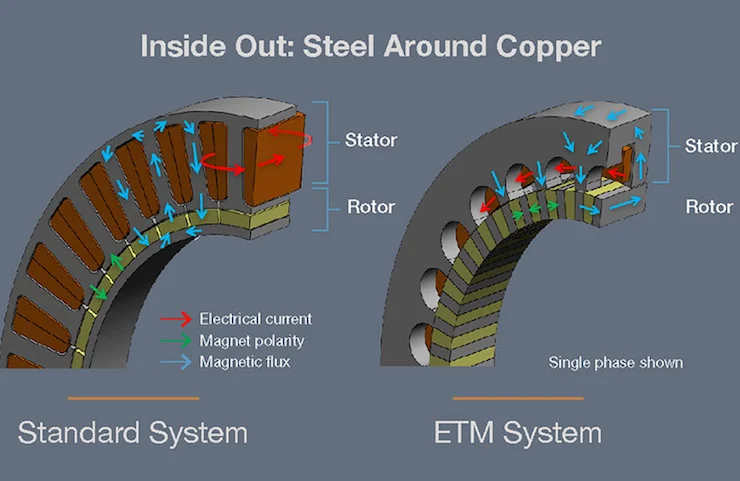
Transverse flux motors, however, introduce a third, distinct category, where the magnetic flux path is oriented transverse to the axis of rotation, meaning it flows across the axis rather than strictly parallel or perpendicular to it. This seemingly subtle difference in magnetic circuit topology leads to profoundly different electromagnetic and mechanical characteristics. In practice, transverse flux motors are distinguished by a unique stator winding configuration: a single winding for each phase is typically wound circumferentially around the stator, enveloping the axis of rotation. This innovative winding strategy facilitates multiple, complex magnetic flux paths, which can flow axially across the stator, circumferentially along the rotor, and radially through the air gap between these components. This multi-directional flux path is a cornerstone of the transverse flux motor’s high performance capabilities.
The Historical Trajectory and Evolution of Motor Architectures
The quest for more efficient and powerful electric motors dates back to the early 19th century with pioneers like Michael Faraday and Joseph Henry laying the groundwork for electromagnetism. The subsequent development of practical DC motors by inventors like Thomas Davenport and Zenobe Gramme revolutionized industrial processes. The late 19th century witnessed the transformative work of Nikola Tesla and George Westinghouse on alternating current (AC) systems, leading to the widespread adoption of AC induction motors, which remain a workhorse of industry today. For over a century, variations and refinements of these radial flux designs dominated the market, with incremental improvements in materials, manufacturing techniques, and control algorithms.
The mid-20th century saw increased interest in specialized motor designs, including early concepts resembling axial flux machines for specific applications requiring compact form factors. However, the theoretical underpinnings and practical realization of transverse flux motors began to gain significant traction in academic and research circles more recently, particularly from the late 20th century into the early 21st century. Researchers recognized the inherent limitations of conventional radial and axial flux machines when confronted with increasingly stringent demands for higher torque density, improved efficiency, and the ability to operate effectively in direct-drive configurations without the need for cumbersome and loss-prone gearboxes. The computational tools and advanced materials necessary to fully explore and optimize the complex geometries of transverse flux machines only became widely available in recent decades, paving the way for their commercialization.
Decoupling and Delineating the Advantages of Transverse Flux Motors
The primary and most celebrated advantage of transverse flux motors stems from their unique magnetic circuit and winding architecture. By wrapping a single winding for each phase circumferentially around the stator, the number of magnetic poles within the machine can be decoupled from the physical size of the electrical windings themselves. In conventional motors, increasing the number of poles typically necessitates smaller, more numerous windings, which can lead to increased resistance, higher copper losses, and greater manufacturing complexity. In contrast, transverse flux designs allow for a high number of poles to be incorporated without compromising the size or efficiency of the windings. This decoupling is a game-changer, as it directly translates to two critical performance benefits: exceptionally high torque density and superior efficiency.
High Torque Density
Torque density refers to the amount of torque a motor can produce relative to its size or weight. For transverse flux motors, the ability to pack a higher number of effective poles into a given volume, combined with an optimized magnetic path that saturates less easily, results in significantly greater torque output for a comparable motor footprint. This attribute is invaluable in applications where space and weight are at a premium, such as robotics, electric vehicles, and aerospace. A motor with higher torque density can achieve the desired performance with a smaller, lighter package, contributing to overall system efficiency and reducing material consumption.
High Efficiency
The design principles of transverse flux motors also contribute to their high efficiency. The larger, simpler windings, decoupled from the pole count, inherently reduce copper losses (I²R losses) compared to designs with many small, intricate windings. Furthermore, the innovative magnetic circuit can be optimized to minimize iron losses (hysteresis and eddy current losses) by ensuring that the magnetic flux paths are effectively utilized and material saturation is managed. This leads to a higher percentage of electrical input power being converted into mechanical output power, resulting in less waste heat and lower energy consumption over the motor’s operational life. In an era where energy conservation is paramount, this efficiency advantage is a significant selling point.
Enabling Direct-Drive Applications
Perhaps one of the most transformative implications of these advantages is the suitability of transverse flux motors for direct-drive applications. Traditional motors often require gearboxes to achieve the necessary torque and speed reduction for the driven load. Gearboxes, while effective, introduce mechanical complexity, friction losses, backlash, noise, and require regular maintenance. By offering inherently high torque at low speeds, transverse flux motors can often eliminate the need for a gearbox entirely. This simplification reduces the overall system footprint, lowers maintenance requirements, enhances precision by removing backlash, and improves overall system efficiency by eliminating the losses associated with mechanical gearing. Industries such as robotics, wind energy (where direct-drive generators eliminate multi-stage gearboxes in turbines), and advanced manufacturing can particularly benefit from this capability.
Addressing the Challenges and Drawbacks
Despite their compelling advantages, transverse flux motors are not without their engineering challenges and drawbacks, which researchers and manufacturers are actively working to mitigate. Understanding these limitations is crucial for their successful integration into broader industrial applications.
Cogging and Ripple Torque
Two commonly cited issues are cogging torque and ripple torque. Cogging torque is an unwanted, parasitic torque that occurs even when the motor windings are not energized. It arises from the magnetic interaction between the permanent magnets on the rotor and the salient (projecting) poles of the stator. This can lead to jerky motion at low speeds, vibrations, and noise. Ripple torque, on the other hand, refers to the variations in the output torque that occur during normal operation, even with constant current excitation. Both phenomena are often more pronounced in transverse flux motors due to their complex magnetic geometries and the strong magnetic interactions within the system. Mitigation strategies include careful stator and rotor pole shaping, magnet skewing, and the use of advanced control algorithms that compensate for these torque variations.
Complex Mechanical Design and Manufacturing Costs
The intricate nature of the transverse flux motor’s magnetic circuit and its unique winding arrangement often translates into a more complex mechanical design compared to conventional radial flux machines. The assembly of multiple magnetic paths, often involving sophisticated laminated structures and precise magnet placement, can be challenging. This complexity directly contributes to higher manufacturing costs, as specialized tooling, more precise assembly processes, and potentially more exotic materials may be required. This economic factor is a significant hurdle for widespread adoption, particularly in cost-sensitive markets.
Non-Linear Dynamics
The complex, multi-directional magnetic flux paths within transverse flux motors often result in highly non-linear dynamics. This non-linearity complicates the mathematical modeling of motor behavior, making it more difficult to accurately predict performance, design optimal control strategies, and diagnose issues. Advanced computational electromagnetics (CEM) and finite element analysis (FEA) are indispensable tools for simulating and understanding these machines, but real-time control still requires sophisticated algorithms that can adapt to the non-linearities. This aspect demands greater expertise in motor control and system integration.
Low Power Factor
Another disadvantage frequently associated with transverse flux motors is a relatively low power factor. The power factor is a measure of how effectively electrical power is being converted into useful work. A low power factor indicates that a significant portion of the current drawn by the motor is reactive power, which does no useful work but still contributes to transmission losses and requires larger components in the power supply chain. This can lead to increased energy costs for industrial users and necessitates power factor correction techniques to improve overall system efficiency and compliance with grid standards.
ETM’s Innovation: Bringing Transverse Flux Technology to Robotics
A significant recent development underscoring the commercial viability and growing potential of transverse flux motors comes from ETM, a company that has made notable strides in introducing this advanced motor technology to the robotics market. ETM’s initiative highlights the practical benefits of these motors in an industry constantly seeking breakthroughs in precision, power, and compactness.
ETM has publicly stated that its transverse flux motor technology effectively eliminates the traditional trade-offs between efficiency and size—a common dilemma for engineers designing robotic systems. By leveraging the inherent ability of transverse flux designs to decouple magnetic flux from electrical windings, ETM claims to achieve a torque density up to ten times greater than that of conventional motors. This claim, if widely validated across diverse applications, represents a monumental leap forward. For robotics, this means that robotic arms and joints can be designed to be significantly lighter and more compact while delivering the same or even greater payload capacity and dynamic performance. The ability to achieve high torque density with high efficiency and thermal reliability, characteristic of low-ratio drives, while still delivering the output typically associated with high-ratio geared systems, is particularly impactful. This capability allows robot designers to potentially remove or significantly reduce the size of gearboxes, which are often sources of friction, backlash, and mechanical wear in robotic actuators. The implications are profound: more agile, precise, and durable robots with lower energy consumption and reduced maintenance requirements.
Broader Industrial and Economic Implications
The advancements in transverse flux motor technology, exemplified by companies like ETM, carry significant broader implications across multiple industrial sectors.
Electric Vehicles (EVs)
In the rapidly expanding electric vehicle market, the quest for higher power density, extended range, and faster charging is relentless. Transverse flux motors, with their high torque density and efficiency, could enable smaller, lighter, and more powerful traction motors. This could lead to more compact vehicle designs, improved energy economy (longer range for the same battery capacity), and potentially direct-drive wheel motors, eliminating complex differentials and transmissions, thus simplifying the drivetrain and reducing vehicle weight.
Renewable Energy
The wind energy sector stands to gain immensely. Direct-drive generators for wind turbines, which eliminate the need for multi-stage gearboxes, are highly sought after for their improved reliability, reduced maintenance, and higher efficiency. Transverse flux generators, with their ability to produce high torque at low rotational speeds characteristic of wind turbine rotors, are a strong candidate for this application, promising to lower the levelized cost of energy (LCOE) for wind power.
Aerospace and Defense
In aerospace, every gram of weight and cubic centimeter of space is critical. Transverse flux motors could power everything from flight control surfaces and landing gear actuators to cabin systems, offering significant weight savings and greater reliability due to fewer moving parts. In defense applications, their robust design and high power density could be advantageous for propulsion systems, robotic platforms, and specialized equipment.
Industrial Automation and Manufacturing
Beyond robotics, precision manufacturing, machine tools, and other industrial automation systems can benefit from the high torque density and direct-drive capabilities. This can lead to more precise motion control, faster cycle times, and reduced downtime in production lines.
Future Outlook and Research Directions
The future of transverse flux motors appears promising, albeit with ongoing research focused on refining their design and mitigating existing drawbacks. Efforts are concentrated on:
- Mitigation of Cogging and Ripple Torque: Advanced magnetic design optimization, including novel rotor and stator geometries, material selection, and active control strategies, will continue to reduce these unwanted torque components, improving smoothness and precision.
- Cost Reduction: Innovations in manufacturing processes, automation, and the exploration of new, more cost-effective materials are crucial for making transverse flux motors more competitive across a wider range of applications. Modular designs and standardized components could also contribute to cost reduction.
- Thermal Management: With high power density comes the challenge of effectively managing heat dissipation. Research into advanced cooling techniques (e.g., liquid cooling