In the intricate landscape of electric motor technology, engineers and innovators continually seek designs that push the boundaries of performance, efficiency, and compactness. While most electric motors are broadly categorized by their magnetic flux path—either radial or axial—a distinctive third category, the transverse flux motor (TFM), stands out for its unique magnetic circuit properties, offering unparalleled advantages in specific high-performance applications. These motors are gaining increasing prominence, particularly in fields demanding exceptional torque density and efficiency, such as advanced robotics and direct-drive systems, where the elimination of traditional gearboxes represents a significant leap forward in design and functionality.
The vast universe of electric motors can be dissected in numerous ways: by their power source (AC or DC), their construction methods, or, most fundamentally, by the characteristics of their magnetic circuits. The path taken by magnetic flux relative to the axis of rotation is a primary differentiator. Radial flux motors, the most ubiquitous type, feature a magnetic flux path perpendicular to the axis of rotation. Axial flux motors, by contrast, are designed with a magnetic flux path parallel to the axis. Transverse flux motors carve out their own niche with a magnetic flux path that flows across the axis of rotation, a design distinction that underpins their remarkable performance characteristics.
The Evolution of Electric Motors: A Historical Context
The journey of electric motors began in the early 19th century with pioneers like Michael Faraday and André-Marie Ampère laying the groundwork for electromagnetism. By the late 1800s, inventors such as Werner von Siemens and Nikola Tesla were developing practical electric motors, with Tesla’s AC induction motor becoming a cornerstone of industrialization. For over a century, radial flux designs, characterized by a rotor spinning within a stator, have dominated the market. These motors, ranging from simple brushed DC motors to sophisticated AC synchronous and induction machines, are the workhorses of industry, powering everything from household appliances to heavy machinery. Their relative simplicity in manufacturing and robust performance have cemented their status.
The mid-20th century saw the emergence of axial flux motors, often dubbed "pancake-style" motors due to their flattened form factor. These designs, where the magnetic flux travels parallel to the axis of rotation, offer advantages in applications requiring high power density in a compact, thin package. Their primary limitation often lies in thermal management and manufacturing complexity compared to their radial counterparts.
Transverse flux motors represent a more recent and sophisticated evolution, conceived to overcome the inherent trade-offs between torque, efficiency, and size that often plague conventional radial and axial designs, especially when aiming for very high pole counts and direct-drive capabilities. While the theoretical foundations for TFMs have existed for decades, practical implementations and widespread adoption have been challenged by their inherent design complexity and manufacturing costs. However, advancements in materials science, computational design, and manufacturing techniques are now enabling TFMs to transition from academic interest to commercial viability, particularly within specialized, high-value applications.
Understanding the Magnetic Flux Path: Radial, Axial, and Transverse
To fully appreciate the innovation of transverse flux motors, it is crucial to understand how their magnetic flux path diverges from the established norms.
-
Radial Flux Motors: In a radial flux motor, the stator typically forms the outer casing, and the rotor, containing the motor shaft, sits inside. The magnetic field lines generated by the stator windings interact with the magnetic material (often permanent magnets or electromagnets) on the rotor, creating torque. This interaction occurs predominantly in a plane perpendicular to the motor’s central axis of rotation. Imagine a bicycle wheel spinning: the spokes extend radially, and if magnetic forces were acting along these spokes, that would be analogous to radial flux. This configuration is highly effective for a vast range of applications due to its mechanical stability, ease of cooling, and relatively straightforward manufacturing.
-
Axial Flux Motors: In contrast, axial flux motors arrange their active components differently. Here, the stator and rotor often consist of flat, disc-shaped structures. The magnetic flux lines travel parallel to the axis of rotation, crossing the air gap between these discs. This "pancake" geometry allows for a very compact design along the axial dimension, making them suitable for space-constrained applications. For example, in-wheel motors for electric vehicles or certain drone propulsion systems often benefit from this compact, high power-to-weight ratio design. However, managing the magnetic forces that try to pull the rotor and stator together axially can add complexity, and thermal dissipation can sometimes be more challenging due to the stacked nature of the components.
-
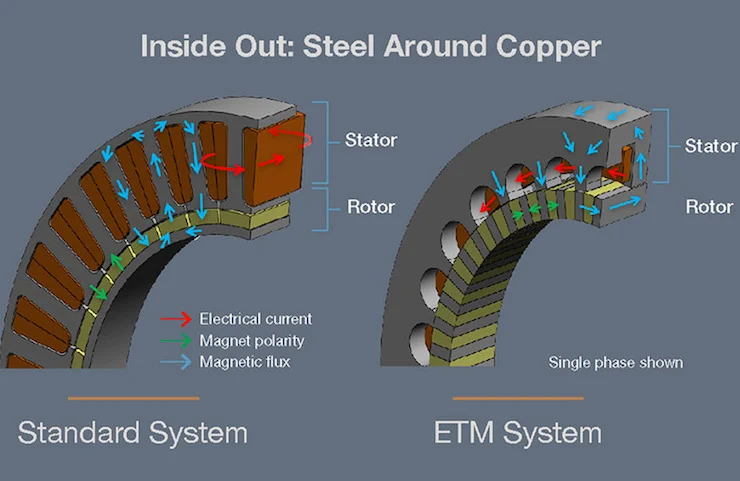
Transverse Flux Motors (TFM): The Distinctive Design: Transverse flux motors distinguish themselves by featuring a magnetic flux path that is transverse to the axis of rotation, meaning it flows across the axis rather than strictly perpendicular or parallel to it. In practice, this is achieved through a unique construction where a single winding for each phase is wound circumferentially around the stator, effectively encircling the axis of rotation. This configuration allows the magnetic flux to follow multiple, complex paths simultaneously: axially across the stator, along the circumference of the rotor, and radially through the air gap separating them.
A key insight into the TFM’s design, as highlighted by companies like ETM, is the innovative arrangement of materials. Conventional motors typically feature copper windings wrapped around a steel core. ETM’s approach, for instance, reverses this, with a steel stator often wrapped around the outside of a low-resistance copper coil. This inversion, coupled with the unique winding architecture, allows for an unprecedented decoupling of the number of magnetic poles from the physical size of the electrical windings. This decoupling is the fundamental enabler of the TFM’s superior torque density and efficiency characteristics. The magnetic circuit can be designed with a very high number of poles to generate significant torque, while the electrical windings remain relatively large and simple, minimizing resistive losses and improving thermal performance.
The Performance Paradigm: Advantages of Transverse Flux Motors
The distinctive design of transverse flux motors translates into several significant performance advantages, making them highly attractive for demanding applications:
-
Exceptional Torque Density: The most prominent advantage of TFMs is their ability to achieve significantly higher torque density compared to conventional motors. As discussed, the decoupling of the number of poles from the winding size means that engineers can incorporate a greater number of magnetic poles without necessarily shrinking the copper windings to an impractically small or inefficient size. More poles interacting simultaneously mean more magnetic force converted into rotational torque within a given volume or weight. This allows for the design of motors that are remarkably powerful for their size and weight, an invaluable attribute in applications like robotics and electric vehicles. Published data and company claims, such as ETM’s assertion of up to 10x greater torque density than conventional motors, underscore this profound advantage. For example, where a conventional motor might yield 5-10 Nm/kg, a TFM could potentially deliver 50-100 Nm/kg or even higher in specialized designs.
-
High Efficiency: The design of TFMs also inherently lends itself to high efficiency. The larger, simpler windings, unconstrained by the need to create individual pole windings, exhibit lower electrical resistance, thereby reducing copper losses (I²R losses). Furthermore, the magnetic circuit can be optimized to minimize eddy current and hysteresis losses in the magnetic materials. This combination results in less energy wasted as heat, leading to higher overall operational efficiency. For direct-drive applications, this efficiency is compounded by the elimination of power losses typically associated with gearboxes, which can range from 5% to 30% depending on the gear ratio and type.
-
Direct-Drive Capability: Perhaps one of the most transformative benefits of high torque density is the ability to enable direct-drive applications. Traditional electric motors often operate at high rotational speeds and require gearboxes to reduce speed and multiply torque for the driven load. Gearboxes, while effective, introduce mechanical complexity, friction, backlash, noise, vibration, and maintenance requirements. By providing high torque directly at low speeds, TFMs can eliminate the need for these mechanical intermediaries. This simplification leads to reduced system weight, lower maintenance costs, improved positional accuracy (no backlash), higher overall efficiency (no gearbox losses), and quieter operation—critical factors in precision robotics, wind turbines, and certain industrial processes.
-
Robust Thermal Management: While high power density can sometimes pose thermal challenges, the TFM’s design, particularly with its larger windings, can offer superior thermal dissipation characteristics. The heat-generating copper coils are often positioned to allow for more effective cooling, either through natural convection or forced cooling methods. Efficient thermal management is crucial for sustained high-performance operation and extends the lifespan of the motor.
-
Scalability and Modularity: The inherent design allows for a degree of scalability. By adding more modules or segments, the motor’s power and torque output can be increased without a complete redesign, offering flexibility for various power requirements across different applications.
Challenges and Considerations
Despite their impressive advantages, transverse flux motors are not without their drawbacks, which have historically limited their widespread adoption and continue to be areas of active research and development:
-
Complex Mechanical Design and Manufacturing: The unique, often three-dimensional magnetic flux path and the intricate arrangement of magnetic and electrical components result in a more complex mechanical structure compared to conventional motors. This complexity can make design and manufacturing more challenging, requiring tighter tolerances and specialized assembly techniques. This directly translates to higher production costs, especially for low-volume manufacturing.
-
Cogging and Ripple Torque: TFMs can be susceptible to issues like cogging torque and ripple torque. Cogging torque is a parasitic torque that occurs even when the motor is unenergized, caused by the magnetic attraction between the permanent magnets on the rotor and the salient poles of the stator. Ripple torque refers to variations in torque output during energized operation, which can lead to vibrations, noise, and less smooth motion, particularly at low speeds. Mitigating these effects often requires sophisticated control algorithms, careful magnetic circuit design (e.g., skewing magnets or stator poles, optimizing pole shapes), and advanced manufacturing precision.
-
Non-linear Dynamics: The complex, multi-directional magnetic flux paths within a TFM often lead to highly non-linear dynamic behavior. This non-linearity complicates the mathematical modeling and simulation of motor performance, making it more challenging to predict behavior, optimize control strategies, and design robust feedback systems. Advanced control techniques, often relying on sophisticated computational models and real-time sensor feedback, are necessary to harness the TFM’s full potential while mitigating these dynamic complexities.
-
Low Power Factor: Many TFM designs inherently exhibit a relatively low power factor. The power factor is a measure of how effectively electrical power is being converted into useful work. A low power factor means that for a given amount of useful power (real power), a larger amount of apparent power (and thus current) must be supplied from the source. This can lead to increased losses in the power supply lines, larger current ratings required for associated electronics (inverters, drivers), and potentially higher energy costs if utility companies penalize low power factors. Power factor correction techniques can be employed, but these add to the system’s complexity and cost.
Transverse Flux Motors in Action: Emerging Applications
The ongoing advancements in mitigating these challenges, coupled with the pressing demand for higher performance in critical sectors, are paving the way for transverse flux motors to make significant inroads into various industries.
-
Robotics Revolution: The robotics industry stands as a prime beneficiary of TFM technology. The demand for more compact, powerful, and precise robots is ever-increasing. Conventional motors often require bulky gearboxes to achieve the necessary torque for robotic joints, adding weight, complexity, and reducing efficiency. ETM’s recent introduction of transverse flux motors into the robotics market exemplifies this trend. The company’s claims—that its motor technology "eliminates trade-offs between efficiency and size by decoupling magnetic flux from electrical windings," and enables "the torque density of high-ratio systems with the efficiency and thermal reliability of low-ratio drives"—directly address the core limitations of traditional robotic actuators. The reported "up to 10x greater torque density" means that robotic arms can be designed with significantly smaller, lighter joints that can still handle substantial payloads. This translates to more agile, faster, and more energy-efficient robots. Collaborative robots (cobots), which work alongside humans and require precise, smooth, and safe movements, stand to gain immensely from the direct-drive capabilities and low-speed torque control offered by TFMs. Industrial manipulators, surgical robots, and autonomous guided vehicles (AGVs) can all benefit from the increased power density, reduced maintenance, and improved reliability that TFMs promise.
-
Electric Vehicles (EVs): The automotive sector, particularly electric vehicles, is another frontier for TFMs. The push for longer range, higher performance, and more compact powertrains aligns perfectly with the TFM’s strengths. Direct-drive in-wheel motors, which integrate the motor directly into the wheel hub, could benefit from the high torque density of TFMs, eliminating axles, transmissions, and differentials, thereby simplifying the chassis, reducing weight, and freeing up interior space. The high efficiency also contributes directly to extending battery range. While currently facing challenges related to cost and complexity for mass-market adoption, ongoing research aims to integrate TFMs into EV propulsion systems, particularly for specialized or high-performance vehicles.
-
Wind Turbines: In large-scale renewable energy generation, direct-drive generators are highly desirable for wind turbines. Eliminating the gearbox in a wind turbine reduces maintenance, improves reliability, and increases efficiency. However, direct-drive generators for wind turbines require extremely high torque at very low rotational speeds, which traditionally leads to very large and heavy generators. TFMs, with their inherent high torque density at low speeds, offer a compelling solution for compact and efficient direct-drive wind turbine generators, potentially reducing the nacelle weight and size.
-
Aerospace and Defense: Weight and volume are paramount in aerospace applications. TFMs’ high power-to-weight ratio makes them attractive for flight control surfaces, landing gear actuation, and even propulsion systems in electric aircraft or drones, where every gram saved translates to increased payload or range.
-
Industrial Machinery: Any industrial application requiring high torque at low speeds, precision control, and robust operation without the complexities of gearboxes could benefit from TFMs. This includes certain types of presses, extruders, and material handling systems.
Market Outlook and Future Development
The market for transverse flux motors is still nascent compared to established motor technologies but is poised for significant growth as manufacturing processes mature and costs decrease. Research efforts are focused on several key areas:
- Advanced Materials: Developing new magnetic materials with higher saturation flux densities and lower losses, as well as improved conductors and insulation, will further enhance TFM performance.
- Manufacturing Innovation: Exploring advanced manufacturing techniques, including additive manufacturing (3D printing) for complex geometries, could streamline production and reduce costs.
- Control Algorithms: Developing even more sophisticated control strategies to effectively manage non-linear dynamics and mitigate cogging/ripple torque will improve smoothness and precision.
- Thermal Management Solutions: Innovative cooling techniques will be crucial for pushing the boundaries of power density without compromising reliability.
In conclusion, transverse flux motors represent a fascinating and increasingly practical frontier in electric motor technology. By re-imagining the fundamental path of magnetic flux, these motors deliver a compelling combination of high torque density and exceptional efficiency, enabling direct-drive solutions that are transforming industries like robotics. While challenges related to design complexity, cost, and dynamic control persist, ongoing innovation is steadily overcoming these hurdles. As the demand for high-performance, compact, and efficient motion control solutions continues to grow, transverse flux motors are set to play an increasingly vital role in shaping the next generation of industrial, automotive, and robotic systems, driving forward the capabilities of advanced machinery across the globe.






