Cambridge, MA – Designers, engineers, and hobbyists worldwide rely on 3D printing for its remarkable ability to rapidly transform digital concepts into tangible objects, spanning from intricate movie props and custom medical implants to architectural models and consumer goods. A critical, yet often overlooked, aspect of this additive manufacturing process is the accuracy of the digital preview. Users need to be confident that the final printed piece will not only function as intended but also possess the desired aesthetic qualities. However, traditional 3D printing software often prioritizes functional previews, leaving users to grapple with unexpected variations in color, texture, and shading. This disconnect can lead to frustrating and costly multiple reprints, wasting valuable time, effort, and precious material resources.
To bridge this gap and empower users with a more intuitive understanding of the final output, a collaborative team of researchers from the Massachusetts Institute of Technology (MIT) and other leading institutions has developed an innovative, user-friendly preview tool. This groundbreaking system, dubbed VisiPrint, places aesthetic fidelity at the forefront, allowing creators to visualize their designs with unprecedented realism before committing to the printing process.
The Genesis of VisiPrint: Addressing a Critical Need in Additive Manufacturing
The journey towards VisiPrint began with a recognition of a significant inefficiency in the current 3D printing workflow. While the functional aspects of a 3D model are paramount for its intended purpose, the visual appeal often dictates user satisfaction and can be crucial for applications in fields like product design, art, and even personal customization. Maxine Perroni-Scharf, an electrical engineering and computer science (EECS) graduate student at MIT and the lead author of the paper detailing VisiPrint, highlighted the stark reality of material waste. "3D printing can be a very wasteful process," she stated. "Some studies estimate that as much as a third of the material used goes straight to the landfill, often from prototypes the user ends up discarding. To make 3D printing more sustainable, we want to reduce the number of tries it takes to get the prototype you want. The user shouldn’t have to try out every printing material they have before they settle on a design."
This sentiment underscores the core problem VisiPrint aims to solve: democratizing the ability to predict a 3D print’s appearance without extensive trial-and-error. The research team, comprising EECS graduate students Faraz Faruqi and Maxine Perroni-Scharf, undergraduate Raul Hernandez, and overseen by esteemed professors William Freeman and Stefanie Mueller from MIT’s Computer Science and Artificial Intelligence Laboratory (CSAIL), along with SooYeon Ahn from the Gwangju Institute of Science and Technology and Szymon Rusinkiewicz from Princeton University, has meticulously engineered a solution that leverages the power of artificial intelligence.
How VisiPrint Works: An AI-Powered Approach to Aesthetic Realism
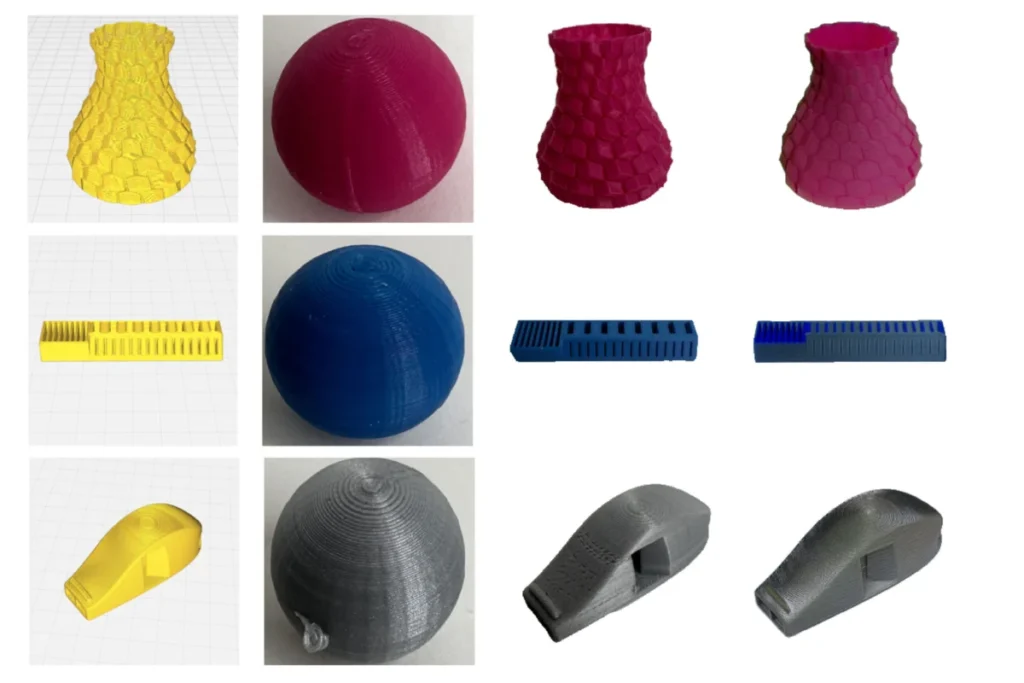
VisiPrint operates on a deceptively simple premise: users provide two key inputs. The first is a screenshot of the digital object from their 3D printing software, often referred to as "slicer" software. This input captures the geometry and intended structure of the object. The second crucial input is a single image of the actual print material. This image can be sourced from an online catalog or captured from a physical sample, allowing VisiPrint to analyze its unique visual characteristics.
At the heart of VisiPrint lies a sophisticated, AI-powered system that analyzes these inputs to generate a remarkably accurate rendering of the fabricated object’s likely appearance. Unlike conventional tools that focus solely on the functional deposition path of the printing nozzle, VisiPrint delves deeper, considering a multitude of factors that influence the final aesthetic. These include not only the base color of the material but also its glossiness, translucency, and how the nuances of the fabrication process itself, such as the layer-by-layer extrusion in fused deposition modeling (FDM), might subtly alter its visual qualities.
The researchers focused their initial efforts on FDM, the most prevalent 3D printing technology. In FDM, a thermoplastic filament is heated and extruded through a nozzle, building the object layer by layer. This process, while effective, can introduce variations. The heat can alter material properties, and the precise path the nozzle follows, along with the height of each deposited layer, can influence surface texture, gloss, and even the perception of color.
To tackle these complexities, VisiPrint employs a dual AI model architecture. A computer vision model first meticulously extracts the salient visual features from the provided material sample image. These features, encompassing color, texture, reflectivity, and other optical properties, are then fed into a generative AI model. This generative model, guided by the extracted material characteristics and the structural information from the slicer software, computes the object’s geometry and internal structure. Crucially, it incorporates the specific "slicing" pattern that the printing nozzle will follow, ensuring that the simulated print accurately reflects the physical process.
A key innovation in VisiPrint’s approach is its "special conditioning method." This technique involves carefully fine-tuning the AI model’s internal workings to ensure it adheres strictly to the slicing pattern and respects the physical constraints inherent in 3D printing. This is achieved through the intelligent use of a depth map, which preserves the object’s overall shape and shading, and an edge map, which delineates internal contours and structural boundaries. This dual-map conditioning is vital for achieving both accurate geometry and realistic simulation of the deposition process. "If you don’t have the right balance of these two things, you could end up with bad geometry or an incorrect slicing pattern. We had to be careful to combine them in the right way," explained Perroni-Scharf, emphasizing the delicate balance required for optimal results.
A User-Centric Interface and Empirical Validation
Beyond its powerful AI engine, VisiPrint boasts an intuitive, user-friendly interface designed for accessibility. Users can easily upload their required images and then evaluate the generated preview. For more advanced makers, the interface offers granular control over various settings, allowing them to fine-tune the influence of specific visual attributes, such as how color variations might manifest in the final print.
It is important to note that VisiPrint is designed to complement, rather than replace, the functional previews provided by slicer software. VisiPrint focuses exclusively on aesthetic prediction and does not assess the printability, mechanical feasibility, or likelihood of print failure. This clear distinction ensures that users understand the scope of VisiPrint’s capabilities.
To rigorously evaluate VisiPrint’s effectiveness, the research team conducted a comprehensive user study. Participants were tasked with comparing VisiPrint’s previews against those generated by other existing methods. The results were overwhelmingly positive. Nearly all participants reported that VisiPrint provided superior overall appearance and a more accurate textural similarity with actual printed objects. Furthermore, the preview generation process for VisiPrint was remarkably swift, averaging about a minute – more than twice as fast as competing methods. "VisiPrint really shined when compared to other AI interfaces," Perroni-Scharf remarked. "If you give a more general AI model the same screenshots, it might randomly change the shape or use the wrong slicing pattern because it had no direct conditioning."
Implications Across Industries and Future Directions
The implications of VisiPrint extend far beyond hobbyist use. In professional fields, the ability to accurately preview aesthetic outcomes could revolutionize design workflows. For instance, in dentistry, clinicians could use VisiPrint to ensure that temporary crowns and bridges precisely match the appearance of a patient’s existing teeth, leading to greater patient satisfaction and fewer adjustments. Architects could leverage VisiPrint to more effectively assess the visual impact of their scale models, allowing for more informed design decisions and client presentations.
The potential for VisiPrint to reduce material waste aligns with a growing global emphasis on sustainability in manufacturing. By minimizing the need for repeated test prints, VisiPrint contributes to a more environmentally conscious approach to 3D printing.
Looking ahead, the VisiPrint team is not resting on its laurels. Future development plans include addressing artifacts that can arise when previewing objects with extremely fine details. Additionally, they aim to expand VisiPrint’s capabilities to allow users to optimize aspects of the printing process beyond just material color, potentially incorporating parameters related to surface finish and structural integrity.
"It is important to think about the way that we fabricate objects. We need to continue striving to develop methods that reduce waste," Perroni-Scharf emphasized. "To that end, this marriage of AI with the physical making process is an exciting area of future work."
Patrick Baudisch, a professor of computer science at the Hasso Plattner Institute, who was not involved in the research, offered a compelling perspective on VisiPrint’s significance. " ‘What you see is what you get’ has been the main thing that made desktop publishing ‘happen’ in the 1980s, as it allowed users to get what they wanted at first try. It is time to get WYSIWYG for 3D printing as well. VisiPrint is a great step in this direction." This analogy powerfully captures the transformative potential of VisiPrint in bringing a similar level of predictability and user confidence to the world of 3D printing.
The research was supported by grants from the MIT Morningside Academy for Design Fellowship and an MIT MathWorks Fellowship, underscoring institutional commitment to advancing innovative technologies in design and engineering. As VisiPrint continues to evolve, it promises to be a pivotal tool in making 3D printing more efficient, sustainable, and aesthetically satisfying for creators across the globe.