The allure of a five-star hotel experience is a multifaceted one, extending beyond opulent amenities and impeccable service to encompass a subtle yet significant aspect of personal style: the wristwatch. Tamim Almousa’s reflection on the “pool watch” evokes a nostalgic era where luxury timepieces were not merely functional objects but potent symbols of status and personal narrative, particularly within the sun-drenched confines of a hotel pool. This essay delves into the author’s evolving relationship with his Rolex Milgauss Z Blue, exploring how its perceived shortcomings in everyday wear are transformed when juxtaposed with the relaxed, uninhibited environment of a poolside setting.
The Spectacle of the Poolside: A Microcosm of Luxury
Almousa’s vivid recollections of a Dubai hotel pool in his youth paint a picture of unadulterated horological display. This was not an environment for discreet timekeeping but for overt pronouncements of wealth and taste. The author meticulously catalogs the wristwear of the era: "Fat cats soaked in Speedos and Day-Dates, shapely concubines hanging from their elbows." This imagery immediately sets a scene of conspicuous consumption, where high-end watches were as much a part of the ensemble as swimwear.
The narrative continues with specific brand and model mentions, highlighting a perceived golden age of watch appreciation: "Russian playboys flaunted Hublot Big Bangs. Young Khaleeji princes luxuriated in the shade, wearing Royal Oak Offshores. Older ones wore Patek Philippe Nautiluses. British expats wielded gaudy Breitlings. There was, likely, a yuppie in there, wearing a Corum Admiral Cup." This litany serves not just as a list of desirable watches but as a cultural barometer, indicating a period characterized by overt displays of wealth and a clear understanding of horological hierarchies. The absence of "Apple watches; no beaters. Just shiny, high-grade metal all around. No stealth wealth, no reissues, no wearing anything ‘ironically’" underscores a perceived purity in watch appreciation – a time when luxury watches were worn with genuine admiration for their craftsmanship and status, rather than for ironic effect or as mere tech accessories.
The Evolving Relationship with the Rolex Milgauss Z Blue
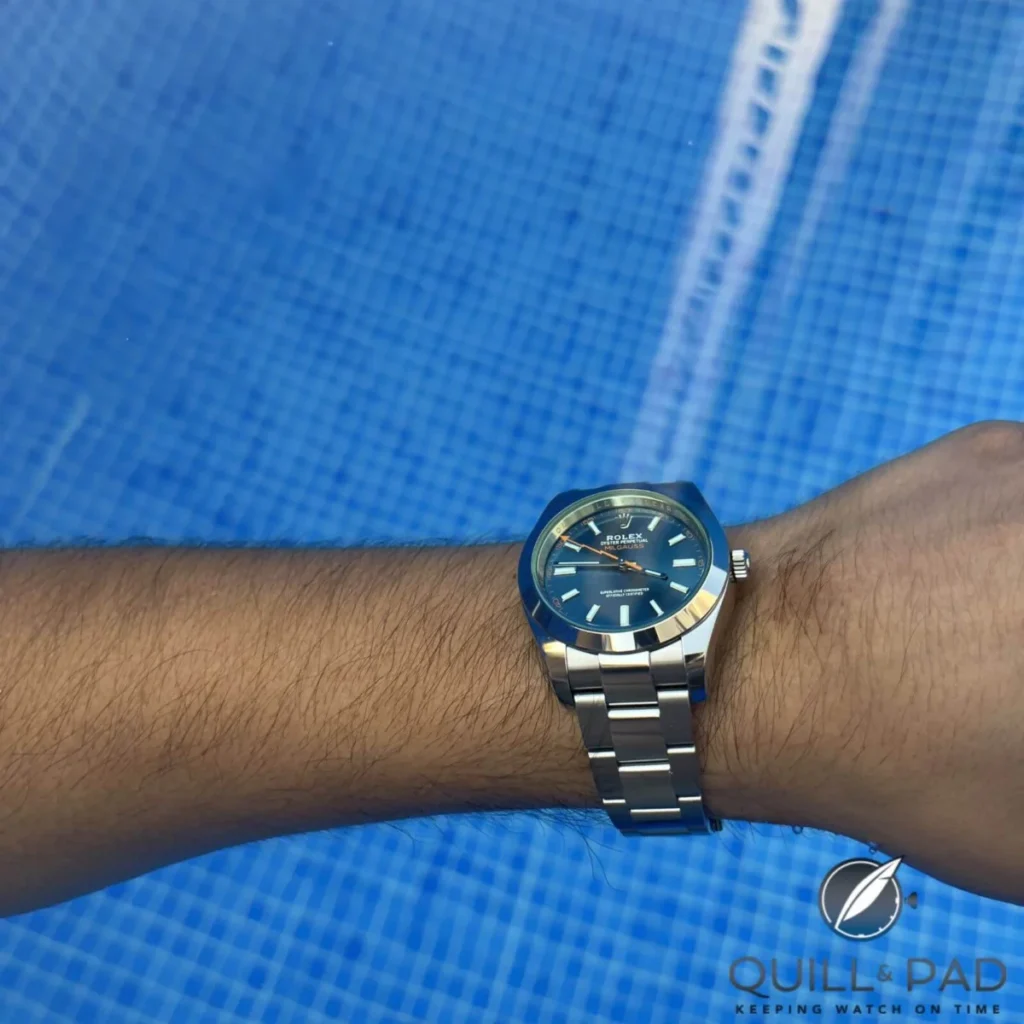
The author’s personal journey into watch ownership began with a youthful aspiration to own a single luxury timepiece. This aspiration evolved into possessing a small collection, a testament to his enduring passion. However, the Rolex Milgauss Z Blue, a watch acquired in 2019 for approximately $7,000, has become a focal point of his evolving sentiments. Initially purchased with the expectation of its value appreciating beyond its peers, Almousa acknowledges this was a miscalculation. This financial aspect, coupled with more significant aesthetic and ergonomic concerns, has led to a disaffection with the watch.
The primary critique leveled against the Milgauss Z Blue revolves around its dimensions. Almousa describes it as "too big and too thick," noting its poor fit on his "flimsy, 16-centimeter wrist." The watch, while technically fitting, "wears poorly," leading to a sense of self-consciousness and an inability to "pull it off." The "top-heavy" nature of the watch is further detailed, with the bezel tending to "flap out" or "flap the other way" depending on the wrist’s position. This discomfort is exacerbated by the accumulation of scuffs and scratches, which, despite the author’s belief that "these things are meant to be worn," have begun to "dampen the ownership experience."
The Transformative Power of the Poolside Environment
The narrative takes a significant turn with the introduction of the hotel pool as a transformative setting. Almousa paints a cinematic scene: "Four Seasons’ pool, magic hour. I toss my shirt on a daybed, kick my flipflops beneath it, and plop in with a delayed gasp, disturbing the glossy, placid state of my own little section of the hydrosphere." In this context, the author finds himself momentarily liberated from the anxieties and perceived flaws of the Milgauss.
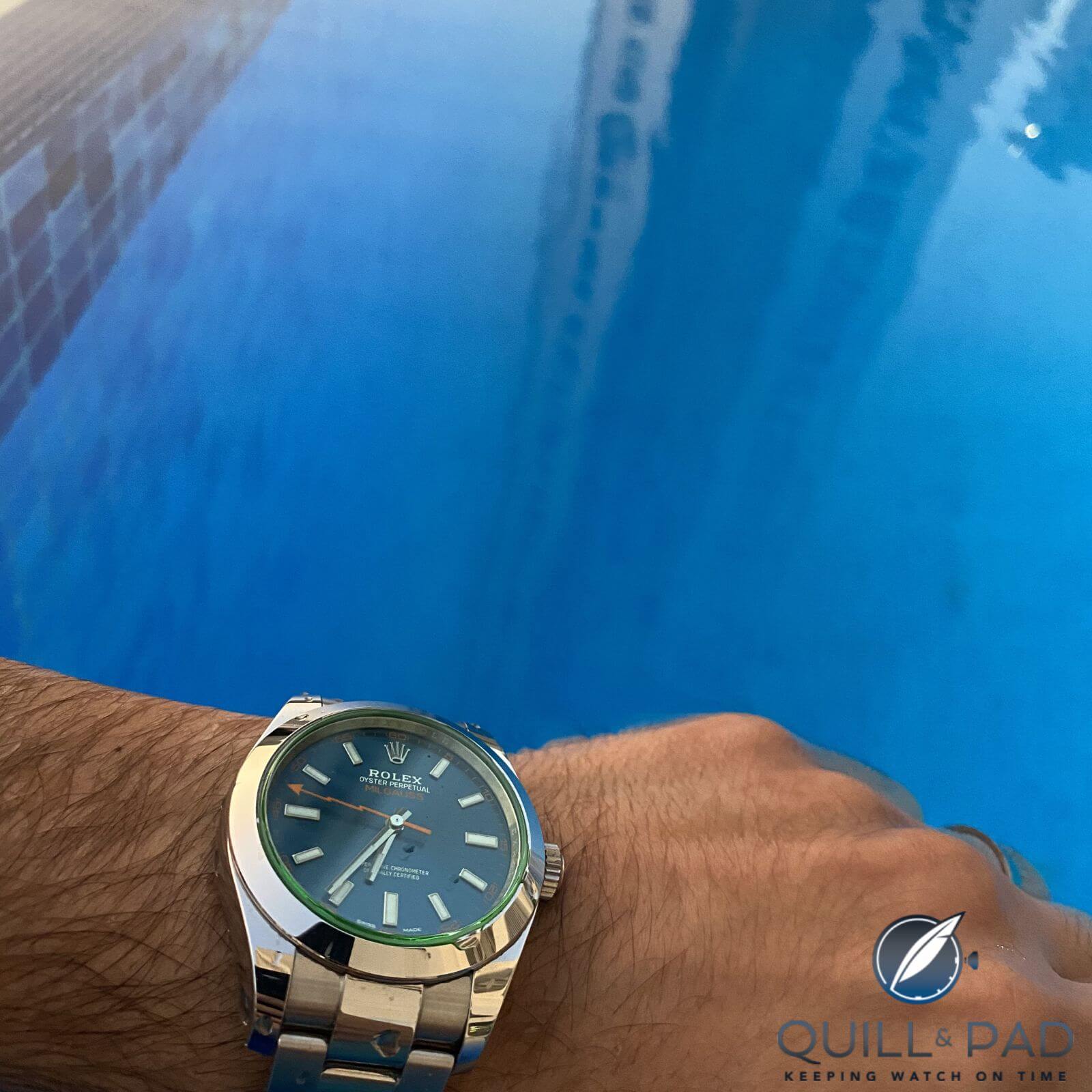
The watch, once a source of discomfort, becomes a captivating object under the play of light and water. "A droplet rolls down the crystal, like the missing, runaway cyclops lens that it is," he observes, before focusing on the visual spectacle. The watch’s signature green crystal, combined with the blue dial, creates a vibrant display: "a vivid plume of jade and aquamarine bursting from the center of the dial and bouncing back against the rippling blue void underneath." This visual phenomenon evokes a sense of nostalgia, recalling childhood memories associated with vibrant colors and tactile experiences, such as "chalky skateparks, school trips to the aquarium, toothpaste marbles, glass bricks, Fisherman’s Friends mints passed around in a family car."
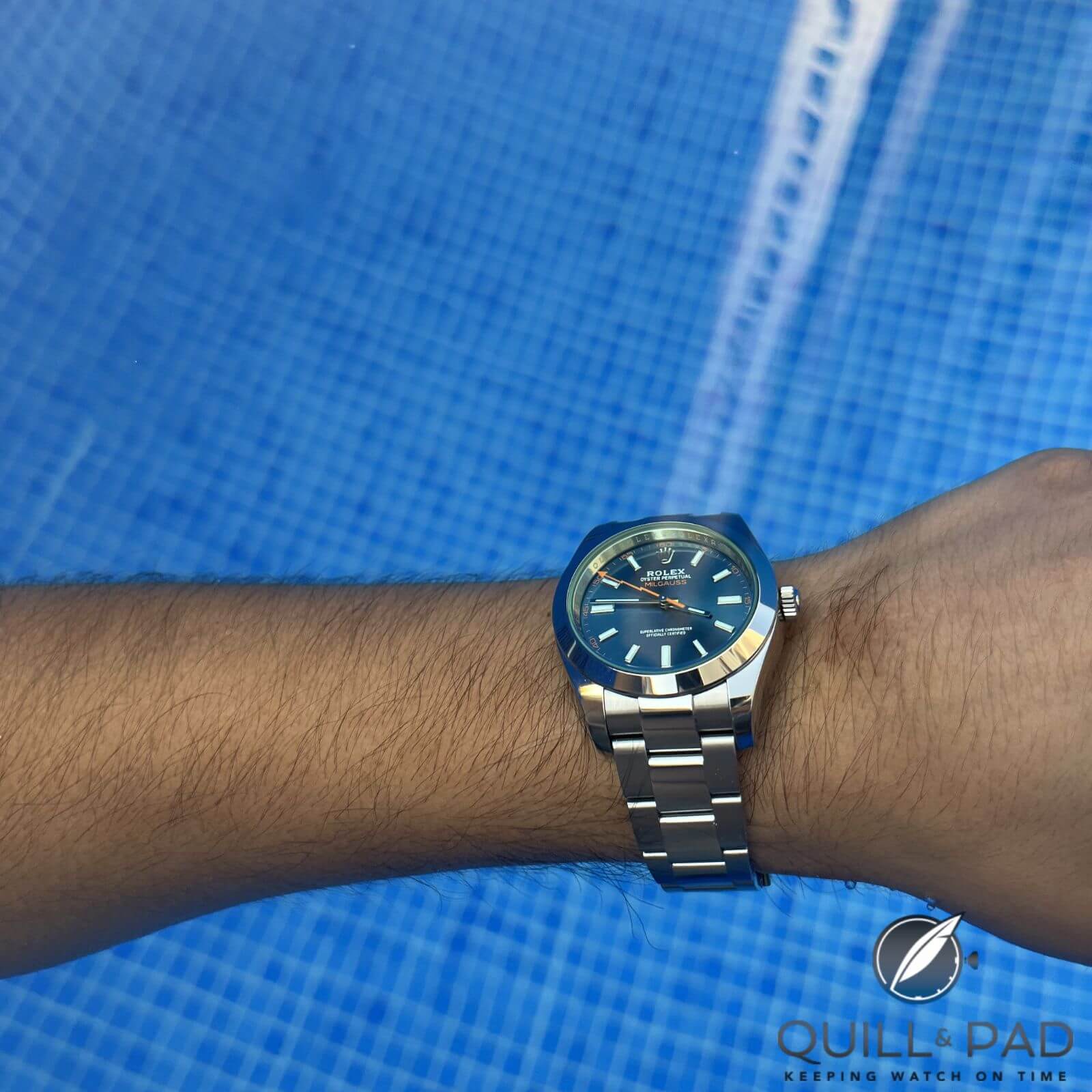
The watch’s design elements are re-evaluated and celebrated within this aquatic setting. The green crystal, when angled, "pops against the mosaic tiling, like a thin menthol strip jutting out of the bezel and circling the dial." Viewed head-on, its "round edge glows like a radioactive halo floating above the watch." The dial itself, described as a "prism-lit disc whose metallic blues, like those of a dragonfly or a TVR Tuscan S, shift and shiver iridescently, broken up by a bright-orange seconds hand shaped like a lightning bolt," comes alive. The author posits that "to plunge this watch into a clear, sun-dappled body of chlorinated water is to run a current through it. This is where the watch comes alive, in the confines of the swimming pool."
Crucially, the physical shortcomings of the watch appear to diminish when wet. "The scratches that scar its case fade away when wet." Furthermore, the fit improves when worn with swimming shorts, transforming the wearer’s perception of himself. In this state, he is "happier, more content. He compares himself to no one—for now—and covets nothing. Market value is irrelevant." The perceived threat of theft, a concern in other settings, evaporates: "No one here, it’s safe to say, will try to steal my watch. All’s right with the world."
The Return to Reality: Dry Land and Diminished Appeal
The magic, however, is transient. As the author dries off, the watch’s luster recedes. "So does the watch and all its luster." The dim, artificial light of indoor environments renders the watch less captivating. The crystal and dial, which animated so brilliantly in sunlight and water, now "hold on to it timidly, like a toddler does a whisk or an ashtray." The vibrant seconds hand becomes "no longer cool, only jagged and jarring." The author concludes that "Inside and bone dry, the watch is out of its element. It needs a splash of water, a sunny day, a blue backdrop."
Redefining the "Natural Habitat" of Watches
Almousa challenges the conventional notion of a watch’s "natural habitat." While the Milgauss was engineered for the scientifically rigorous environment of CERN, its aesthetic appeal, particularly in the Z Blue configuration, is, in his view, best realized by the pool. He extends this argument to other iconic watches, suggesting that their intended environments do not always translate to their most visually striking or enjoyable contexts.
He draws parallels with other items of clothing and accessories: "A peacock’s natural habitat is the forest, but it looks best on a Maharaja’s manicured lawn. Timberland boots are meant for the construction site, but they look best on a washed-up rapper, bumming around Manhattan in sagging jeans." This analogy highlights how context and presentation can dramatically alter the perceived value and aesthetic impact of an object.
The author argues that watches designed for specific, often utilitarian, purposes—like the Breitling Cosmonaut or Omega Speedmaster Moonwatch—might not be at their most visually engaging in their intended "natural habitats." The example of an F1-themed watch is particularly poignant: the environment of an F1 car race is so restrictive that wearing such a watch there is practically impossible, rendering its thematic connection moot in terms of actual use and display.
The Pool as a Stage for Horological Spectacle
The hotel pool, therefore, emerges not as a utilitarian space but as a curated stage for horological display. It is a place where "status symbols and statement pieces" are not only accepted but expected. Almousa categorizes the watches that excel in this environment, favoring overt luxury and brand recognition over understated or niche appeal. "Parmigiani? Czapek? Ain’t nobody got time for that. Bremont? Carl F. Buchere? Sinn? You’re killing the mood." These brands, while respected in horological circles, are deemed inappropriate for the poolside milieu.
The author is critical of watches that prioritize functionality over aesthetic impact in this setting, such as the Apple Watch: "Apple Watch? What, are we counting laps? This ain’t the Y, it’s the W." The implication is that a luxury hotel pool is a venue for aspirational display, a place where the "give the people what they want" mentality prevails, urging attendees to "get with the program."
Curating the Poolside Collection: Hits Over Deep Cuts
Almousa advocates for a curated approach to watch selection for the poolside, favoring "hits" over "deep cuts." This extends to his personal preferences, which, outside of this context, lean towards "quirky, offbeat, slept-on (if not looked down upon) watches." However, at the hotel pool, he desires "unimaginative eye rollers. Starter-kit luxury. Old school staples. Beef Wellington in watch form."
This preference translates into specific recommendations: "Most Royal Oak Offshore and Vacheron Constantin Overseas models qualify. A Pre-Kern Breitling B01 Chronomat also qualifies. Speedmaster Moonwatch? In yellow gold, yes, but can it swim? Rolex Daytona? Hell yes! Again, in yellow." The emphasis on precious metals and established, recognizable luxury sports watches underscores the social signaling inherent in this environment.
"Almost all Rolex sports models perform well here, two-tone bluesies and the like. Almost any +10-bar Richard Mille works. As does any Big Bang Hublot, which, in many respects, is the cheaper alternative. Virtually any Nautilus works, too, and (to a lesser extent) any Aquanaut." These watches, often associated with wealth and a certain lifestyle, are deemed suitable for the poolside. The author’s assertion that "anything that will get you stabbed outside your hotel in London or Paris is meant for the pool that’s in it, water resistance permitting" is a provocative statement that highlights the perceived security and relaxed atmosphere of a high-end hotel pool compared to urban streets.
Conclusion: A Nostalgic Embrace of the Pool Watch Era
Tamim Almousa’s "Return of the Pool Watch" is more than just an essay about a specific timepiece; it is a nuanced exploration of how context can redefine our perception of luxury objects. The Rolex Milgauss Z Blue, initially a source of dissatisfaction due to its size and perceived flaws, finds redemption in the vibrant, uninhibited environment of a hotel pool. This setting strips away the pressures of everyday wear, allowing the watch’s inherent aesthetic qualities to shine, much like the luxury watches of Almousa’s youth that defined an era of conspicuous consumption. The essay ultimately celebrates the enduring appeal of the "pool watch"—a timepiece that, when placed in its element, transcends its functional limitations to become a symbol of carefree indulgence and horological appreciation. It is a reminder that sometimes, the most profound enjoyment of a luxury item comes not from its intended purpose, but from its ability to evoke a feeling of liberation and delight within a specific, curated experience.