In the intricate and ever-evolving landscape of electric motor technology, engineers and researchers continually seek innovative designs to meet the escalating demands for efficiency, power density, and precision across diverse applications. While the vast majority of electric motors fall into well-established categories defined by their power source, construction, or fundamental magnetic circuit properties, a lesser-known yet increasingly significant variant known as the transverse flux motor is gaining prominence for its unique characteristics and transformative potential. This motor type distinguishes itself from its more conventional counterparts—radial flux and axial flux machines—through a magnetic flux path that defies traditional classifications, offering a compelling blend of advantages particularly suited for demanding, high-performance scenarios.
The fundamental classification of electric motors often begins with the orientation of their magnetic flux relative to the axis of rotation. This foundational distinction dictates much about a motor’s physical form, performance characteristics, and suitable applications. Understanding these established categories is crucial for appreciating the innovative leap represented by transverse flux motors.
The Dominance of Radial Flux Designs
By far the most ubiquitous and historically prevalent type of electric motor is the radial flux design. In these machines, the magnetic flux, which is responsible for generating torque, flows perpendicularly to the motor’s axis of rotation. Visualize a conventional electric motor: a central rotor, often incorporating the motor shaft, spins within a stationary stator. The magnetic fields generated by the stator windings interact with the rotor’s magnetic fields (either permanent magnets or electromagnets), creating forces that act radially, driving the rotor’s rotational motion. Examples abound, encompassing everything from simple brushed DC motors found in household appliances to complex AC synchronous and induction motors powering industrial machinery and electric vehicles. Their robust design, ease of manufacturing, and well-understood operational principles have cemented their status as the workhorses of electrification for over a century. However, the inherent coupling between the number of poles and the physical size of the windings in radial flux designs can impose limitations on achieving extremely high torque densities in compact packages.
The Niche of Axial Flux Motors
In contrast to radial flux motors, axial flux motors are engineered such that the magnetic flux travels parallel to the axis of rotation. This design typically features disk-shaped rotors and stators, where the magnetic interaction occurs across the axial plane. The most recognizable embodiment of this principle is the "pancake-style" motor, characterized by its flat and thin profile. This inherent compactness makes axial flux motors particularly attractive for applications where space is at a premium, such as certain electric vehicle traction systems, specialized robotics, or direct-drive applications where a low axial length is critical. While offering improved power density for their form factor compared to some radial flux designs, axial flux motors can sometimes present challenges in terms of thermal management and manufacturing complexity due to their unique geometry.
The Distinctive Nature of Transverse Flux Motors
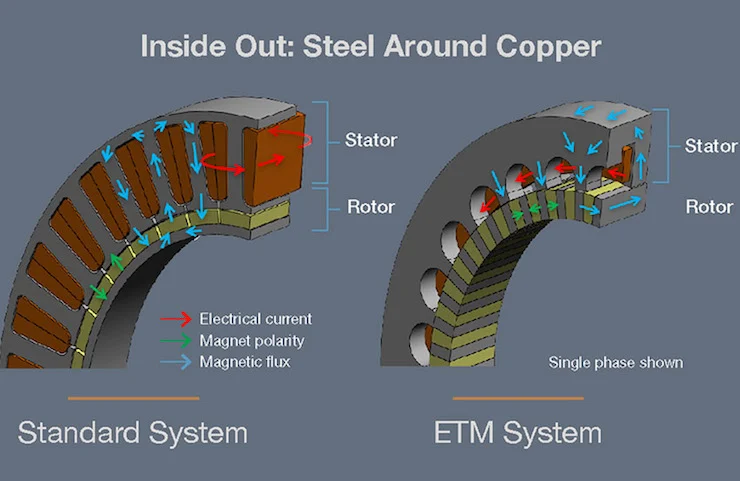
Stepping beyond these two primary classifications, transverse flux motors carve out their own unique space. Their defining characteristic is a magnetic flux path that is "transverse" to the axis of rotation. This means the flux flows across the axis, in a manner that is neither purely radial nor purely axial, but rather a complex, multi-directional path that leverages the motor’s distinct construction. In practical terms, this innovative design typically involves a single winding for each phase, which is wound circumferentially around the stator, enveloping the axis of rotation. This architectural choice is fundamental to the motor’s operational principles, allowing the magnetic flux to traverse multiple pathways. Specifically, the flux can flow axially across the stator, along the circumference of the rotor, and radially through the air gap separating the stator and rotor. This unique magnetic circuit design is the lynchpin of the transverse flux motor’s remarkable performance capabilities.
Unlocking Superior Performance: Key Advantages
The unconventional design of transverse flux motors translates directly into several compelling advantages that position them as a leading candidate for future high-performance applications.
-
Decoupling of Poles and Windings: One of the most significant breakthroughs offered by transverse flux motor architecture is the ability to decouple the number of machine poles from the physical size of the electrical windings. In conventional motors, increasing the number of poles to achieve higher torque often necessitates smaller, more complex windings that can be challenging to manufacture and less efficient. Transverse flux motors, by contrast, can achieve a high number of poles without compromising the winding size or simplicity, as the windings are wound circumferentially around the stator. This allows for a more efficient use of copper and magnetic material.
-
Exceptional Torque Density: The direct consequence of this decoupling and optimized flux path is an exceptionally high torque density. Torque density refers to the amount of torque a motor can produce relative to its volume or weight. Transverse flux motors are capable of generating significantly more torque for a given size and weight compared to conventional radial or axial flux designs. For instance, companies like ETM, a recent entrant into the robotics market with transverse flux technology, claim their patented architecture provides up to 10 times greater torque density than conventional motors. This dramatic increase in torque density is transformative for applications where space and weight are critical constraints, such as robotics, aerospace, and electric vehicles. It enables the design of more compact, lighter, and powerful systems.
-
High Efficiency: Beyond raw power, transverse flux motors also boast high efficiency. The design minimizes copper losses due to the simpler, larger windings and optimizes the magnetic circuit to reduce core losses. High efficiency directly translates to lower energy consumption, reduced operational costs, and less heat generation, which simplifies thermal management systems. For industries striving for energy conservation and sustainable practices, this efficiency gain is a major draw.
-
Suitability for Direct-Drive Applications: The combination of high torque density and high efficiency makes transverse flux motors ideal for direct-drive applications. Direct drive systems eliminate the need for gearboxes, which are traditionally used to multiply torque and reduce speed from a high-speed, low-torque motor. Gearboxes introduce complexity, friction losses, backlash, noise, and require regular maintenance. By directly coupling the motor to the load, transverse flux motors simplify mechanical designs, improve reliability, reduce energy losses, and offer superior precision and responsiveness, making them invaluable in areas like robotics and industrial automation where precise motion control is paramount.
Emerging Applications and Industry Adoption
The unique advantages of transverse flux motors are beginning to resonate across several high-growth industries, promising to redefine performance benchmarks.
Robotics: The robotics sector is perhaps one of the most immediate beneficiaries. Modern robots, particularly collaborative robots and dexterous manipulators, demand motors that are powerful yet compact, enabling sleeker designs and higher payload capacities without sacrificing speed or precision. ETM’s recent introduction of transverse flux motors into the robotics market underscores this potential. The company emphasizes that its motor technology effectively eliminates the traditional trade-offs between efficiency and size. By decoupling magnetic flux from electrical windings, ETM’s motors are designed to deliver the torque density typically associated with high-ratio geared systems, but with the superior efficiency and thermal reliability of low-ratio direct drives. This innovation could lead to more agile, powerful, and energy-efficient robotic arms and mobile platforms, significantly impacting manufacturing, logistics, and service robotics. Imagine a robot arm that can lift heavier objects with greater precision using smaller, lighter joints, or a drone with extended flight times due to more efficient propulsion systems.
Electric Vehicles (EVs): While radial and axial flux motors currently dominate the EV market, transverse flux technology holds significant promise. The ability to achieve high torque density in a compact form factor could lead to smaller, lighter, and potentially more powerful traction motors, contributing to increased range and improved vehicle performance. Furthermore, their high efficiency could reduce battery consumption, extending the usable range per charge. The potential for in-wheel motor designs, which free up chassis space and offer enhanced vehicle dynamics, is also a compelling prospect, though current challenges in terms of unsprung mass and durability need to be addressed.
Renewable Energy: In the realm of renewable energy, particularly large-scale wind turbines, direct-drive generators are a highly sought-after solution. Eliminating the gearbox in a wind turbine reduces maintenance costs, improves reliability, and increases overall system efficiency, especially at varying wind speeds. Transverse flux generators, with their inherent high torque at low speeds, are well-suited for this application. They can capture more energy from the wind and operate more reliably over the long operational lifetimes of wind farms.
Aerospace and Defense: Industries where weight is a critical factor, such as aerospace, could leverage transverse flux motors for propulsion systems, actuators, and various onboard mechanisms. Their high power-to-weight ratio could lead to more fuel-efficient aircraft or more capable unmanned aerial vehicles (UAVs). Similarly, defense applications requiring robust, high-performance, and compact motors could find transverse flux technology advantageous.
Industrial Automation and Machine Tools: The precision and reliability offered by direct-drive transverse flux motors make them attractive for advanced industrial automation, high-precision machine tools, and robotics in manufacturing environments. They can enable faster cycle times, greater accuracy, and reduced downtime due to fewer mechanical components.
Navigating the Challenges: Disadvantages and Drawbacks
Despite their impressive advantages, transverse flux motors are not without their complexities and challenges, which have historically limited their widespread adoption. Addressing these drawbacks is a key focus of ongoing research and development.
-
Cogging and Ripple Torque: These are commonly cited issues. Cogging torque refers to the torque produced by the interaction between the permanent magnets (if present) and the stator slots, even when no current is flowing. Ripple torque is the periodic variation in torque during rotation, even under constant current. Both phenomena can lead to vibrations, acoustic noise, and reduced precision in control systems, which are particularly problematic in applications requiring smooth motion, such as robotics or high-fidelity servo systems. Research is actively exploring various stator and rotor geometries, as well as advanced control algorithms, to mitigate these undesirable effects.
-
Complex Mechanical Design: The unique magnetic circuit and winding configuration of transverse flux motors often translate into a more intricate mechanical design compared to conventional motors. This complexity can involve specialized laminations for the stator and rotor, more challenging assembly processes, and the need for precision manufacturing techniques. As a result, they can be more complicated and expensive to design and manufacture, especially for mass production. This higher upfront cost can be a barrier to entry for some applications, though the long-term operational benefits (efficiency, reduced maintenance) may offset it.
-
Non-linear Dynamics: The magnetic behavior within transverse flux motors can exhibit significant non-linearity. This complicates the mathematical modeling of motor behavior, making it more challenging to predict performance accurately and design robust control systems. Advanced computational techniques, such as finite element analysis (FEA), and sophisticated control strategies are often required to manage these complexities, adding to the engineering effort.
-
Low Power Factor: Transverse flux motors can sometimes exhibit a lower power factor compared to other motor types. A low power factor means that a larger apparent power (and thus higher current) is required from the power supply to deliver the same amount of real power to the motor. This can lead to increased losses in the power supply infrastructure, larger conductor sizes, and potentially higher utility costs if power factor correction is not implemented. While solvable with appropriate power factor correction circuitry, it adds another layer of complexity to the overall system design.
-
Thermal Management: While high efficiency helps, the exceptional power density of transverse flux motors means that a significant amount of power is concentrated in a relatively small volume. Effective thermal management becomes crucial to prevent overheating, which can degrade performance, shorten component lifespan, and reduce reliability. Innovative cooling solutions, including advanced heat sinks and liquid cooling systems, are often necessary.
The Future Outlook: Research and Development
The challenges associated with transverse flux motors are actively being addressed by researchers and engineers worldwide. Efforts are focused on:
- Material Science: Developing new magnetic materials with improved properties and lower losses, as well as advanced composites for structural components.
- Manufacturing Techniques: Exploring advanced manufacturing processes, including additive manufacturing (3D printing), to create complex geometries more cost-effectively and with greater precision.
- Control Algorithms: Designing sophisticated control strategies that can effectively compensate for cogging, ripple torque, and non-linear dynamics, ensuring smooth and precise operation.
- Thermal Management Innovations: Developing more efficient cooling systems to dissipate heat effectively from these high-power-density machines.
- Design Optimization: Using advanced simulation tools to optimize motor geometries for specific applications, balancing performance, cost, and manufacturability.
The ongoing research, exemplified by academic papers such as those found in IEEE Xplore (like document 9709772, "A Review of Transverse Flux Permanent Magnet Motors"), highlights the intense interest and dedication within the engineering community to refine and popularize this technology.
Broader Impact and Implications
The rise of transverse flux motor technology carries significant implications for various industries and the broader push towards sustainable technological advancement. As global demand for energy-efficient and compact power solutions continues to grow, particularly in sectors like electric mobility, robotics, and renewable energy, the value proposition of transverse flux motors becomes increasingly compelling.
Their ability to deliver superior performance in terms of torque density and efficiency, while enabling direct-drive systems, positions them as a key enabler for next-generation designs. While the initial investment in design and manufacturing might be higher due to their complexity, the long-term operational savings from reduced energy consumption and lower maintenance, coupled with the enhanced performance capabilities, are expected to drive wider adoption in high-value applications.
In essence, transverse flux motors represent a fascinating and impactful departure from conventional motor design paradigms. While challenges related to complexity, cost, and specific performance nuances like cogging torque remain, the relentless pursuit of innovation by companies like ETM and academic institutions signifies a strong belief in their transformative potential. As these hurdles are overcome through continued research and technological advancements, transverse flux motors are poised to play a crucial role in shaping the future of electric power and motion control, enabling more compact, efficient, and powerful systems across a myriad of critical applications.